

This Proclamation may be cited as “the Excise Tax Proclamation No. 1186/2020” .
No matches found.
ATLA's AI Assistant
Preamble
Preamble
WHEREAS, it has become necessary to review the type of goods on which excise tax has been collected and impose the tax on goods and services that are believed to be luxury, hazardous to health, causes social problems as well as on basic goods which are demand inelastic;
WHEREAS, it is believed that replacement of the current excise tax which was assessed on production cost by ex-factory price will alleviate the problem encountered by taxpayers due to lack of predictability on the amount of tax they are liable to pay;
WHEREAS, to overcome the problems encountered in collecting proper excise tax due to shortcomings in the current Excise Tax Proclamation, it has become necessary to introduce a new law that puts in place a system which alleviates problems so far encountered;
NOW, THEREFORE, in accordance with Article 55 (1) and (11) of the Constitution of the Federal Democratic Republic of Ethiopia, it is hereby proclaimed as follows.
(Article 55 (1) and (11))
[ASSENTED TO 17 MARCH, 2020.]
[DATE OF COMMENCEMENT: 13 FEBRUARY, 2020.]
as amended by
Excise Tax (Amendment) Proclamation, No. 1229 of 2020
[w.e.f. 12 November 2020.]
Excise Tax (Amendment) Proclamation, No. 1287 of 2022
[w.e.f. 29 April 2023.]
CHAPTER ONE - General
Article 1. Short title
Article 2. Definitions
Unless the context otherwise requires, in this Proclamation—
(1) “Aircraft” means every description of conveyance by air of human beings or goods.
(2) “Arm’s Length Transaction” means a transaction between persons dealing with each other at Fair, Market Value.
(3) “Denature” means to render unfit for human consumption for drink.
(4) “Distillery” means a licensed distiller’s factory.
(5) “Customs Duty” means customs duty, surtax or any other similar tax imposed on the importation of goods.
(6) “Bonded Warehouse” means the building or place destined for storage of specified goods before the tax is paid and secured in accordance with the requirements of the Tax Authority.
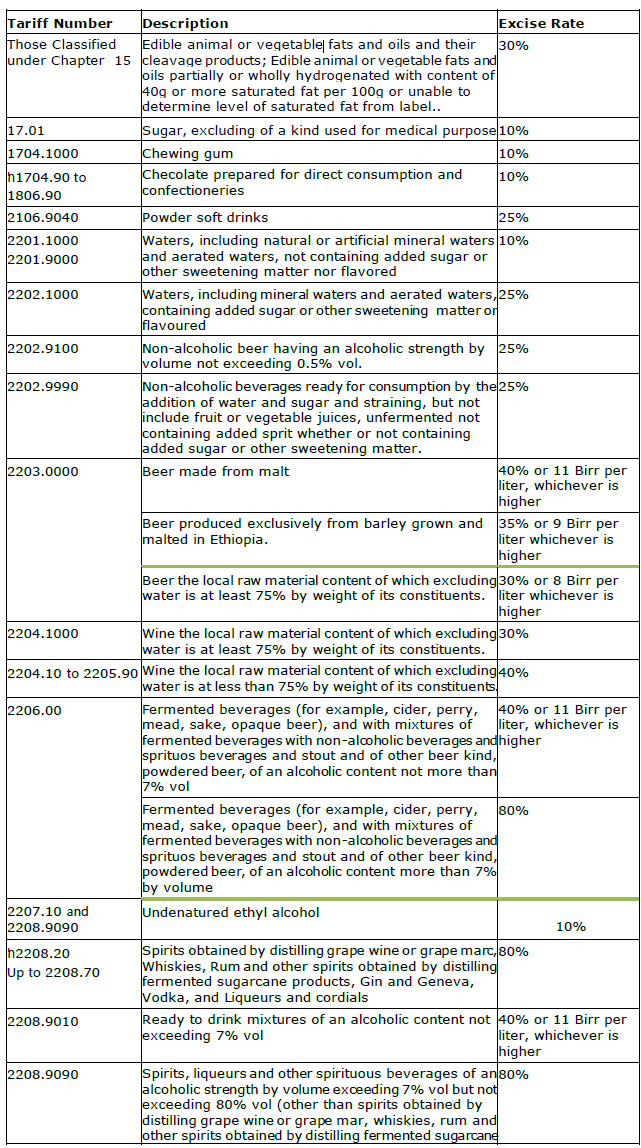
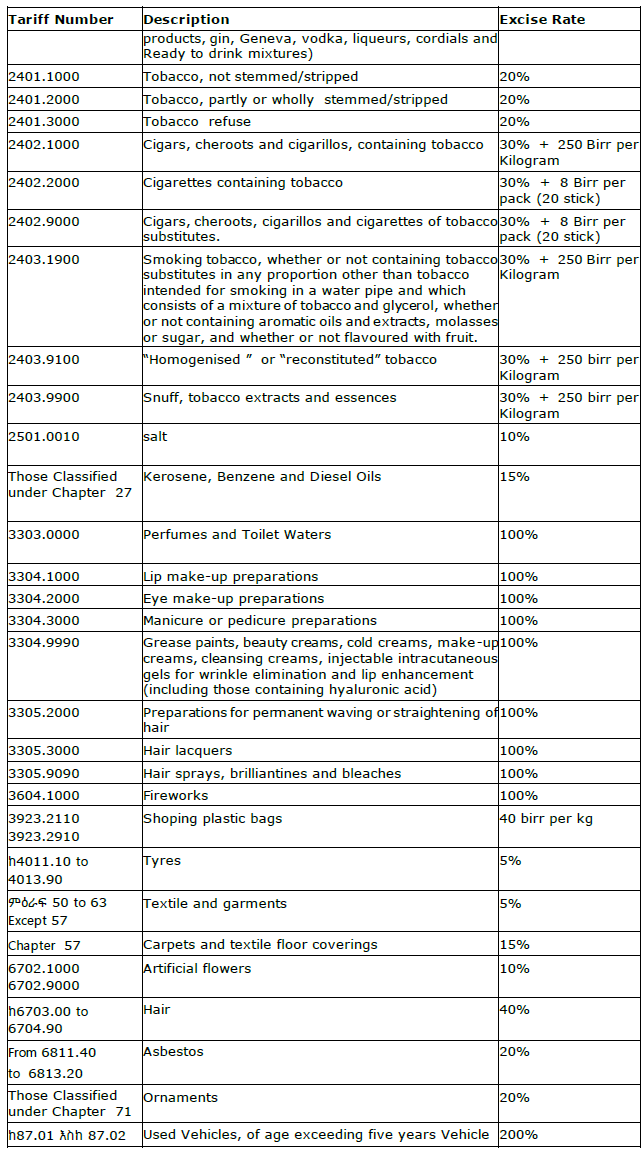
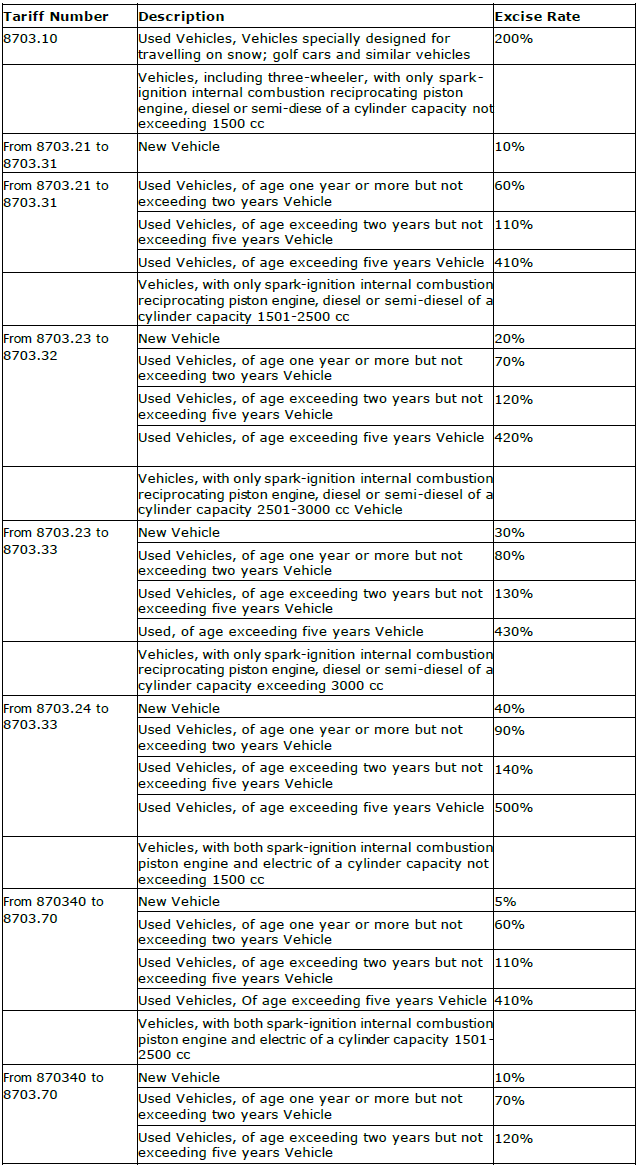
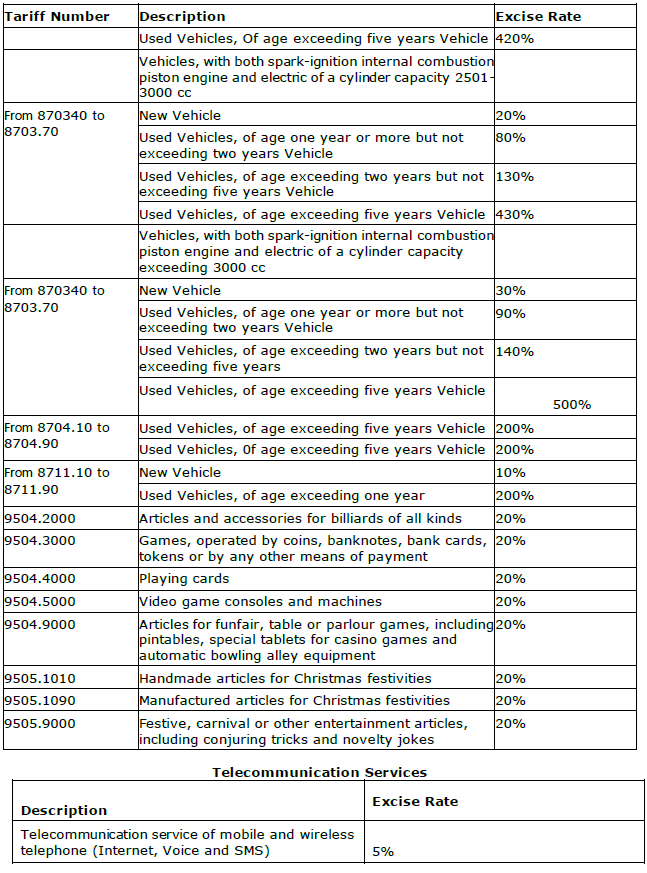
(7) “Excisable Goods” means the goods specified in Part I of the First Schedule.
(8) “Excisable Services” means the services specified in Part II of the First Schedule.
(9) “Excise Tax or Tax” means the excise tax imposed under this Proclamation.
(10) “Exempt Goods” means goods specified in the Second Schedule.
(11) “Export” means to take or cause to be taken from Ethiopia to a foreign country, or to an export processing zone.
(12) “Export Processing Zone” means a zone designated as such by the Management Board of the Ethiopian Investment Commission.
(13) “Factory” means any premises at which a licensed manufacturer is licensed to manufacture and store excisable goods, but does not include any part of the premises through which excisable goods are sold to the public.
(14) “Import” means to bring or cause goods to be brought into Ethiopia from a foreign country, a special economic zone or an export processing zone.
(15) “Importer” in relation to goods, means the person who owns the goods, or any other person who is, for the time being, in possession of or beneficially interested in the goods at the time of importation.
(16) “Excise Stamp” means a mark or an object affixed on excisable goods to indicate that Excise Tax has been paid on such goods.
(17) “International Traffic”, in relation to an aircraft means any operation of the aircraft except as between two places in Ethiopia.
(18) “License” means in case of excisable services, the Certificate of Registration or in case of excisable goods, the license, issued under Article 17 of this Proclamation.
(19) “Licensed Distiller” means a distiller licensed under Article 17 of this Proclamation.
(20) “Licensed Manufacturer” means a person licensed under Article 17 of this Proclamation to manufacture excisable goods.
(21) “Manufacture” includes—
(a) the production of excisable goods;
(b) any intermediate or uncompleted process in the production of excisable goods; or
(c) the distilling, rectifying, compounding, or denaturing of spirits.
(22) “Rectify” means to redistill spirits removed from a spirits receiver for the purpose of purifying or adding flavor.
(23) “Ethyl Alcohol” means alcohol of purity of 80 degrees or more.
(24) “New Vehicle” means a vehicle that has not been used over what is stated in this SubArticle since its manufacturing year and includes the following—
(a) imported in semi-knocked down (SKD) or complete knocked down (CKD) form to be assembled by local industry;
(b) a complete built up (CBU) vehicle of tariff heading 87.02, 87.03, 87.04, 87.05 and 87.11 which arrives at the Ethiopian customs territory (entry point) within a time period of three Gregorian calendar years including the manufacturing calendar year of the vehicle and when the number of
kilometres driven abroad at the time it arrives at the Ethiopian custom territory (entry point) does not exceed 4,000 kilometres;
(c) if the vehicle is not covered under paragraph (b) of this subarticle it arrives at Ethiopian Customs territory (entry point) within a time period of four Gregorian calendar years including the manufacturing calendar year of the vehicle.
(25) “Used Vehicle” means a vehicle not covered under subarticle (24) of this Article and the age is counted beginning the manufacturing Gregorian calendar year to the Gregorian calendar year of its arrival at Ethiopian Customs territory (entry point).
(26) “Spirits” means any drink with zero point five percent (0.5%) or more alcohol volume.
(27) “Still” means a distilling apparatus and includes any part of a still.
(28) “Stores” means goods for use or consumption by passengers or crew on an aircraft or ship while in international traffic, and includes goods for sale on board such aircraft or vessel.
(29) “Time of Importation” has the meaning assigned to it under Article 4 of this Proclamation.
(30) “Value Added Tax” means the Value Added Tax Proclamation No. 285/2002.
[Proc. No. 285 of 2002.]
(31) “Person” means a natural or juridical person.
(32) “Authority” means the Ministry of Revenue or Tax Authorities of the Regional Governments and City Administrations.
(33) “Minister” and “Ministry” means the Minister of Finance and the Ministry of Finance, respectively.
(34) “Proclamation” means the Excise Tax Proclamation.
(35) “Tax Administration Proclamation” means Tax Administration Proclamation No. 983/2016.
(36) Unless defined otherwise in this Proclamation the terms and phrases defined in the Tax Administration Proclamation shall also apply to this Proclamation.
(37) Any expression in the masculine gender includes the feminine.
[Article 2 amended by article 2 (1) of Proc. No. 1287 of 2022.]
Article 3. Fair Market Value
(1) The fair market value of excisable goods or services at a particular time is the price that the goods or services would reasonably be expected to fetch in an arm’s length transaction at that time at the wholesale level.
(2) If the open market value of excisable goods or services at a particular time cannot be determined under subarticle (1) of this Article, the fair market value shall be the price which is an objective approximation of the price of the goods or services according to Article 3 of the Tax Administration Proclamation.
Article 4. Time of Supply or Importation
(1) The time of importation of excisable goods may be one of the following—
(a) for excisable goods cleared for home use directly at the port of importation or goods entered for removal to an inland station and there cleared for home use, at the time of customs clearance;
(b) for excisable goods removed to a licensed warehouse subsequent to importation, at the time of final clearance from the warehouse for home use;
(c) for excisable goods removed from an export processing zone or special economic zone for home use, at the time of removal for home use;
(d) in any other case, at the time the excisable goods are brought into Ethiopia.
(2) The time of supply of excisable services shall be the earlier of:
(a) the date on which the services are performed;
(b) the date on which the invoice for the supply of the services is issued; or
(c) the date on which payment for the supply of the services is received, in whole or part.
CHAPTER TWO - Liability for Excise Tax
Article 5. Imposition of Excise Tax
(1) Subject to this Proclamation, a tax, to be known as excise tax, shall be charged in accordance with the provisions of this Proclamation on—
(a) excisable goods manufactured in Ethiopia by a licensed manufacturer;
(b) excisable goods imported into Ethiopia;
(c) excisable services supplied in Ethiopia by a licensed person.
(2) Excise Tax shall be charged at the rate specified in the First Schedule attached herewith for the excisable goods and services in force at the time the liability arises for Excise Tax as determined under Article 9 of this Proclamation.
(3) The commencement date for collection of excise tax charged on edible animal or vegetable fats and oils and their cleavage products specified in Schedule 1 attached herewith as classified in Chapter 15 of the Customs Tariff shall be determined by the Ministry of Finance based on the information it receives from the Ministry of Health.
[Article 5 amended by article 2 (2) and (3) of Proc. No. 1287 of 2022.]
Article 6. Obligation to Pay Excise Tax
The following shall pay the excise tax imposed under this Proclamation—
(1) On excise tax imposed on goods manufactured in Ethiopia the licensed manufacturer.
(2) On goods imported into Ethiopia the Importer of the excisable goods .
(3) On services supplied in Ethiopia by the registered person.
Article 7. Timing of Liability for Excise Tax
(1) The liability of a licensed manufacturer for excise tax on excisable goods manufactured in Ethiopia shall arise at the time of removal of the goods from the manufacturer’s factory.
(2) For the purposes of this Proclamation, excisable goods that are consumed in a licensed manufacturer’s factory shall be treated as removed from the factory at the time of consumption.
(3) The liability of a licensed person for excise tax on excisable services shall arise at the time of the supply of the services.
(4) The liability of an importer for excise tax on excisable goods imported into Ethiopia shall arise—
(a) for petroleum products, at the time of importation unless under a directive to be issued by the Minister special permits are granted;
(b) for any other excisable goods, at the time of importation.
(5) A licensed person shall pay the liability for excise tax arising under this Article, in accordance with Article 37 of this Proclamation.
(6) An importer shall discharge the liability for excise tax referred to in Article 6 of this Proclamation in accordance with Article 36 of this Proclamation.
Article 8. Goods and Services Not Liable to Excise Tax
(1) Without Prejudice to the provision of other Articles of this Proclamation no excise tax shall be charged on the following—
(a) exempt goods which meet the conditions set out under the Second Schedule attached with this Proclamation;
(b) excisable goods exported under customs control, including those stored in the approved warehouse;
(c) excisable services exported from Ethiopia;
(d) excisable goods that the manufacturer has destroyed, with the prior written permission of the Authority, under the supervision of the officer’s of the Authority prior to their removal from the factory in which they were manufactured;
(e) excisable goods and services that are supplied to entities that are exempt from excise tax by law;
(f) goods and services exempted from excise tax by the Minister due to economic, social and administrative reasons;
(g) denatured alcohol produced in a manner that it cannot be used for human consumption;
(h) excisable goods that have been lost or destroyed by accident or other unavoidable cause—
- (1) in the course of removal of the goods by the manufacturer from the manufacturer’s factory including when loading or unloading the goods;
- (2) in the factory of the manufacturer in which the goods were manufactured before removal from the factory;
- (3) on board an aircraft or vessel prior to importation into Ethiopia.
(2) Excisable services shall be considered to be exported from Ethiopia if the services are supplied from a place of business in Ethiopia for use or consumption outside Ethiopia.
(3) Subarticle (2) of this Article shall apply only if the Authority is satisfied that the services have not been consumed in Ethiopia.
(4) Subarticle (1) (d) shall not apply if the licensed manufacturer has been compensated for the loss of the excisable goods and the compensation includes the excise tax payable on the goods.
[Article 8 amended by article 2 (4) of Proc. No. 1287 of 2022.]
Article 9. Excisable Value
(1) This Article shall apply where the First Schedule specifies a rate of excise tax payable by reference to the excisable value of excisable goods or services.
(2) The excisable value of excisable goods imported into Ethiopia shall be the sum total of the following amounts—
(a) the customs value of the goods as determined under the Customs Proclamation, whether or not any Customs Duty is payable on the goods;
(b) the amount of Customs Duty (if any) payable on the goods under the Customs Proclamation.
(3) The excisable value of excisable goods manufactured in Ethiopia shall be the ex-factory selling price of the goods, but not including the following—
(a) the value added tax payable on the supply of the goods;
(b) the cost of excise stamps, if any; and
(c) the cost of returnable containers.
(4) without Prejudice to the provision of subarticle (5) of this Article, the excisable value of excisable services shall be—
(a) if the excisable services are supplied by a registered person in an arm’s length transaction, the fee, commission or charge payable for the services;
(b) in any other case, the fair market value of the services.
(5) The excisable value of excisable services shall not include the value added tax, if any, payable on the supply of the services.
Article 10. Adjustment for Inflation
(1) The Minister by a directive to be issued it may increase or decrease not exceeding 10% in the rate changed it first schedule in relation to this Proclamation.
(2) The Authority shall, in accordance with the Directive issued by the Minister, adjust the specific rate of excise tax specified in First Schedule of this Proclamation at least once a year to take inflation into account.
Article 11. Ex-factory Selling Price of Excisable Goods
(1) The ex-factory selling price of excisable goods shall be—
(a) if the excisable goods are sold by the manufacturer, other than to a purchaser in an arm’s length transaction, the price payable by the purchaser;
(b) in any other case, the open market value of the goods at the time of removal from the manufacturer’s factory.
(2) The excise tax paid on the ex-factory selling price shall be separately shown in the invoice.
Article 12. Quantity of Excisable Goods
(1) This Article shall apply where the First Schedule specifies a rate of excise tax
payable by reference to a quantity measured by volume or weight.
(2) If—
(a) excisable goods are imported into Ethiopia, or removed from the factory of a licensed manufacturer, in a package intended for sale with, or of a kind usually sold with the goods in a sale by retail; and
(b) the package—
(1) is not marked or labelled with a net weight; or
(2) is not commonly sold as containing, or is not commonly reputed to contain, a specific quantity or weight.
(c) the owner of the goods is unable to satisfy the Authority of the correct net weight of the package, the excisable goods shall be liable to excise tax according to the gross weight of the package and its contents.
(3) Without prejudice to the provision of subarticle (4) of this Article, if—
(a) excisable goods are imported into Ethiopia, or removed from the factory of a licensed manufacturer, in a package intended for sale with, or of a kind usually sold with, the goods in a sale by retail; and
(b) the package—
(1) is marked, or labeled as containing a specific quantity of the goods; or
(2) is commonly sold as containing, or is commonly reputed to contain, a specific quantity of the goods, the package shall be treated as containing not less than the specific quantity.
(4) If the package referred to in subarticle (3) of this Article contains more than the specific quantity, excise tax shall be computed on the actual quantity.
(5) The Authority may by Directive determine and specify the allowance for tare or wastage that may be granted and the conditions under which it is granted.
Article 13. Place of Supply of Excisable Services
A supply of excisable services shall be deemed to be made in Ethiopia if the services are supplied from a place of business of the supplier in Ethiopia.
Article 14. Relief for Raw Materials
(1) Where excise tax has been paid in respect of excisable goods imported into, or manufactured in Ethiopia by a licensed manufacturer and which have been used as raw materials in the manufacture of other excisable goods (hereinafter referred to as “finished goods”), the excise tax paid on the raw materials shall be offset against the excise tax payable on the finished goods.
(2) The provisions of subarticle (1) of this Article shall not apply to alcohol, tobacco and sugar.
CHAPTER THREE - Licensing
PART ONE Application for a License
Article 15. Activities Requiring a License
(1) A person shall not undertake any of the following activities unless the person is licensed or registered by the Authority to undertake the activity—
(a) the manufacture of excisable goods in Ethiopia;
(b) the importation into Ethiopia of excisable goods specified by the Minister under Article 29 as requiring an excise stamp;
(c) the supply of excisable services; or
(d) the carrying out of any other activity in Ethiopia for which the Minister by a Directive, may impose a requirement or a license.
(2) A person who manufactures excisable goods or supplies excisable services in contravention of subarticle (1) of this Article shall be liable for the excise tax payable in respect of the excisable goods or services at the rate specified in the First Schedule.
(3) A person who is liable to pay the excise tax under subarticle (2) of this Article—
(a) shall pay the tax immediately upon demand made by the Authority;
(b) shall be in addition to any penalty and interest imposed on the person under this Proclamation or the Tax Administration Proclamation.
Article 16. Applications for a License
(1) A person who intends to undertake any of the activities specified in Article 15 (1) shall apply to the Authority for a license for any of the activities specified under Article 15 (1).
(2) An application under subarticle (1) of this Article shall be—
(a) in the prescribed form;
(b) accompanied by the prescribed fees;
(c) lodged with the Authority in the prescribed manner.
PART TWO Issue of Licenses
Article 17. Issue of License
(1) Without Prejudice to the provision of subarticle (2) of this Article, the Authority shall consider an application under Article 16 and may grant or refuse to issue the applicant with a license.
(2) The Authority may refuse an application under if satisfied that—
(a) the applicant has been convicted of tax evasion or fraud under this Proclamation or the Tax Administration Proclamation;
(b) the applicant has been convicted of an offence involving dishonesty or fraud under any law;
(c) the applicant—
(1) is or has been declared bankrupt or insolvent;
(2) is in the process of liquidation or receivership;
(d) in the case of an application to be a manufacturer of excisable goods, the factory, plant or equipment, specified in the application is not adequate to manufacture or secure excisable goods;
(e) the applicant has not kept proper records as required under any tax law or has otherwise failed to comply with its obligations under a tax law; or if he does not agree to comply with his obligation to keep proper records within a given timeframe as required by the Authority;
(f) paragraphs (a), (b), (c) and (e) of subarticle (2) of this Article apply to a person related to the applicant and the Authority is satisfied that the related person is reasonably expected to be involved in the conduct of the activity to which the application relates.
(3) The Authority may impose such terms, conditions or restrictions as it considers appropriate in relation to a license issued under this Article.
(4) The Authority shall give an applicant for a license under Article 16 written notice of the decision on the application within 30 days from the date the application is submitted and if the application is refused, the notice shall include reasons for the refusal.
(5) A license shall take effect from the date specified therein by the Authority and shall unless earlier suspended, remain in force until cancelled under Article 21.
Article 18. Form of License
(1) The license issued under Article 17 shall be in the prescribed form.
(2) A license issued to a manufacturer of excisable goods shall specify the following—
(a) the class or classes of excisable goods that the manufacturer is licensed to manufacture;
(b) the factory/factories at which the manufacturer is permitted to manufacture excisable goods.
(3) A factory specified in a license issued under this Article shall be used only for the manufacture of the class/classes of excisable goods specified in the license.
(4) Only the person specified as the licensed manufacturer in a license issued under this Article shall manufacture excisable goods in the factory specified in the license.
(5) A license issued to a supplier of excisable services shall specify the excisable services offered.
Article 19. Obligations of Licensed Person
(1) A licensed person has the obligation to carry out the following—
(a) display in a conspicuous place the original of the license at the principal place of business;
(b) in case of excisable services, a certified copy of the license at every other place of business.
(2) A licensed person shall notify the Authority, in writing—
(a) if the licensed person ceases to carry on the activity for which the license is issued;
(b) if there is any change in the name, address, place of business ownership, constitution, or nature of the principal activity or activities carried on by the licensed person;
(c) of any period in which the licensed person closes operations on a temporary basis; or
(d) if, the case of a licensed manufacturer, there is any change in the factory specified in the license, or the plant and equipment used to manufacture excisable goods.
(3) A notification under subarticle (2) shall be lodged with the Authority—
(a) in the case of a notification under subarticle (2) (c) of this Article where the closure was unplanned, within 7 days after the event causing the closure;
(b) in any other case, at least 7 days prior to the event requiring notification occurs to the Authority of Tax.
PART THREE Suspension and Cancellation of Licenses
Article 20. Suspension of License
(1) The Authority may suspend a license issued under this Proclamation if the Authority is satisfied that—
(a) any of the matters specified in Article 19 (2) (a), (b) or (c) apply to the licensed person;
(b) the licensed person has not kept proper records as required under this Proclamation or the Tax Administration Proclamation, or has otherwise failed to comply with obligations under this Proclamation;
(c) the licensed person has breached a condition of the license;
(d) the licensed person has made a false or misleading statement to the Authority;
(e) for a licensed manufacturer, the factory, or plant or equipment, specified in the license is no longer adequate to manufacture or secure excisable goods.
(2) Where a license is suspended under subarticle (1) of this Article, the Authority shall serve the licensed person with written notice of the suspension.
(3) The suspension of a license shall take effect from the date of service of the notice under subarticle (2) of this Article.
(4) A person served with a notice of suspension under subarticle (2) may, by notice in writing and within 14 days of service of the notice, or within such further time as the Authority may allow, appeal against the suspension to the tax complaint review department of the Authority.
(5) Where a licensed person lodges a notice of appeal in accordance with subarticle (4) of this Article, the Authority shall, within 14 days after receipt of the notice, either—
(a) accept the appeal and revoke the suspension of the license;
(b) provide the licensed person with written notice of the action required to be taken before the date specified in the notice to remedy the deficiencies that led to the suspension of the license and revoke the suspension if the action is taken within the specified time; or
(c) reject the appeal and cancel the license in accordance with Article 21 of this Proclamation.
(6) If the Authority fails to take action under subarticle (5) of this Article within the time specified in that subarticle, the suspension shall stand revoked.
Article 21. Cancellation of License
(1) The Authority shall, by notice in writing, cancel the license of a person when—
(a) the Authority has received notification under Article 19 (2) (a);
(b) the person fails to appeal the suspension of the license within the time specified in Article 20 (4);
(c) the person fails to comply with a notice served on the person under Article 20 (5) (b) within the time specified in the notice or within such further time as the Authority may allow;
(d) the Authority rejects an appeal against the suspension of a license under Article 20 (5) (c).
(2) The cancellation of a license takes effect from the date specified in the notice of cancellation.
(3) Any obligation or liability of a licensed person under this Proclamation or the Tax Administration Proclamation in respect of anything done or omitted to be done by the person while licensed, including the obligation to pay excise tax or to file excise tax returns, shall not be affected by cancellation of the person’s license.
Article 22. Consequences of Suspension or Cancellation of License
(1) If the license of a licensed manufacturer is suspended or cancelled—
(a) the manufacturer shall—
(1) immediately cease to manufacture excisable goods;
(2) immediately pay all excise tax on excisable goods on hand in respect of which tax is still unpaid;
(3) dispose of excisable goods and materials in the manufacturer’s factory in accordance with the direction of the Authority;
(b) the Authority may—
(1) require the licensed manufacturer to remove excisable goods in the manufacturer’s factory to another place approved by the Authority; and
(2) take control of the manufacturer’s factory and seize any excisable goods at the factory as may be necessary in accordance with Article 41 of the Tax Administration Proclamation for the protection of revenue and ensure compliance with this Proclamation.
(2) If the license of a person licensed to supply excisable services is suspended or cancelled, the person shall—
(a) cease to supply the excisable services; and
(b) pay excise tax on excisable services supplied in respect of which tax is still unpaid.
(3) If the license of an importer, other than a person to whom subarticle (2) of this Article applies, is suspended or cancelled, the person shall immediately cease to undertake the activity for which the license is issued.
(4) The Authority may, by notice in writing, require a licensed person to pay such costs as may be incurred by the Authority as a result of the suspension or cancellation of the person’s license as specified in the notice and the costs shall be treated as tax for the purposes of the Tax Administration Proclamation.
Article 23. Authority to Notify Licensee Prior to Suspension, Revocation or Cancellation of a License
(1) Where the Authority seeks to suspend, revoke or cancel a license under this Proclamation, it shall give 21 days’ notice to the licensee prior to taking the intended action, giving the grounds upon which such intended action shall be taken, and requiring the licensee to remedy any circumstances which may require to be remedied.
(2) The licensee shall, within 21 days of receipt of the notice, take actions as required by the Authority.
(3) The Authority shall, within 14 days, acknowledge in writing the actions taken by the licensee or proceed to confirm the effect of the intended notified action.
(4) A licensed person who receives notification of confirmation of the intended action is dissatisfied with the decision of the Authority may file a notice of objection with the tax compliant Review Department of the Authority within 10 days from receipt of such decision.
(5) The Review Department shall make a decision on the notice of objection within 10 days from receipt of such notice.
(6) A licensed person dissatisfied with the decision of the Review Department may file a notice of appeal with the Tax Appeal Commission with 14 days after being served with a notice of decision and shall serve the Authority with the appeal application within 7 days of filing.
Article 24. Appeal
(1) The Tax Appeal Commission shall hear and determine the appeal made in accordance with Article 23 (6) of this Proclamation within the time prescribed by the Tax Administration Proclamation.
(2) Any party aggrieved by the decision of the Tax Appeal Commission may appeal to the Federal High Court on question of law within 30 days from the date of the decision.
CHAPTER FOUR - Excise Tax Control
Article 25. Excisable Goods under Excise Control
(1) Excisable goods stored in the factory of a licensed manufacturer shall be subject to the control of the Authority (hereinafter referred to as “excise control”).
(2) Excisable goods shall be subject to excise control until the earlier of—
(a) the removal of the goods from the factory of a licensed manufacturer for consumption in Ethiopia;
(b) until the goods are export from Ethiopia; or
(c) the destruction or disposal of goods in accordance with subarticle (4) of this Article or Article 8 (1) (h) of this Proclamation.
(3) When goods are subject to excise control—
(a) an officer authorised by the Authority may, at any time, examine the goods;
(b) no person shall, except with authority of the Authority granted in accordance with this Proclamation, remove the goods from a factory or otherwise interfere in any way with the goods.
(4) When goods are subject to excise control, the Authority may permit the owner of those goods to abandon them to the Authority, and on such abandonment the goods may, at the expense of the owner thereof, be destroyed or otherwise disposed of as the Authority may direct.
Article 26. Obligations of Licensed Manufacturer in Relation to Excisable Goods under Excise Control
(1) For the purposes of ensuring proper accounting of excisable goods under excise control, a licensed manufacturer shall—
(a) keep and maintain at the factory, metering and measuring devices, and such other equipment as may be necessary in order to enable the Authority to take an account of, or check by weight, gauge or measure, all excisable goods or materials in the factory;
(b) store excisable goods in the factory in such manner as to facilitate the taking of a full account of the goods;
(c) keep a materials account in the approved form and enter therein the particulars of all raw materials and intermediate goods received at the factory for use in manufacturing, and balance the account at the end of each month;
(d) keep a finished goods account in the approved form and enter therein particulars of all excisable goods manufactured therein and delivered therefrom and shall balance the account at the end of each month;
(e) ensure that excise tax is paid on any excisable goods consumed at the factory; and
(f) comply with such other requirements as may be specified in the directive issued by the Minister.
(2) For the purpose of subarticle (1) (a) of this Article, the Authority shall, by a Directive, specify the requirements of a measuring or metering device and such other equipment as may be required.
(3) The Authority—
(a) may, at any time, take samples of excisable goods free of charge for such purposes of the Proclamation as the Authority may deem necessary, and any such samples shall be disposed of or returned to the Manufacturer as the Authority may direct; or
(b) may, subject to such written conditions as the Authority may impose, permit the owner of excisable goods to take samples which are of no commercial value without payment of the excise tax thereon.
Article 27. Keeping or Use of Still otherwise than by Distiller or Rectifier Prohibited
(1) Without prejudice to the provision of subarticle (2) of this Article, no person other than a licensed distiller or rectifier shall keep or use a still.
(2) The Authority may permit, without prejudice to such conditions as the Authority may impose, the keeping or use of a still by a person other than a licensed distiller or rectifier when the still is—
(a) kept by a person who makes or keeps stills solely for the purpose of sale;
(b) kept or used for experimental, analytical, or scientific purposes;
(c) kept or used for the manufacture of an article other than spirits.
Article 28. Deemed Removal of Excisable Goods
(1) A licensed manufacturer who cannot account, to the satisfaction of the Authority, for any quantity of excisable goods manufactured shall be deemed to have removed those goods from excise control in the month in which the discrepancy arose.
(2) A licensed manufacturer shall notify the Authority of any discrepancies between the manufacturer’s actual and recorded inventory as soon as the manufacturer becomes aware of the discrepancy.
CHAPTER FIVE - Excise Stamps
Article 29. Excise Stamps and other Markings
(1) The Minister may by Directive specify—
(a) the excisable goods to which excise stamps shall be affixed;
(b) the markings that shall be affixed on spirits that are exempt from Excise Tax;
(c) the systems for management of excise stamps and excisable goods;
(d) the place and time of affixing excise stamps.
(2) The Authority shall, by notices to be issued two times in at least two newspapers of national circulation, specify the types and descriptions of excise stamps to be affixed on goods specified under subsrticle (1) of this Article.
(3) If excisable goods are manufactured for export, or for delivery to persons listed in No. (2) and (3) of the Second Schedule, the goods shall be marked with such inscriptions as the Minister may specify to facilitate the tracking and tracing of the goods.
(4) A person shall not remove excisable goods specified in subarticle (1) from the place designated for affixing stamps unless the goods have been affixed with stamps in accordance with the Directive.
(5) Notwithstanding subarticle (4) the Authority may in exceptional circumstances, and with prior approval of the Minister, allow removal of excisable goods from excise control without affixing excise stamps on the goods.
CHAPTER SIX - Refunds
Article 30. Refunds
(1) If excise tax has been paid by a person on excisable goods manufactured in, or imported into Ethiopia, the Authority shall, on written application by the person, refund the excise tax paid if satisfied that—
(a) before being consumed or used in Ethiopia—
(1) the goods have been damaged or stolen during the voyage or transportation to Ethiopia;
(2) the goods have been damaged or stolen while subject to excise control;
(3) the buyer has returned the goods to the seller in accordance with the contract of sale.
(b) excisable goods that have subsequently been used by a licensed or registered manufacturer to manufacture unexcitable goods after excise tax has been paid.
(2) A licensee may apply to the Authority for a refund of excise tax if the excisable goods or excisable services satisfy the conditions stated in subarticle (1) of this Article and he has paid and accounted for excise tax on such goods or services but has not received any payment from the purchaser for the goods or services, and the Authority may refund the excise tax if satisfied that payment for the goods or services has not been received.
(3) An application for a refund under subarticle (2) of this Article may be made on the earlier of—
(a) one year from the date of the sale of the goods or services; or
(b) the purchaser becoming legally insolvent.
(4) An application for a refund under this Article shall be—
(a) in the prescribed form; and
(b) lodged with the Authority in the prescribed manner within 12 months from the date of payment of the excise tax, in the case of an application under subarticle (1) of this Article.
(5) The amount of a refund of excise tax payable under this Article shall be made in accordance with the Tax Administration Proclamation.
(6) If excise tax has been paid on the importation of excisable goods that have been subsequently exported the tax shall be refunded in accordance with the Customs Proclamation.
(7) If excise tax has been refunded under subarticle (5) of this Article and the licensed person has subsequently recovered the whole or part of the excise tax from the purchaser of the goods or services, the licensed person shall repay the refunded excise tax to the Authority to the extent that it has been recovered within 30 days of the recovery.
Article 31. Excisable Goods Subject to a Refund Liable for Excise Tax on Disposal or Inconsistent Use
(1) Without prejudice to the provision of this Proclamation, when excisable goods in respect of which a refund of excise Tax has been paid are subsequently disposed of, or used, in a manner inconsistent with the purpose for which the refund was granted, the goods shall be liable for the excise tax that would have been payable on the goods if the refund had not been granted.
(2) When a person who, being in possession of excisable goods in respect of which a refund of excise tax has been granted for any purpose, proposes to dispose of, or use, the goods for a purpose inconsistent with the purpose for which the refund was granted, the person shall furnish the Authority with the particulars of the proposed disposal or use, and shall pay the excise tax thereon.
Article 32. Exempt Excisable Goods Liable for Excise Tax on Re-importation or Purchase
(1) Without prejudice to the provision of this Proclamation when excisable goods that have been exported for use as stores on an aircraft operating in international traffic are subsequently unloaded in Ethiopia for home use, the importer shall be liable to pay excise tax on such goods at the rate in force at the time of unloading.
(2) Excisable goods imported or purchased free of excise tax shall be liable for excise tax on disposal or inconsistent use.
Article 33. Exempt Excisable Goods Liable for Excise Tax on Disposal or Inconsistent Use
(1) When a person imports or purchases excisable goods which are exempt from excise tax under the Second Schedule and the person subsequently disposes of, or uses, the goods in a manner inconsistent with the exemption, the person shall be liable to pay excise tax on the goods at the rate applicable to goods of that class or description at the time of disposal or inconsistent use.
(2) Notwithstanding the provisions of subarticle (1) of this Article in the case of a motor vehicle, excise tax shall not be payable where in the case of a natural person, that person dies and the ownership of the motor vehicle is transferred by way of bequest to or inheritance by another person.
CHAPTER SEVEN - Excise Tax Administration
Article 34. Application of Tax Administration Proclamation
The Tax Administration Proclamation shall subject this Proclamation apply for the purposes of the administration of this Proclamation.
Article 35. Record keeping
A person liable to pay excise tax under this Proclamation shall keep such records as may be specified in this Proclamation or the directive to be issued by the Authority and shall retain the records for the time period and in the manner, specified in the Tax Administration Proclamation.
Article 36. Excise Tax Returns
A licensed manufacturer or a supplier of excisable services shall submit an excise tax return, in the approved form and in the prescribed manner, for each calendar month not later than 30 days of the succeeding month, whether or not any excise tax is payable for that month.
Article 37. Payment of Excise Tax
(1) The excise tax payable by a licensed manufacturer in respect of excisable goods removed from a manufacturer’s factory during a calendar month shall be paid not later than the 30th day of the succeeding month.
(2) The excise tax payable by a supplier of excisable services in respect of supplies of excisable services made by the supplier during a calendar month shall be paid not later than the 30th day of the succeeding month.
(3) The excise tax payable by an importer in respect of the importation of excisable goods into Ethiopia shall be paid to the Tax Authority at the time of importation.
(4) For the purpose of assessing, collecting, accounting and enforcing the payment of excise tax on the importation of goods into Ethiopia, the customs law shall apply as if excise tax were customs duty.
CHAPTER EIGHT - Offences and Administrative Penalties
Article 38. Administrative Penalty
(1) A person who undertakes an activity referred to in Article 15 (1) (a) and (b) without being licensed to do so shall be liable to a penalty equal to—
(a) double the excise tax that would have been payable if the person were licensed in the case of a person to whom Article 15 (1) (a) applies;
(b) double the amount of excise tax payable in respect of the importation of excisable goods requiring an excise stamp, in the case of a person to whom Article 15 (1) (b) applies.
(2) A licensed manufacturer who manufactures excisable goods in premises that are not specified on the manufacturer’s license as the factory in which the manufacturer is permitted to manufacture the goods shall be liable to a penalty equal to double the excise tax payable on those goods.
(3) If under Article 28 (1) has been applied to deem a licensed manufacturer to have removed excisable goods from excise control, the manufacturer shall be liable to pay a penalty equal to double the excise tax payable on those goods.
(4) Without prejudice to the provision of this Article, the Tax Administration Proclamation shall apply to penalties imposed under this Article.
Article 39. Offences Relating to Licensing and Excise Control
(1) Any person who contravenes the provisions of Articles 15 (3), 18 (4), 26 (1), 27 (1), 30 (7), 31 (2), and 32 commits an offence and is liable if convicted to a rigorous imprisonment for a term of 3 to 5 years and a fine of Birr 50,000 to 100, 000.
(2) A licensed manufacturer commits an offence if he manufactures excisable goods in premises that are not specified on the manufacturer’s license as the factory in which such manufacture is permitted and is liable to a rigorous imprisonment for a term of 5 to 7 years and a fine of Birr 100,000 to 200,000.
(3) A licensed person who fails to comply with Articles 19 (1) and 19 (2) commits an offence and is liable if convicted to a rigorous imprisonment for a term of 1 to 3 years and a fine of not more than Birr 100, 000.
(4) A person commits an offence if he or she—
(a) removes excisable goods from excise control in contravention of Article 25 (3) (b);
(b) enters any place where excisable goods are stored under excise control without authorisation;
(c) is involved in the unauthorised removal, alteration, or interference with excisable goods under excise control and is liable if convicted to a rigorous imprisonment for a term of 5 to 7 years and a fine of Birr 100, 000 to 200,000.
(5) Any person who buys, or, without proper authority, receives or has in the person’s possession, any excisable goods that have been manufactured contrary to the provisions of this Proclamation, or which have been removed from the place where they ought to have been charged with excise tax before such tax has been charged and either paid or secured or engaged in the trading of excisable goods on which the tax has not been paid commits an offence and is liable, if convicted, to a rigorous imprisonment for a term of 3 to 5 years and a fine of Birr 100, 000 to 200,000.
(6) Any person who contravenes Article 29 of this Proclamation, which provide about excise stamps commits an offense and is liable if convicted to an imprisonment for a term of 3 to 5 years and a fine of Birr 50,000 to 100,000.
Article 40. Applicability of the Tax Administration Proclamation
The provisions of the Tax Administration Proclamation shall be applicable on Excise Tax offences and penalties that are not provided under this Proclamation.
CHAPTER NINE - Miscellaneous Provisions
Article 41. Tax Avoidance Schemes
(1) Notwithstanding the provisions of this Proclamation, if the Authority of Tax is satisfied that—
(a) a scheme has been entered into or carried out excise tax;
(b) a person has obtained a tax benefit in connection with the scheme;
(c) having regard to the substance of the scheme, it would be concluded that the person, or any other, who entered into or carried out the scheme did so for the sole or main purpose of enabling the person to obtain the tax benefit, the Authority may determine the excise tax liability of the person who obtained the tax benefit as if the scheme had not been entered into or carried out.
(2) If a determination is made in accordace with subarticle (1) of this Article, the Authority shall issue an assessment giving effect to the determination. (3) A determination in accordace with subarticle (1) of this Article shall be made within 5 years from the last day of the month in which the excise tax liability arose.
(4) In this Article—
(a) “scheme” includes a course of action, or an agreement, arrangement, promise, plan, proposal, or undertaking, whether express or implied, and whether or not legally enforceable.
(b) “tax benefit” means—
(1) a reduction in the liability of a person to pay excise tax, including a reduction of the liability to zero;
(2) an entitlement to a refund of excise tax;
(3) a postponement of a liability for the payment of excise tax;
(4) any other advantage arising to the person because of a delay in payment of excise tax;
(5) anything that causes—
(a) excisable goods not to be excisable goods or excisable services not to be excisable services;
(b) excisable goods or excisable services to be subject to a lower rate of excise tax.
Article 42. Regulation and Directive
(1) The Council of Ministers may issue Regulation for the better carrying out of the provisions of this Proclamation.
(2) The Minister shall issue Directives for the proper implementation of this Proclamation and Regulation to be issued in accordance with subarticle (1) of this Article.
Article 43. Transitional Provisions
(1) Notwithstanding provisions of Chapter Three, Part One of this Proclamation which provides for licensing, persons engaged in the manufacture of excisable goods or provisions of services may continue to do so until March 9th, 2021 without having the license Registration.
(2) Excise tax shall be assessed and collected in accordance with this Proclamation on excisable goods produced before the enactment of this Proclamation on which excise tax is not paid.
(3) Excise tax on goods to be imported into Ethiopia, for which Letter of Credit has been opened prior to the enactment of this Proclamation, and imported with in six months since the Proclamation came in to force shall be assessed and collected in accordance with the Excise Tax Proclamation No. 307/2002 (as amended).
[Proc. No. 307 of 2002.]
(4) Excise tax due prior to the enactment of this Proclamation shall be assessed and collected in accordance with the Excise Tax Proclamation No. 307/2002. (as amended).
[Proc. No. 307 of 2002.]
(5) This Proclamation shall not be applicable for excise tax on goods to be imported into Ethiopia free of any taxes and duties, for which bank permit has been obtained prior to the enactment of this Proclamation and imported within two months from the effective date of this Proclamation.
[Article 43 amended by article 2 of Proc. No. 1229 of 2020 and article 2 (5) of Proc. No. 1287 of 2022.]
Article 44. Laws Repealed and Not applicable
(1) The Excise Tax Proclamation No.307/2002 (as amended) is hereby repealed and replaced by this Proclamation.
[Proc. No. 307 of 2002.]
(2) Any law, Directive or procedure which is not consistent with this Proclamation shall not be applicable on matters provided by this Proclamation.
Article 45. Effective Date
This Proclamation shall enter into force on the date of its ratified 13th day of February 2020 by House of People’s of Representatives.
Done at Addis Ababa this 17th day of March 2020
SAHLEWORK ZEWDIE
PRESIDENT OF THE FEDERAL DEMOCRATIC
REPUBLIC OF ETHIOPIA
Annex
SECOND SCHEDULE
PART A
EXEMPT EXCISABLE GOODS
The following excisable goods shall be exempt from excise duty—
(1) Excisable goods that are bona fide stores for aircraft, being goods for use or consumption by passengers or crew of aircraft while on board and while the aircraft is in international traffic;
(2) Excisable goods imported into Ethiopia or purchased in Ethiopia by a diplomatic or consular mission, or by a diplomat or consul, or a member of the diplomat or consul's family forming part of the diplomat or consul's household in Ethiopia to the extent provided for under the Privileges and Immunities Regulations;
(3) Imported consignments for emergency relief in response to an emergency call issued by the Government;
(4) All goods imported or purchased locally for the official use by the Ethiopian Defense Forces and the Federal and State Police Commissions as provided in a Directive issued by the Minister;
(5) Excisable goods except vehicle imported by, and in the possession of a passenger subject to limitations provided for in the appropriate law.
PART B
EXEMPT EXCISABLE SERVICES
The following excisable services shall be exempt from excise duty—
Excisable services supplied in Ethiopia to a diplomatic or consular mission or to a diplomat or consul, or a member of the diplomat or consul's family forming part of the diplomat or consul's household in Ethiopia to the extent provided for under the Privileges and Immunities Regulations.