

ATLA

Revenue Code, 2020
PART I. GENERAL PROVISIONS - Chapter 1. GENERAL PROVISIONS
Sub-Chapter A. General Provisions
Section 1. Matters Regulated by the Revenue Code of Liberia
(a) This Code, which shall be referred to as The Revenue Code of Liberia, governs taxation in the Republic of Liberia.
(b) The definitions and rules established by this Code are employed only to govern matters connected with taxation.
Section 2. Legal Basis for Taxation
(a) Every person is obliged to pay the taxes for which the person is liable.
(b) No one may be required to pay taxes that are not provided for by this Code.
Section 3. Tax Legislation of the Republic of Liberia
(a) The tax legislation of the Republic of Liberia consists of this Code and regulations promulgated
thereunder.
(b) In the case of a conflict between this Code and other legislation, the provisions of this Code are
applied for purposes of taxation. Concepts and terms of civil, family, and other branches of legislation
of the Republic of Liberia used in this Code, are applied in the same meaning as they are used in these branches of legislation, unless otherwise provided by this Code.
(c) All changes relating to taxation are instituted by amendments to this Code, notwithstanding contrary provisions of other laws.
(d) Matters connected with taxation may not be included in non-tax legislation, except for provisions on the priority of tax obligations as included in the bankruptcy law.
(e) Where an international agreement ratified by the Legislature has entered into force and establishes rules inconsistent with those provided by this Code, the international agreement takes priority over and supersedes this Code to the extent of the inconsistency.
(f) Privileges contemplated by international treaties on the avoidance of double taxation do not apply to a resident of a state that is party to the treaty if such resident has been used or established by another person who is not a resident of such state for the purpose of obtaining the privileges.
Section 4. Taxes in Effect in the Republic of Liberia
The taxes in effect in the Republic of Liberia are:
(a) The Personal and Business Income Tax, Chapters 2-9 of this Code, and royalties stated in this Code;
(b) The Goods and Services Tax, Chapter 10 of this Code;
(c) Excise Taxes, Chapter 11 of this Code;
(d) Customs Duties, Chapters 12-18 of this Code;
(e) The Real Property Tax, Chapter 20 of this Code.
(f) Government Agency Fees, Chapter 21 of this Code; and
(g) Obligatory payments required of a person under a mining or petroleum agreement with the
Government of Liberia in accordance with the Mining Law or Petroleum Law (for example, concession
fees, social development fund charges, signature bonus payments), are not taxes under this Code, but may be collected according to the procedures of this Code as if they were tax liabilities under this Code, and the person having the obligatory payment obligation may be treated as a taxpayer.
Section 5. Persons Regulated by Tax Legislation
The following persons are subject to the Liberia Revenue Code:
(a) Natural and legal persons considered taxpayers in accordance with this Code;
(b) All persons considered tax agents in accordance with this Code;
(c) Tax and customs offices, agencies and their employees, including the Minister of Finance and
Development Planning and the Commissioner General of the Liberia Revenue Authority and their
delegates, and the offices, agencies, and employees of the Liberia Revenue Authority ;
(d) Customs offices, agencies, and their employees (in cases where responsibility for the collection of
tax or tariff under this Code devolves upon the Commissioner of Customs);
(e) The Liberia Revenue Authority, finance agencies (in cases where tax receipt, collection, or withholding responsibility is assigned by this Code to finance agencies);
(f) Other agencies and officials responsible for tax collection, receipt, or enforcement;
(g) Members of the Board of Tax Appeals; and
(h) Any other persons whose rights, authority, or duties are determined by this Code.
Section 6. Amounts Stated in Dollars
(a) Accounts. Dollar amounts stated in this Code are in Liberian dollars, and taxation books of account may be kept in Liberian dollars or US dollars ( but if kept in US dollars the Liberian dollar equivalent of taxable income and tax must be shown in the financial statement). Tax may be assessed either in Liberian dollars or US dollars and may be paid in Liberian dollars or US dollars. If payment is made in US dollars, the amount due in Liberian dollars is to be translated into US dollars at the market rate of exchange published by the Central Bank in effect on the day payment is made. The term “Liberian dollar” refers to money authorized and duly issued under the law establishing the Central Bank.
(b) US Dollars. The Government of Liberia may, by regulation, require that—
(1) Certain user fees, license fees, and other fees which are designed to cover the cost of providing a service be stated in US dollars;
(2) Customs duties be stated in US dollars and paid in US dollars.
(c) Foreign Exchange Transactions. Except as otherwise provided by this Code, when it is necessary to
translate foreign currency into Liberian or US dollars, or US dollars into Liberian dollars, the exchange
rate shall be the applicable buying rate published by the Central Bank.
Section 7. Tax Revenues
Unless expressly provided otherwise by law, all tax revenues shall be considered general revenues of Liberia, and shall be paid into the Consolidated Fund and available for appropriation by the Legislature for the general purposes of the government.
Section 8. Inflation Adjustment for the Payment of Taxes
If, during a calendar year, the average market rate of exchange between U.S. and Liberian dollars changes by 10 or more basis points from the average rate prevailing for the preceding calendar year, the Minister of Finance Development Planning shall make an inflation adjustment to the Liberian dollar amounts set out in this Code.
The determination that the requisite change has occurred in the average annual market rate of exchange is to be made by the Minister of Finance Development Planning by January 31 of a calendar year, with regard to the preceding year and by comparison between that preceding year and the year immediately prior to it. If the Minister determines that the requisite rate change has occurred, then the inflation adjustment is to be made and is to be effective for the current calendar year and, with respect to taxpayers using a fiscal year, for any fiscal year ending after June 30 of the current calendar year. The amount of increase or decrease in the Liberian dollar amounts stated in this Code is to reflect the proportionate change in the average annual rate of exchange as determined by the Minister, but amounts may be rounded off.
Section 9. Exempt Persons
(a) General Rule. The Government of the Republic of Liberia, government agencies, and charitable
private organizations that are approved by and registered with the Ministry of Finance and Development Planning, Republic of Liberia is referred to as “Exempt Persons” and are exempt from tax to the extent provided by this Code.
(b) Public Corporations. A public corporation that is not a government agency as defined in Section 10 is subject to taxes imposed by this Code.
(c) Regulatory Agencies. A regulatory agency or regulatory authority is subject to Customs duties but not to other taxes imposed by this Code, except as a withholding agent. If it is structured to achieve a profit it is subject to income taxation under Part II.
(d) Central Bank. The Central Bank is exempt from income taxation. It shall be subject to other taxes imposed by this Code, except that Excise Tax, Goods and Services Tax, and Customs duties (and related levies) shall not be applied to the Central Bank’s importation of bank notes.
(e) Foreign Agencies. Foreign governments, foreign diplomatic representatives, foreign consular
officials, international organizations and officials of international organizations that are exempt from taxation under international agreements and conventions are exempt from tax to the extent required by those agreements or conventions.
(f) Registered Charities. A private charitable or not for profit organization qualifies for registration as
a registered charity if it is a non-commercial organization established for the purpose of carrying out
charitable activity.
(1) An organization does not qualify as a registered charity, or if registered is subject to loss of its
approved and registered status, if—
(A) it pursues political goals or performs political activities, including direct or indirect participation in the election campaign of any political party, public organization or movement, or person; or
(B) the revenue or property of the organization is used in a way inconsistent with the charitable purposes for which the organization was established.
(2) If a registered charity engages in activity inconsistent with its charitable purposes, or has income
from business activity (whether or not consistent with its charitable purposes), the charity is subject
to tax with respect to those activities and, under conditions as specified in regulations, may lose its
approved and registered status.
(g) Non-resident. Non-resident natural and legal persons are taxable on their Liberia-source income as provided in Chapter 8, Income Taxation of Non-residents.
Section 10. Definitions
(a) Assessment. The term “assessment” means an assessment as defined in Section 74 of this Code.
An assessment is the amount of a taxpayer’s unpaid tax liability, and is immediately due and payable.
The Commissioner General is empowered (subject to the conditions specified in Section 64 and 65) to enforce an assessment on the assessment date.
(b) Board of Tax Appeals. The term “Board of Tax Appeals” means a 5-member deliberative body
convened to review taxpayer protests of the Minister of Finance and Development Planning and the Commissioner General determinations. The composition of the Board of Tax Appeals and its obligations under the Code are set out in Section 60. A decision of the Board of Tax Appeals is a final administrative determination for purposes of Section 6.2 of the Judiciary Law (1972) as amended.
(c) Certification. The term Certification, when used in this Act, means ensuring compliance and
confirmation by the Minister of Finance and Development Planning that the standards and policies
prescribed by the Chairperson of the National Investment Commission (NIC) for the grant of Special Investment Incentives as provided in Section 16 are adhered to.
(d) Corporation. The term “corporation” means a joint stock company, an insurance company, a business trust, and any similar organization or association whether or not incorporated. The terms “shareholder” and “stockholder” mean any person having an ownership or equity interest in a corporation including a person holding a right, including a contingent right, to participate in the income or capital of a corporation.
(e) Commissioner General. The term “Commissioner General” means the Chief Executive Officer of
the Liberia Revenue Authority responsible for the administration and supervision of the execution of this Code (and other related laws under which it is assigned responsibility), the direction and day to day management and administration of the authority, for the supervision of officers, managerial staff, and other employees of the Authority as well as other matters of the Authority.
(f) Customs Department. The term “Customs Department” means the department within the Liberia Revenue Authority responsible for administration and enforcement of the customs laws of the Republic of Liberia.
(g) Commissioner for Customs. The term “Commissioner for Customs” means the duly appointed
head of the Customs Department or any person duly designated to perform duties this code assigns to the Commissioner for Customs.
(h) Day. Unless otherwise provided, the term “day” means a calendar day, unless the term is used in a stated period of less than 7 days, in which case the term “day” means business or working day.
(i) Deputy Minister. The term “Deputy Minister” means the Deputy Minister for Fiscal Affairs as defined in Section 21.6 of the Executive Law and any person to whom the Deputy Minister delegates authority to perform a duty of the Deputy Minister (subject to the limitations on delegation described in Section 10.6 of the Executive Law).
(j) Determination. The term “determination” means a decision of the Minister or Commissioner
General listed in Section 70(b). If the taxpayer submits a protest within 30 days, a determination is
subject to review by the Board of Tax Appeals. If the taxpayer does not protest within the 30-day period, the determination is a final administrative determination for purposes of Section 6.2 of the Judiciary Law (1972) as amended.
(k) Employment Contract. The term “employment contract” means any employment arrangement or relationship, whether agreed to orally or in writing, in which the hiring party has supervisory authority over the other party.
(l) Estate. The term “estate” means the property that a deceased natural person owned at the time of death; the estate comes into existence at the moment of death and continues during the period before complete distribution of property to devisees, legatees, trustees or other persons in accordance with a will or the applicable laws of inheritance.
(m) Fiduciary. The term “fiduciary” means a person with a legal duty of loyalty or care, and includes
a guardian, trustee, executor, administrator, receiver, conservator, or other person acting in a similar capacity.
(n) Government. The term “government” means the Government of the Republic of Liberia, and
“government agency” means a Ministry, board, council, or other organization created for administrative purposes and carrying out administrative functions of the government including the Central Bank, but not including a public corporation carrying out profit-making endeavors.
(o) Legal Person. The term “legal person” means any person other than a natural person. The term has the same meaning as the term “person” in Title 16 of the Liberian Code and includes any legal person created by the operation of law such as a government agency, partnership, corporation, trust, estate, or similar legal person created under foreign law. A legal person created under foreign law is to be taxed under the rules applicable to the Liberian legal person to which it is most similar.
(p) Liberia. The term “Liberia” means the political entity of the Republic of Liberia, and also means
the geographical territory of the Republic of Liberia, its territorial waters, and areas adjacent to the
territorial waters of Liberia over which Liberia may exercise rights, in accordance with international
law, with respect to the seabed, soil, and natural resources.
(q) Liberia Revenue Authority (LRA). The “Liberia Revenue Authority” means the authority established by the Liberia Revenue Authority Act to collect taxes, audit, maintain records of taxpayer information, monitor and enforce taxpayer compliance with this Code (and other related laws under which it is assigned responsibility), facilitate legitimate trade and to establish offices for the payment of tax and the filing of tax returns.
(r) Mining Law. The term “Mining Law” means An Act Adopting a New Minerals and Mining Law
(2000) as it may be amended from time to time, or any successor law.
(s) Minister. The term “Minister” means the Minister of Finance and Development Planning as defined in Section 21.2 of the Executive Law, and any person to whom the Minister delegates authority to perform a duty of the Minister (subject to the limitations on delegation described in Section 10.6 of the Executive Law).
(t) Ministry. The term “Ministry ”means the Ministry of Finance and Development Planning established by the Ministry of Finance and Development Planning Act to oversee all matters concerning framing of proposals regarding tax and non-tax revenue, tax reform as part of fiscal consolidation, coordinate with and generally perform all such services relative to the management of government finances as may be required by law.
(u) Month. Unless otherwise provided, the term “month” means a calendar month.
(v) Partnership. The term “partnership” means any joint enterprise or venture organized to engage in activities for profit, including a syndicate, group, pool, or other unincorporated organization, but does not include a corporation, trust, or estate.
(w) Partner. The term “partner” means any member-owner or member-participant in a partnership.
(x) Petroleum Law. The term “Petroleum Law” means An Act Adopting the New Petroleum Law of the Republic of Liberia (2002) as it may be amended from time to time, or any successor law.
(y) Person. The term “person” means any legal person or any natural person.
(z) Regulations. The term “regulations” means the rules, promulgated by the Commissioner General with the consultation and concurrence of the Minister of Finance and Development Planning, for the purpose of interpreting this Code and to specify the procedures or standards for compliance with it.
(aa) Rent. The term “rent” means periodic payments received for the use of real or personal property under a lease agreement whether written or oral. The term “real property” includes buildings or structures fixed to the land and the term “personal property” includes structures that are not fixed.
(bb) Tax. The term “tax” means any tax, tariff, duty, impost, or fees imposed by this Code, including an advance payment under Section 904, and shall be subject to the assessment and collection rules of Sub-Chapter B of this Part.
(cc) Tax Court. The term “Tax Court” means the Tax Court established under Chapter 6 of the Judiciary Law (1972) as amended. If a Tax Court is not constituted or operational in a county or territory of the Republic of Liberia, any other court of competent jurisdiction is empowered to hear matters that otherwise would be referred to the Tax Court, including the Circuit Court.
(dd) Taxpayer. The term “taxpayer” means any person subject to a tax imposed by this Code, or subject to a related obligation to pay interest, penalties, or fees. In the case of a renewable resource project subject to Chapter 6, or a mining project or petroleum project subject to Chapter 7—
(1)The Chapter 6 contractor or Chapter 7 producer is the taxpayer legally responsible for reporting,
withholding, and paying tax on behalf of a project.
(2)If the contractor or producer is organized as a partnership or similar form of unincorporated joint venture, each partner shall be considered a taxpayer with respect to the activities of the project.
(3)A taxpayer is not permitted to combine or consolidate projects for the purpose of determining
liability for any tax under this Code.
(ee) Tax Return. The term “tax return” means any return, tax declaration, voucher, Customs entry form, or withholding statement required to be submitted under this Code (including a statement required to be filed with an advance payment under Section 904).
(ff) Trust. The term “trust” means any testamentary or inter vivos arrangement under which property is placed in the hands of a trustee for management or distribution. A trustee is:
(1) An executor, administrator, tutor, or curator,
(2) A liquidator or judicial manager,
(3) A person having or taking on the administration or control of property subject to another person having a beneficial interest in the property,
(4) A person acting in a fiduciary capacity,
(5) A person having the possession, control, or management of the property of a person under a legal disability, or
(6) A person who manages property under a private foundation or other similar arrangement.
(gg) Value. The phrase “fair market value” (including its short form, “value”) means the fair market value as determined in an arm’s length transaction by parties acting without obligation or coercion.
A transaction between related persons is assumed not to be at arm’s length, and regulations may
specify disclosure and documentation requirements not applicable to transactions between unrelated persons. The meaning of “arm’s length” may be established for related-person transactions through a methodology specified in an advance pricing agreement in accordance with Section 18.
Section 11. Interest Rate
Except as otherwise provided by this Code, when it is necessary to determine an interest rate, the rate
shall be the market rate as published by the Central Bank of Liberia.
Section 12. Tax as a Debt Due to Government of Liberia
(a) General Rule. Any amount of tax due by a person under this Code is a debt due to the Government and is payable to the Commissioner General in the manner and at the place prescribed. Payments of tax debts to the Government shall be treated as made in the following order: interest; penalties; amounts of taxes.
(b) Recovery of Unpaid Tax. Tax that has not been paid by the due date may be sued for and recovered in any court of competent jurisdiction by the Commissioner General acting in an official capacity in the manner provided for in subsection (c).
(c) Judgment Debt. If any person fails to pay tax when due, the Commissioner General may file, with
the clerk or registrar of a court of competent jurisdiction, a statement certified by the Commissioner
General setting forth the amount of tax due by the person. The statement shall be treated for all purposes as a civil judgment lawfully given in that court in favor of the Commissioner General for a liquid debt in the amount specified in the statement. The court shall issue a writ of execution in respect of the debt against the defaulter.
Section 13. Bad Tax Debts
(a) General Rule. Bad debts owed for taxes, penalties, and interest shall be written off by the Minister, if the following circumstances occur:
(1) Expiration of the statute of limitations for collection of tax;
(2) Cessation of the tax obligation on grounds established by this Code or other acts of tax legislation.
(b) Other Cases. In other cases, bad tax debts shall be written off by the Minister, according to procedures established by regulations.
Section 14. Interest on Overpayments and Underpayments
(a) Underpayments. If any amount of tax is not paid by the due date, the taxpayer is obligated to pay interest, compounded monthly, at the rate determined under Section 11, on the unpaid amount for the period from the due date to the date the tax is paid.
(b) Overpayments. In the case of an overpayment of tax, interest, compounded monthly, at the rate
determined under Section 11, shall be paid to the taxpayer from the date of the overpayment to the date on which the refund is made. Interest is not payable to the taxpayer if the refund is made no more than 45 days from receipt of the taxpayer’s application for a refund of the overpayment.
Section 15. Anti-Avoidance Rule
(a) General Rule. For the purposes of determining liability to tax under this Act, the Commissioner
General may:
(1)Re-characterize an arrangement or part of an arrangement that is entered into or carried out as
part of a tax avoidance scheme;
(2) Disregard an arrangement or part of an arrangement that does not have substantial economic
effect; or
(3) Re-characterize an arrangement or part of an arrangement the form of which does not reflect its
substance.
(b) Definitions. In this Section,
(1) “Arrangement” means any arrangement, action, agreement, course of conduct, promise, transaction, understanding, or undertaking, whether express or implied, whether or not enforceable by legal proceedings and whether unilateral or involving more than one person.
(2) “Tax Avoidance Scheme” includes any arrangement, one of the main purposes of which is the avoidance or reduction of liability to tax.
Section 16. Special Investment Incentives
(a) Incentives for New Investment. In the case of a new investment activities qualifying under both paragraphs (1) and (2) below, the qualifying activity is entitled to the special tax incentives specified in paragraph (3) below upon certification by the Minister.
(1) Procedure.
(A) To be qualified for special investment incentives allowable under this Section, the investor must be certified as described in this paragraph and the investment must be in a sector that qualifies under paragraph (2).
(B) To request certification, an investor makes application to the National investment Commission (“NIC).
(i) The NIC is required to conduct an economic evaluation of the business plan and make a decision whether to approve the applicant’s request for certification.
(ii) The NIC is required to determine the recommended exemptions of GST under Part III of this Code and import duty under Part V, including types of goods and quantities proposed for exemption and the investor’s proposed importation schedule.
(iii) In consultation with the Ministry and the Liberia Revenue Authority, the NIC is required to estimate the fiscal costs of the incentives (as developed in consultation with the Ministry and Liberia Revenue Authority).
(iv) If the NIC approves a request for certification under this Section, it must then forward to the Minister for review the applicant’s approved request; the recommended exemptions described in subparagraph (ii); and the estimated fiscal costs described in subparagraph (ii); and the Ministry and Liberia Revenue Authority).
(C) The Minister has 15 working days after NIC approval to review the certification, list of exempted goods, and fiscal cost. Before the expiration of the 15-day period, the Minister is required either to issue certification or to give the NIC a written statement of the grounds for denial of certification (or the rejection of specific exemption). If the Minister denies certification or rejects exemptions .the Minister and the NIC have 60 days to resolve any differences. If they are unable to reach agreement, the investor may seek review by the Board of Tax Appeals as if the denial of certification or rejection of specific exemptions were a determination by the Minister resulting in a dispute over tax liability, with the investor treated as a taxpayer for the purposes of this Section.
(D) The NIC rejection of an application for certification does not give rise to a right of review by the Board of Tax Appeals.
(2) Requirements.
(A) To qualify for Section 16 incentives, the investment must be set out in a list of qualifying sectors in a regulation issued subject to the condition in subparagraph (B). sectors listed in former Section 16 as it existed prior to its expiration on June 30, 2015, and as further defined and limited in a regulation issued prior to that date, are qualifying sectors until June 30, 2017, at which time they are no longer qualifying sectors unless the Minister has made a new determination in accordance with subparagraph (C) and published in a regulation listing them as qualifying sectors.
(B) Capital invested must be at least US $ 500,000. If the investment is to establish a hospital or health clinic, the minimum capital invested must be at least US $50,000.
(C) The Minster’s determination of qualifying sectors is subject to the following restrictions:
(i) Before issuing the regulation, the Minister must engage in a deliberative process in consultation with the Commissioners of the National Investment Commission (NIC) and the Commissioner General of the Liberia Revenue Authority.
(ii) The deliberative process must include consideration of a revenue impact study showing the likely revenue cost of the incentives for each sector and an economic impact study showing a likely net benefit of the incentives for a listed sector;
(iii) Agreement by a majority of the NIC Commissioners plus the Minister that Section 16 tax incentives for the proposed listed sectors support the economic growth policy of the Government, thereby enhancing and improving the economic development of the country;
(iv) Prior publication of and the public opportunity for comment on a draft proposed regulation listing qualifying sectors, followed by consultation between the Minister and the Commissioner of the NIC as to whether to make revisions to the draft proposed regulation in light of the comment;
(v) Approval by a majority of the NIC Commissioners plus the Minister on the text of the final version of the proposed regulation; and
(vi) The Minister’s issuance and publication of the regulation under the Minister’s signature and including the Minister’s certification that the deliberative process has met the requirements of Section 16(a) (2)(B)
(3) Duration of Certification. A certified investment as determined under both paragraphs (1) and (2) is entitled to the special tax incentives of this paragraph for a period of up to five(5) years, subject to continuing oversight by the NIC and the Liberia Revenue Authority. Failure to meet the
requirements of the approved business plan may result in early termination of certification under
subsection (d).
(4) Definition of New Investment. An investment activity that qualified previously for Section 16 incentives is not eligible for additional Section 16 incentives. “The term new investment” means an investment that not only meets the threshold amount of subsection (a)(2)(B) but that also is__
(A) More than a mere continuation of the investor’s (or predecessor investor’s) ongoing business activity;
(B) Demonstrably an activity for which incentives are necessary to reduce the economic entry barrier;
(C) An activity that involves a significant degree of risk as determined by the NIC”s evaluation of the business plan.
(5) Definition of Manufacturing. If relevant to any application of Section 16, including the determination of sectors qualifying for Section 16 incentives, the term “manufacturing” or the term
“manufacture” has the same meaning as in Section 204(g).
(b) Incentives Allowed. The incentives allowed, subject to the restrictions of subsection (a), are exemption from GST under Part III and import duty under Part V of:
(1) Medical and educational equipment and supplies purchased for use directly in or in connection
with the investment activity and intended to be placed in service within one year of purchase.
(2) Equipment and machinery; specialized vehicles; capital spare parts, and other specialized capital goods that are purchased for use directly in the activity and intended to be placed in service immediately upon purchase, as specified in a regulation setting out the Harmonized System Code
for each item permitted under this provision.
(3) Automobiles, small trucks, and fuel are prohibited from exemption under this provision.
(c) Investment Agreements under Prior Law.
(1) An investment agreement allowing tax concessions and entered into under the Liberia Revenue
Code prior to its amendment by the Consolidated Tax Amendments of 2011 shall be given effect if
approved according to the terms allowed by the Code at the time of approval; provided, however, that the holder of such an agreement—
(A) Shall be allowed the incentive deduction under Section 204(d) but, taking into account other accelerated cost recovery allowable under the investment agreement with respect to an asset, not more than the Section 204(d) amount;
(B) Shall file a copy of the investment agreement with the Ministry;
(C) Shall file an annual income tax return for information purposes, regardless of whether filing
is required by the agreement.
(2) Investment agreements described in this subsection are nontransferable and become invalid if the conditions for application of Section 405 apply.
(d) Consequences of Non-compliance. A holder of a section 16 investment agreement or the holder of an investment agreement allowing tax concessions and entered into prior to January 1, 2011 who does not materially comply with the requirements of the agreement or this Code as it relates to the agreement is subject to the consequences described in this subsection, unless the agreement expressly provides an alternative process.
(1) If the Minister, in consultation with NIC and Liberia Revenue Authority, determines that noncompliance has occurred, and that the failure to comply is not knowing and willful misconduct, the Minister must serve the holder with a notice of determination of noncompliance allowing the
holder ninety (90) days to correct the noncompliance. If the noncompliance is not corrected within
90 days–
(A) The Minister is authorized to suspend or terminate any tax benefit allowed under the agreement; and
(B) If the Minister elects to terminate a tax benefit, the holder’s right to future claims or allowances of the terminated tax benefit is forfeit, and with respect to that benefit the investment activity is returned to taxation under the standard rules of this Code.
(2) If the Minister determines that noncompliance has occurred, and that the failure to comply is
knowing and willful misconduct, the Minister must serve the holder with a notice of determination of noncompliance specifying–
(A) Immediate suspension or termination of any tax benefit allowed under the agreement;
(B) If the Minister elects to terminate a tax benefit, the holder’s right to future claims or allowances of the terminated tax benefit is forfeit, and with respect to that benefit the investment activity is returned to taxation under the standard rules of this Code;
(C) With respect to a terminated tax benefit, the holder must repay any benefits previously allowed with respect to the two tax periods preceding the first determined act of noncompliance; and
(D) The holder must pay a forfeiture penalty in an amount equal to three times the repayment amount under subsection (C).
(3) A determination under this subsection is a Section 70 determination subject to the taxpayer’s
right of protest and appeal within 30 days of the notice date, except that an alternative method of
resolving disputes specified in an investment agreement is substituted if the method is expressly
applicable to the asserted noncompliance.
(e) Investments Exceeding US $10 Million. For investments exceeding US $10 million, and subject
to approval by the President and the Legislature, the tax incentives permitted by this section may be allowed for a period of up to 15 years. No tax incentive under this subsection shall be valid or
enforceable without legislative approval. Investment evaluation procedures applicable to investments under this subsection shall be transparently defined in regulations to be published jointly by the National Investment Commission and the Ministry of Finance and Development Planning (subject to the Public Procurement and Concessions Act of 2005 or successor legislation, if otherwise applicable to the investment). Only those sectors qualifying under Section 16 may be granted additional tax incentives.
No tax incentives additional to those provided in subsection (b) are permitted.
(f) Exclusion of Investments Subject to Part II Chapter 6 or 7. The tax incentives allowed by this section, including the special investments qualifying under subsection (e),are not allowed to an investment covered by Chapter 6 or Chapter 7 of Part II.
(g) Sunset Rule. This section expires June 30, 2021. Investments that qualify for Section 16 incentives prior to that date are entitled to the full term of benefits allowed under this section, even if the term of benefits extends beyond the expiration date.
Section 17. Stability of Fiscal Regime for Mining, Petroleum, and Renewable Resource Projects
When entering into an agreement with a Chapter 6 contractor, or a Chapter 7 producer, the Government of Liberia is permitted to accept a clause stabilizing the following aspects of taxation to the terms under Code provisions for a period not to exceed 15 years from the effective date of the agreement:
(1) The income tax rate;
(2) The rate of royalty;
(3) The special rule for extended net operating loss carry forward;
(4) The special rule for depreciation and other cost recovery;
(5) The rate for withholding of tax on payments;
(6) The exemption provided in Section 1001(e)(6) and 1001(g)(5);
(7) The exemption provided in Section 1708(b); and
(8) The exemption provided in Section 2009(i).
Section 18. Advance Pricing Agreement
(a) General Rule. The term “Advance Pricing Agreement” (“APA”) means an agreement with the
Government of Liberia establishing a transfer pricing methodology (“TPM”) intended to reflect transactions between related parties as they would be if they had been between unrelated parties dealing at arm’s length.
If a person who has entered into an APA complies fully with its terms and conditions, the Liberia Revenue Authority will not contest the application of the TPM to the subject matter of the APA.
(1) In addition to the TPM, an APA may specify the related party transactions or transfers the agreement covers (“covered transactions”), the APA term, operational and compliance provisions, appropriate adjustments, critical assumptions regarding future events, mandatory recordkeeping, annual reporting responsibilities, and other provisions that may be appropriate, necessary, or desirable.
(2) An APA is a supplement to administrative and judicial mechanisms for resolving transfer pricing
issues.
(3) A person who has entered into an APA must maintain books and records sufficient to enable the
Liberia Revenue Authority to examine whether the producer has complied with the APA.
(4) Both while an APA request is pending and after an APA is executed, a person who has entered into
an APA is under a continuing duty to supplement material facts and information submitted in connection with the person’s request for the APA. If, after an APA is executed, the person discovers that information provided in connection with the APA request was false, incorrect, or incomplete in some material respect, the person must disclose the error or omission in its next-filed tax return or other scheduled report (or sooner as specified in regulations).
(b) Guidelines. The term “Guidelines” means the guidelines established by the Organization for Economic Cooperation and Development , the United Nations, and or the African Tax Administration Forum with respect to transfer pricing.
(c) Obligations of the Parties. In negotiation of a TPM, the Liberia Revenue Authority and the producer are required to take the Guidelines into account.
Section 19. Award of Compensation to Informers
(a) Any person, not an officer of the Republic of Liberia, who detects any vessel, aircraft, vehicle, animal, goods or baggage subject to seizure and forfeiture under the customs laws, and who reports the same to the Commissioner General, or who furnishes the Commissioner General or the Minister of Justice original with information concerning any fraud upon the customs or domestic tax revenue, or a violation of the customs and domestic tax laws perpetrated or contemplated, which detection and seizure or information leads to a recovery of any duties or taxes withheld, or of any fine, penalty, or forfeiture incurred, shall be given a taxable proportional award (not to exceed 10% percent) by the Commissioner General of the net amount recovered as specified in regulation.
(b) If Any person, not an officer of the Republic of Liberia detects vessel, aircraft, vehicle, animal, goods or baggage which is forfeited to the Republic of Liberia, and is thereafter, in lieu of sale, destroyed under the customs laws or delivered to any Governmental agency for official use, proportional compensation (not to exceed 10% percent) of the appraised value thereof shall be awarded and paid by the Commissioner General to the Informer under the provisions of this section as specific in regulation.
Section 20-49 Reserved.
Sub-Chapter B. Tax Administration and Procedure
Section 50. Time and Place of Filing and Payment of Tax
(a) Timely Filing and Payment. A taxpayer’s return is considered to have been timely filed if it is
received at the taxpayer’s designated place for filing by the due date, and any accompanying payment is considered to have been timely made.
(b) Due Date. A taxpayer’s income tax return and turnover tax return and tax payments are due no later than 5:00 p.m. on the date provided in Part II. A taxpayer’s sales or services tax return and payment is due no later than 5:00 p.m. on the date provided in Part III.
(c) Extension of Time to File Return. Upon application in writing by a person required to file a return under any provision of this Code, the Commissioner General may, where good cause is shown, extend the period within which a return is to be filed. The granting of a filing extension does not alter the due date for payment of the tax.
(d) Extension of Time to Pay Tax. Upon application in writing by a person liable for tax under this
Code, the Commissioner General may, where good cause is shown, extend the time for payment of tax by the person and, as a condition of the extension, may impose requirements appropriate to ensure the payment of the tax due. An extension under this subsection does alter the due date for payment of tax for the purpose of calculating interest under Section 13(a).
(e) Designated Place for Filing and Payment. A taxpayer’s tax return and tax payment are to be
received on or before the due date in the Liberia Revenue Authority or its designated office. Taxpayers resident or domiciled outside Liberia and required to file a tax return or make a tax payment may file the return or make the payment at the place designated by the Ministry for receiving returns in their country of domicile or in the Liberia Revenue Authority office in Monrovia; if no location is designated, the place of filing is in the Liberia Revenue Authority office in Monrovia.
(f) Method of Delivery. A tax return or tax payment may be delivered by any method of delivery, provided it is received by the due date in the designated place. If a return or payment is delivered to an official place of filing other than the taxpayer’s designated place of filing, it is not considered received at the designated place for filing until it is received in the correct office, or within 10 days after delivery (provided the taxpayer has proof that delivery was made), whichever is sooner. The penalty for late filing applies to a return that is received at the designated place after the due date, and the penalty for late payment applies to a payment that is received at the designated place after the due date.
(g) Proof that Delivery was made. Proof of timely filing is made by presentation of any of the following:
(1) A dated and time-stamped receipt issued by the designated place of filing and signed by a person who can be identified as an employee of the Liberia Revenue Authority at the designated place of filing on the date signed.
(2) A certified copy of an approved delivery service label that includes the following: the correct
name and address of the designated place for filing; the signature of a recipient who can be identified as a Liberia Revenue Authority employee at the designated place of filing on the date signed; and the date of receipt (or other information sufficient to establish the date of delivery). Approved delivery services are: DHL, EMS and any other services designated by the Liberia Revenue Authority.
(h) Proof that Payment was made. Proof of timely payment is made by presentation of a dated and time-stamped receipt issued by the designated place of payment, indicating the amount of payment received, and signed by a person who can be identified as a Ministry employee at the designated place of payment on the date signed.
(i) Tax Clearance Certificate. The Commissioner General may by regulation require persons who are in specified categories of taxable persons to obtain a tax clearance certificate from the Liberia Revenue Authority.
Section 51. Penalty for Late Filing or Failure to File
(a) Late Filing or Failure to File. A taxpayer who is late in filing a return is subject to the late-filing
penalty and may also be subject to the failure-to-file penalty.
(1) Late-Filing Penalty.
(A) A taxpayer is subject to the late-filing penalty if a return is not filed by the required due date
(determined with regard to any granted extension of time for filing).
(B) If the delay in filing is for not more than one month, the late-filing penalty is 5 percent of the
amount of tax shown on the return. For each additional month (or partial month) that the delay
continues, an additional 5-percent penalty is imposed on the sum of the tax shown plus any previously imposed penalty. The total penalty under this paragraph is not permitted to exceed 50 percent of the amount of tax shown on the return.
(C) If a late return shows no tax due, or if it is subsequently determined that there is no tax due, the taxpayer is subject to a flat penalty amount specified in regulations, but not more than US$150,000.
(2) Failure-to-File Penalty.
(A) A taxpayer is subject to the failure-to-file penalty if a return is not filed within the listed period after the due date (determined with regard to any granted extension of time for filing)—
(i) Six months for an income tax return;
(ii) One month for any other return.
(B) The failure-to-file penalty is equal to the late-filing penalty and is in addition to it. If a taxpayer has not filed a return, the Commissioner General may assert a failure-to-file penalty specified in regulations that is not more than $300,000. This penalty must be recomputed based on (a) if the taxpayer files a return.
(b) Penalty Imposed on Net Amount. The penalty is imposed on the net amount of unpaid tax liability shown on the return, increased by previously imposed penalties, and reduced by payments made on or before the payment due date (including withheld tax creditable on the taxpayer’s return).
(1) If the taxpayer is found to owe more tax than the amount shown on the return, the penalty is
recalculated using the higher amount (as if it had been shown on the return) .
(2) If the taxpayer is found to owe less tax than the amount shown on the return, the penalty is recalculated using the lower amount (as if it had been shown on the return).
(c) Penalty for Willful Failure to File. If the taxpayer is convicted of willful failure to file a tax return in a criminal court proceeding as authorized under the Criminal Justice Law of Liberia, the penalty under subsection (a) is doubled and the taxpayer may also be subjected to a term of imprisonment of up to five years.
(d) Tax Return for Tax Required to be Collected on Import. On the import of goods for which a
Customs consumption entry is required, evidence of payment of any tax required to be collected on import is sufficient to satisfy the return filing requirement with respect to those goods (and the Customs entry form is evidence of the amount and type of tax paid).
(e) Coordination with Late Payment Penalty. For the coordination of the penalties imposed under this Section with the penalties imposed under Section 52, see Section 52(e).
Section 52. Penalty for Late Payment of Tax or Failure to Pay Tax
(a) Failure to Pay Amount Shown. A taxpayer is required to pay the correct tax liability on or before the payment due date. If a taxpayer does not pay by that date (determined with regard to any granted extension of time to make payment) the amount shown as tax liability on the taxpayer’s return, a penalty is imposed.
(1) If the delay in payment is for not more than a month, the penalty is 5 percent of the amount of tax shown. For each additional month (or partial month) the delay continues, an additional 5-percent penalty is imposed on the balance, which is sum of—
(A) The tax shown, plus
(B) Previously imposed Section 52(a) penalty.
(2) If the taxpayer makes a partial payment after the due date, the tax liability is reduced by the
payment and for succeeding months the penalty is calculated based on the remaining unpaid balance.
(3) The total penalty under this subsection is not permitted to exceed 25 percent of the amount of
tax `;ushown on the return.
(4) In accordance with the treatment of the amount shown on a tax return as a final assessment, the Commissioner General may use the collection procedures described in this Part to collect the tax shown on the return, increased by the penalty under this subsection.
(b) Failure to Pay Correct Tax Liability. If a taxpayer fails to pay the full amount of correct tax liability
on or before the payment due date, a penalty is imposed.
(1) If the delay in payment is for not more than a month, penalty is 0.5 percent of the amount correct tax liability. For each additional month (or partial month) that the delay continues, an additional 0.5-percent penalty is imposed on the balance, which is sum of—
(A) The tax shown, and
(B) Previously imposed Section 52(b) penalty.
(2) If the taxpayer makes a partial payment after the due date, the tax liability is reduced by the payment and for succeeding months the penalty is calculated based on the remaining unpaid balance.
(3) The total penalty under this subsection is not permitted to exceed 50 percent of the amount of
correct tax liability, and is in addition to the penalty described in subsection (a).
(c) Coordination of Penalties. A taxpayer may be subject to penalties under Section 51, Section 52, or both sections.
(1) If a taxpayer does not pay on time, the Section 52 penalty applies even if the taxpayer has filed on time.
(2) If a taxpayer does not file on time, the Section 51 penalty applies even though the taxpayer has
paid on time.
(3) If the conditions for imposition of a penalty under both Section 51(a) and Section 52(a) apply, both penalties are imposed; provided, however, that the amount of the penalty under Section 51(a)
shall be reduced by the amount of the penalty under Section 52(a) for any month or fraction thereof to which a penalty applies under both Section 51(a) and Section 52(a).
(4) If the conditions for imposition of a penalty under both Section 51(a) and Section 52(b) apply,
both penalties are imposed without any reduction.
(d) Penalty for Willful Failure to Pay. If the taxpayer is convicted of willful failure to pay tax in a
criminal court proceeding as authorized under the Criminal Justice Law of Liberia, the penalty under subsections (a) or (b), as the case may be, is doubled and the taxpayer is also subject to a term of imprisonment of up to ten years.
(e) Payment of Tax Required to be Collected on Import. On the import of goods for which a Customs entry is required, payment at the time of import of any tax required to be collected on import is sufficient to satisfy the tax payment requirement with respect to the import of those goods (and the Customs entry form is evidence of the amount and type of tax paid). Failure to pay at the time of import any tax required to be paid on import is subject to the penalties provided in this Code for failure to pay tax (including Customs duties).
Section 53. Taxpayer Identification Number
(a) General Rule. Every resident having a tax obligation under this Chapter is required to obtain a
Tax Identification Number (“TIN”), but in no case may a resident obtain more than one TIN. The
Commissioner General shall by regulation provide procedures for acquiring a TIN and shall widely
publish information about those procedures. No taxpayer is to be charged a fee for obtaining a TIN. A resident subject to tax withholding is required to supply the TIN to the withholding agent (as defined in Section 905 and Section 806).
(b) Penalties.
(1) If tax withholding is required on a payment, and the payment amount is $1,000 or more, a withholding agent who makes a payment to a person who has not supplied a TIN is liable to pay a
fine of $5,000 or the amount of the tax required to be withheld, whichever is less.
(2) If a person subject to tax to obtains more than one TIN, that person is liable to pay a fine of
$1,000 per additional TIN obtained.
(3) If a withholding agent makes a payment to a person who has not supplied a TIN, or if a person
subject to tax obtains more than one TIN, and is convicted of having acted deliberately or willfully to avoid the requirements of the tax law, that person shall be liable to pay a fine of not less than $200,000 nor more than $5,000,000.00 and to imprisonment for up to one year.
Section 54. Confidentiality of Tax Return Information
(a) General Rule. A taxpayer’s tax return, the information contained therein, and any other information obtained from the taxpayer or about the taxpayer in the course of the tax collection, audit, investigation, or enforcement process is confidential. No officer, agent, or employee of the Liberia Revenue Authority and the Liberia Revenue Authority is permitted to disclose confidential information received in an official capacity.
(b) Exceptions. Information concerning a taxpayer may be disclosed to another person with the
taxpayer’s written consent. Without the taxpayer’s written consent, an officer, agent, or employee
of the Liberia Revenue Authority (or former officer, agent, or employee) may disclose confidential
information only to the following persons or agencies (and only to the extent required for performance of their official functions)—
(1) Other agents or employees of the tax authorities in the course of and for the purpose of carrying out their official duties;
(2) Law enforcement agencies, for the purpose of the prosecution of a person who has committed tax violations or offenses;
(3) A court, in proceedings to establish a taxpayer’s tax liability, responsibility for tax violations or offenses, or in a criminal case;
(4) The tax authorities of a foreign country in accordance with international treaties or agreements;
(5) Government financial authorities of the Republic of Liberia to the extent necessary in administering the law on budget;
(6) The customs authorities, for purposes of administering the customs legislation, and also to authorities that have the right to administer taxes according to this Code, for purposes of administering those taxes.
(7) To the administrator of the Extractive Industries Transparency Initiative (EITI) to the extent necessary for Liberia’s participation in and compliance with the EITI, including the publication of
disaggregated reports that may identify payments by persons or projects.
(c) Duty of Persons to Whom Information Is Disclosed. Persons who receive information under
subsection (b) shall maintain secrecy regarding that information, except to the minimum extent
necessary to achieve the object for which disclosure is permitted. Except for information received under the exceptions listed in subsection (b), a person who receives information the disclosure of which is regulated by this Section may not disclose the information and must return documents reflecting the information to the Commissioner General.
(d) Penalties. Any person who discloses confidential information in violation of this Section is guilty of a criminal offense and, if convicted, is subject to a penalty of up to $800,000, a term of imprisonment of up to one year, or both.
Section 55. Records
(a) Records to Be Kept.
(1) Every person with a tax obligation, whether for payment of tax or withholding of tax, shall
maintain in Liberia, in the English language, books and records adequate to substantiate the tax due in accordance with the person’s method of accounting (provided such method is consistent with international accounting standards and any applicable regulations), and is required to produce them upon request.
(2) The records to be maintained include the following items as well as any other items specified in regulations:
(A) A copy of all goods and services tax invoices, purchase orders, sales receipts, sales logs, invoices, bank statements (from Liberian and foreign banks, whether resident or nonresident), credit notes, and debit notes issued by the person;
(B) Customs documentation relating to imports or exports (including transshipment) by the person.
(C) Accounting and other financial and related records specified in regulations.
(3) For purposes of paragraph (2), regulations may specify additional records to be kept, provided
that they are reasonably related to the determination of tax liability or to compliance with obligations under this Code, and may specify the records appropriate to a particular type of business.
(A) Regulations may specify additional disclosure and documentation requirements for transactions between related persons that are not applicable to transactions between unrelated persons.
(B) An agreement governing a related-party transaction is a record subject to this section and must be provided upon request.
(4) The invoices, receipts, or notes a person generates must be serialized and must be created using a method that allows for production in duplicate or, in the case of a Goods and Services Tax invoice, in triplicate, one copy of which is retained by the person.
(b) Retention Period. The books and records required to be maintained under this section must be
retained for 7 years after the end of the tax period to which they relate.
(c) Electronic Records. Regulations may permit or require that taxpayers with the capacity to do so
keep records in electronic form and process transactions using at minimum electronic equipment such as a cash register.
(d) Information Collection.
(1) In accordance with Section 83.1 of the Executive Law, and Section 55 of this Code, the Commissioner General is authorized to request, demand, and collect from any person, natural or legal, within the Republic of Liberia, or from the head of an agency of the Government, all information necessary to enable the Liberia Revenue Authority effectively carry out its lawful
functions (including but not limited to the records, inspections, and entry onto premises specified in Section 55).
(2) A person with a recordkeeping obligation under this section must make records and business premises available and open for the Liberia Revenue Authority inspection upon request, within reasonable bounds of consideration for the convenience of the taxpayer. In the case of a Section 74 jeopardy assessment proceeding, convenience of the taxpayer is not a consideration.
(3) Information the Commissioner General collects is entitled to the confidential protections of Section 83.2 of the Executive Law.
(e) Penalty for Inadequate Recordkeeping. If a person fails to maintain books and records as described in subsections (a) and (b), then, in addition to any applicable penalty under Section 51 and Section 52, there also shall be imposed as a penalty for inadequate recordkeeping the amount of 150 percent of any underpayment of tax that may have resulted from the lack of adequate recordkeeping. A person subject to the penalty for inadequate recordkeeping for three or more years within a five-year period or whose total understatement of tax for any year is an amount equal to more than 50 percent of the tax due, shall, on conviction, be subject to a term of imprisonment of up to 4 years.
(f) Non-Cooperation Penalty. A person who refuses to cooperate with the Commissioner General’s request for records, request to inspect the person’s business premises, or request to examine records at the business premises, is subject to a civil tax penalty of $50,000 per day of refusal, and to the criminal penalty for non-cooperation described in Section 93.
(g) Order of Inspection. If a person refuses to produce records for inspection, or refuses entry to the person’s business premises, the Commissioner General is authorized to obtain the assistance of the Ministry of Justice to enter the premises or seize the records.
(h) Emergency Hearing. A person objecting to entry to premises or to seizure of records is entitled to an emergency hearing (described in Section 61) to review the legality of the entry or seizure, but the Commissioner General is not required to give advance notice to a taxpayer who has refused a written request to produce records or to allow entry onto premises.
Section 56. Duties of the Minister and the Commissioner General.
(a) Minister. The Minister is authorized and required to oversee all of the operations of the Ministry
of Finance and Development Planning, including any matters assigned under this Code, through the
agencies, officers, and employees of the Ministry of Finance and Development Planning, delegating
such responsibilities as the Ministry may deem appropriate; except that the Ministry may not delegate the authority to approve the remittance or reduction of tax otherwise due. The Minister has a duty of loyalty to the public and a duty to carry out these responsibilities in accordance with the law and in an equitable manner.
(b) Commissioner General. The Commissioner General is authorized and required to oversee all of the operations of the Liberia Revenue Authority, including application of this Code through its agencies, officers, and employees, delegating such responsibilities as the Commissioner General may deem appropriate;. The Commissioner General has a duty of loyalty to the public and a duty to carry out these responsibilities in accordance with the law and in an equitable manner.
(c) Exercise of Discretion. In any action, proceeding, process, or task undertaken or not undertaken by the Minister of Finance and Development Planning or Commissioner General in which the Minister of Finance and Development Planning or Commissioner General has the discretion to act or the discretion to refrain from acting, that discretion shall be exercised reasonably and without prejudice or favoritism.
Upon a showing that the Minister of Finance and Development Planning or Commissioner General has abused discretion granted to a person, the Board of Tax Appeals or a court may order the appropriate action to be taken by that person, or may order the person to refrain from taking an inappropriate action or, if the action has begun, to cease and desist immediately.
Section 57. Public Reports
(a) Annual Report. The Commissioner General, in consultation with the Minister, is required to make
public an annual report on the enforcement of this Code and the revenues collected. The report shall
include information showing the amount of tax revenues collected from each sector of the economy
under each type of tax. The report shall also contain information showing the revenue foregone as a result of concessions or investment incentives having a tax effect. The Commissioner General shall provide the Minister with information within the purview of the Liberia Revenue Authority as is necessary for the preparation of this report.
(b) Proposed Legislation. If any legislation is proposed in the Legislature that would have an effect
on tax revenues collected by the Liberia Revenue Authority, or on the distribution of tax burdens, the
Minister is to make a timely public report on the tax effect of the proposed legislation.
Section 58. Written Communications with Taxpayers
Any notice or other document sent by tax authorities to a taxpayer must be in writing, signed by a director or an authorized official of the tax agency, noting taxpayer’s last name and initials, officially stamped, and sent to or served upon the taxpayer. Written communications are deemed properly served if they are delivered to the taxpayer’s address, as listed in connection with the taxpayer’s tax identification number, by registered mail with return receipt, or by an authorized delivery service described in Section 50; or personally served upon the taxpayer or the taxpayer’s representative.
Section 59. Right of Appeal
The taxpayer has the right to appeal a determination of the Minister and or the Commissioner General to the Board of Tax Appeals, provided that the taxpayer first pays the tax due or provides a bond or other security for payment (as provided in regulations); except that, in the case of an emergency hearing under Section 60(b)(1), advance payment of tax or provision of security for payment is not required. If a taxpayer has appealed a determination, the Minister and or the Commissioner General may not enforce that determination until the decision of the Board of Tax Appeals is final.
Section 60. Board of Tax Appeals
(a) Board of Tax Appeals.
(1) The Board of Tax Appeals, a five-member deliberative body, hears taxpayer appeals from
determinations by the Minister or Commissioner General and emergency protests of the Minister
or Commissioner General’s actions and is the final administrative remedy available to taxpayers.
The Board has the authority to approve, modify, or reverse a determination of the Minister or
Commissioner General. The taxpayer may appeal a decision of the Board to the Liberia Tax Court,
provided that the appeal is lodged within 30 days of the Board’s decision and is in conformity with
the rules of the Tax Court.
(2) The Board is independent of the Ministry of Finance and Development Planning and the Liberia
Revenue Authority. The Board is administered under the authority of the Ministry of Finance and
Development Planning, but has autonomous decision-making power. The Ministry or Liberia Revenue Authority may appeal a decision of the Board to the Liberia Tax Court, provided that the
appeal is lodged within 30 days of the Board’s decision and is in conformity with the rules of the Tax Court.
(3) The Minister is required to take all reasonable steps to ensure a proper appropriation to fund the Board, which is authorized to manage its own budget funds, hire its own staff, and make arrangements for its administrative offices and hearing room.
(b) Hearings. The Board is authorized to hold regular and emergency hearings.
(1) A person who objects to a determination by the Minister or Commissioner General with respect to any tax under this Code, including the amount of tax withheld in accordance with any withholding provisions of this Code, or who objects to the seizure or confiscation of goods or accounts carried out in the tax collection process may appeal to the Board of Tax Appeals for a review of the Minister or Commissioner General’s determination in a regular hearing. The Board may schedule regular hearings at its discretion, subject to the limitations of subsection (c).
(2) A person whose property has been seized by the Commissioner General for nonpayment of tax,
a person whose business premises have been closed by the Minister, or a person who can show a
likelihood of any other immediate harm that will be caused by an action or determination of the
Minister is entitled to request an emergency hearing, which is to be held within the time period and subject to the conditions set out in Section 61.
(c) Time Limits for Regular Hearings. A regular hearing is to be held within six months of the date
the taxpayer files a written protest of the Minister or Commissioner General’s determination. The Board shall give adequate notice of the time, date, and place of the hearing, taking into account the taxpayer’s domicile and place of business when setting the hearing date and giving notice. In no event is the Board permitted to schedule a hearing without providing at least 15 days’ notice to the taxpayer, the Minister or the Commissioner General, unless all the parties consent to the hearing date.
(d) Rules for Conduct of Hearings. The Board shall establish rules consistent with justice, equity,
and due process of law, but its rules are not required to follow the rules of evidence that apply in a
court proceeding and may be informal when informality is consistent with fair process. The Board shall publish its hearing rules so that they are readily available, and shall provide a taxpayer with a copy on request.
(e) Composition of Board. The members of the Board are to be appointed by the President with the concurrence of the Legislature for a term of five years, for no more than two consecutive terms. Members must meet the following minimum qualifications:
(1) The member must have been awarded a university degree;
(2) The member shall not be a current member of the board of directors or officer of any Liberian
legal person; be related (within the definition of Section 208) to an employee of the Ministry; or be
related (within the definition of Section 208) to a Liberian legal person.
(3) The member must have experience or training in at least one of the following areas: law, accounting, banking, business administration, finance, or economics.
(4) At least two Board members must be lawyers.
(f) Quorum. A majority of the Board members not recused constitutes a quorum at any hearing. No hearing shall be held without a quorum. If the Board members constituting a quorum present at a hearing decide that absent members should be present to hear the case, the Board may order a re-hearing of the case at a time when all Board members not recused can be present, but in any event within three months of the initial hearing date.
(g) Decision. The Board is to render its decision in writing within the period for decision, which is
60 days after the date the hearing is concluded. A party dissatisfied with the decision may appeal to a court of competent jurisdiction provided that the appeal is made within 30 days of the date the Board’s decision has been served on the party. The Board’s decision is not final until the 30-day period for appeal has ended or, if the Board’s decision is appealed, at the time the decision of the court becomes final.
All decisions of the Board are to be available as public records as soon as practicable after the Board’s written decision has been entered by the Board’s clerk, and not later than 10 working days after the decision is entered. A decision must be entered within the period for decision.
(h) Recusal. Any Board member having a relationship with a party to the case or a representative of a party to the case is to recuse himself or herself if a reasonable person would consider the relationship, if disclosed, to give the appearance of impropriety. This rule applies regardless of whether the member discloses the relationship.
(i) Compensation. A Board member serves on a part-time basis and is compensated for service at a minimum rate of US $1,500 per month, with an additional per-case fee as specified in regulations. The Board’s chairperson also serves on a part-time basis and is compensated for service at US $2,500 per month (plus a per-case fee). The Minister has the authority and responsibility to propose to the National Legislature any necessary adjustments in the Board’s annual budget.
(j) Removal. Members of the Board may be removed from office for gross misconduct or inability
(by reason of infirmity of mind or body) to perform the functions of the office. Removal occurs on the recommendation of the President followed by impeachment by the National Legislature.
Section 61. Procedure for Taxpayer Protest and Appeal
(a) Regular Hearing. The Board of Tax Appeals may schedule a hearing at the Board’s convenience,
but no more than six months after the date of the taxpayer’s request for hearing.
(1) To appeal a Section 70 determination, the taxpayer must submit a written request for a regular hearing stating briefly the basis for appeal.
(2) Within 30 days of the date of the hearing request, the taxpayer must also submit a written protest containing an explanation of the issues to be heard.
(b) Emergency Hearing. If a seizure of property has taken place and no more than 10 days have
elapsed; if the taxpayer’s place of business has been closed under Section 78 and no more than 3 days have elapsed; if a person objects to seizure of records or entry into premises as described in Section 55; or if the Commissioner General has acted or given notice of an intent to act in a way likely to cause immediate harm if the action is not prevented or immediately reversed, the taxpayer has a right to an emergency hearing—
(1) Within 5 days of the taxpayer’s protest and request for hearing in the case of a seizure of property under Section 65;
(2) Within 2 days in the case of a closing of the taxpayer’s place of business under Section 78; and
(3) Within 3 days in any other case (unless the taxpayer agrees to a longer period, which is not, permitted to exceed 10 days).
(4) An emergency hearing must be granted if:
(A) The taxpayer makes a written protest and request for hearing within the relevant period stated in this subsection;
(B) With respect to property seized under Section 65, the taxpayer attaches a certified copy of evidence that the correct amount of tax has been paid;
(C) With respect to a closure of business under Section 78, the taxpayer attaches a certified copy of evidence establishing that the taxpayer has registered (if required to register), has filed any tax returns due, and has kept the records required to be kept each year for the preceding three years (or for a shorter period in the case of a taxpayer who has been required to file returns for less than three years); or
(D) The taxpayer submits evidence (or an affidavit stating that evidence is available) establishing that the Commissioner General has made an error as to the identity of a taxpayer, the owner of the property seized, or the operator of the business premises that were closed. Copies of tax returns, invoices, or registration documentation; taxpayer identification number; affidavits of witnesses with knowledge of the relevant facts; or other documentary evidence establishing that the Commissioner General’s seizure or closure is based on a factual error is sufficient to warrant an emergency hearing if a reasonable person would consider it to be clear and compelling.
(c) Commissioner General’s Acquiescence. If the taxpayer makes a written protest satisfying the
requirements for an emergency hearing and the Commissioner General upon review of the protest and supporting evidence does not dispute the taxpayer’s assertions of fact, the Commissioner General may acquiesce in the taxpayer’s position.
(1) If the Commissioner General acquiesces, the Commissioner General must immediately permit
the taxpayer to recover the property or to re-open the business premises, or immediately rescind the action or refrain from the action protested, and the emergency hearing is cancelled.
(2) If the Commissioner General’s actions are insufficiently prompt to allow the taxpayer access to
the property or premises within two days of the taxpayer’s written protest, the emergency hearing
proceeds (unless the taxpayer agrees that there is no longer cause for a hearing).
(3) If the Commissioner General’s acquiescence eliminates the need for an emergency hearing, the
taxpayer may request a regular hearing to object to the Commissioner General’s handling of the
matter that was the subject of the taxpayer’s request for an emergency hearing.
(d) Determination of the Board. If the Board of Tax Appeals determines that the Commissioner
General’s seizure of goods or closure of business premises constitutes an abuse of discretion within the meaning of Section 56(c), the Board may make an order permitted under that Section.
(e) Burden of Proof. The taxpayer shall have the burden proving the Commissioner General’s
determination incorrect, except in the case of a jeopardy assessment or a determination of fraud, when the Commissioner General’s shall have the burden of proof.
Section 62. Suit for Unpaid Tax
In lieu of the collection procedures allowed under Section 65, Commissioner General may sue in any court of competent jurisdiction for payment of tax that has not been paid when due and payable under Section 74, unless the period for collections has ended.
Section 63. Security for Tax Payable by Withholding
(a) Priority of Tax Withheld. Tax that a withholding agent is required to withhold from a payment is-
(1) a first lien on that payment; and
(2) Withheld prior to any other deduction which the withholding agent may be required to make by
virtue of an order of any court or any other law.
(b) Trust Fund. Tax withheld by a withholding agent—
(1) Is held in trust for the Government of Liberia, including any property acquired by the agent into
which tax withheld may be traced;
(2)Is not subject to attachment in respect of a debt or liability of the agent; and
(3)In the event of the liquidation or bankruptcy of the agent, does not form part of the estate in liquidation, assignment, or bankruptcy and the Commissioner General acting for the Government
has a first claim over the tax or property before any distribution in liquidation or bankruptcy is made.
Section 64. Lien for Taxes
(a) Creation of Lien. A tax lien is created in favor of the Government upon the property of a tax debtor if the tax debtor has not paid tax that is due and payable as stated in an assessment notice under Section 74(e).
(1) the person fails to pay tax on or before the date the tax is due and payable; or
(2) The Commissioner General has made a jeopardy assessment under Section 74(a)(4).
(b) Perfection of Lien. The lien is not perfected and does not have effect until the Commissioner
General has complied with subsection (d), except in the case of a jeopardy assessment:
(1) The lien is created by serving the tax debtor with a notice in writing specifying the tax debtor,
the tax debtor’s tax identification number, the property subject to the lien, the extent of the lien as
provided in subsection (c), the tax to which the lien relates, details regarding the Commissioner
General’s power to sell property subject to the lien, and a statement of the taxpayer’s rights.
(2) In the case of the tax debtor’s money or property of the tax debtor held by another person, or
that another person may subsequently come to hold, the lien is created serving a notice and order
in writing upon that person specifying the tax debtor, the tax debtor’s tax identification number, the money or property subject to the lien, the amount of the lien as provided in subsection (c), the tax to which the lien relates, and ordering the person—
(A) To hold in trust (to the extent of the lien) the tax debtor’s money or property that the person holds or subsequently may come to hold for a period of 5 days on the sixth day after receiving the notice, to pay (to the extent of the lien) to the government the tax debtor’s money or property,
(B) Or to take the steps provided in Section 68 (receivers) or Section 69 (agents of nonresidents).
(c) Amount of Lien. The amount of the tax lien shall be the principal amount of the tax due, plus
interest accruing with respect to that tax, and any costs of lien and sale.
(d) Effect of Lien. A lien created under subsection (b) does not have effect until—
(1) In the case of land and buildings, the Commissioner General files an application to register the
lien under subsection (f);
(2) In the case of the tax debtor’s money or property held by another person for the tax debtor, or
that another person may subsequently come to hold, when a copy of a notice and order described in subsection (b)(2) is served upon the tax debtor in accordance with Section 65(c), except that in the case of tax liens created by serving the notice described in subsection (b)(2)(A), notice served on the person in custody of money shall not substitute for notice served on the owner;
(3) In the case of other tangible property, the Commissioner General takes possession of the property under Section 65; and
(4) In any other case, notice is served under subsection (b)(1) or (b)(2).
(e) Effect of Notice and Order to Hold in Trust. A person who has received the notice and order
described in subsection (b)(1) is, from the time of receipt, considered to hold (to the extent of the
lien) the tax debtor’s money or property in trust for the Government of Liberia as if that person were a withholding agent described in Section 63, and is required to comply with the order.
(f) Registration. Where the Commissioner General creates a lien over land or buildings under subsection (b), the Commissioner General shall apply to the court of proper jurisdiction and the proper court shall, without fee, register the lien referred to in subsection (b) on the title of the land or buildings.
(g) Release. A lien created under subsection (b) is released when the tax debtor pays to the Commissioner General in full the amounts referred to in subsection (c) that are secured by the lien, or when the period for collections has ended, whichever occurs earlier. If the lien is with respect to money or property held in trust under subsection (e), the Commissioner General shall immediately send notice of release to the person holding the money or property.
(h) Filing of Release. Where a lien over land or buildings is released under subsection (e), the
Commissioner General’s shall file a release of the lien with the Chief Registrar and the Chief Registrar shall, without fee, remove the entry of the lien from the title of the land or buildings.
(i) Notice of Costs. The Commissioner General may at any time serve on a tax debtor a notice in writing specifying any costs of lien and sale with respect to property of the debtor incurred by the Commissioner General prior to the date of service and requiring the debtor to pay those costs to the Commissioner General by the date specified in the notice.
(j) Definitions. In this Section, “costs of lien and sale” with respect to property means any costs incurred or to be incurred by the Commissioner General—
(1) Under this Section with respect to creating or releasing a lien over the property, or
(2) Under Section 65 with respect to taking possession of, holding, and selling the liened property.
Section 65. Seizure of Assets Subject to Tax Lien
(a) Notice. The Commissioner General may notify a tax debtor of the Commissioner General’s intention to seize and sell property held by the debtor which is subject to a tax lien.
(b) Contents of Notice. A notice under subsection (a) may be incorporated into or accompany a notice referred to in Section 61(b) and shall be in writing, served on the tax debtor, and specify—
(1)The property subject to a tax lien, the Commissioner General’s intention to seize and sell that
property, and the proposed method and timing of sale; and
(2) In the case of tangible property, the manner and place at which Commissioner General intends
to take possession of the property.
(c) Service of Notice. A notice in writing is considered served on the owner of property if it has
been properly served in accordance with Section 67(a) on the owner or on the person in custody of
the property at the time of seizure; if it has been placed on the owner’s business premises; or, if the
Commissioner General does not have sufficient information to identify the person on whom the notice should be served, by publication of a notice in a local daily newspaper (within two days of seizure) identifying the items seized and stating the location at which seizure was made.
(d) Seizure. The Commissioner General may—
(1) take possession of tangible property referred to in a notice under subsection (a) at any time after the notice is served,
(2) for the purpose of taking possession, enter at any time any premises described in the notice and request the assistance of the police;
(3) where the property is tangible property other than land or buildings, store the property, at the cost of the tax debtor, at any place that the Commissioner General considers appropriate; and
(4) where the property is money in the hands of another person, take possession of the money subject to the restrictions imposed under Section 64.
(e) Sale. If the Commissioner General has served a tax debtor with a notice under subsection (a), the Minister may sell the property subject to the tax lien by public auction or deal with the property in such manner as the Commissioner General considers appropriate—
(1) where the property subject to the tax lien is land or a building, 30 days after taking possession
under subsection (d);
(2) where the property is perishable property, one day after taking possession under subsection (d);
(3) where the property is tangible property other than those referred to in paragraphs (1) or (2), 10
days after taking possession under subsection (d); and
(4) in any other case, 10 days after service of the notice.
(f) Proceeds of sale. The proceeds of a sale under subsection (d) shall be used to pay the costs of lien and sale of the property sold, then to pay the tax due and interest accrued with respect to that tax, and any remainder shall be paid to the tax debtor. After applying sale proceeds in accordance with this subsection, the Commissioner General shall serve the tax debtor with a written notice detailing the manner in which the sale proceeds have been applied.
(g) Insufficiency. If the proceeds of a sale applied in accordance with subsection (e) are insufficient
to pay in full the costs of lien and sale, the tax due and interest accrued with respect to that tax, the
Commissioner General may proceed to collect the insufficiency with fresh actions under Section 58 or this section.
(h) Other Rights Unaffected. This section does not restrict the exercise of any rights that the Commissioner General otherwise has by reason of a security created under Section 61 or 64.
(i) Definitions. In this section—
(1) “property subject to a tax lien” held by a tax debtor means property held by a withholding agent on trust under Section 61(b) or property of a tax debtor which the Commissioner General has
created a lien upon under Section 64.
(2) “tax debtor” has the meaning in section 64 and includes a withholding agent referred to in Section 61.
Section 66. Officers of Legal Persons
(a) General Rule. Subject to subsection (c), when a legal person commits an offense, every person who is an officer of the legal person at that time is treated as also having committed the same offense.
(b) Liability for Tax. Subject to subsection (c), where a legal person commits an offense by failing to
pay tax on or before the date on which the tax is due and payable, every person who is an officer of the legal person at that time or was such an officer within the previous six months is jointly and severally liable with the legal person and every other such person for the payment of the tax to the Commissioner General.
(c) Exceptions. Subsections (a) and (b) do not apply to a person where—
(1)The offense is committed by the legal person without that person’s knowledge or consent; and
(2) The person has exercised the degree of care, diligence, and skill that a reasonably prudent person would have exercised in comparable circumstances to prevent the commission of the offense.
(d) Recovery. Where a person makes a payment to the Commissioner General under subsection (b)—
(1) the person may recover the payment from the legal person;
(2) for the purposes of paragraph (1), the person may retain out of any property including money of the legal person in or coming into the possession of the person an amount not exceeding the payment; and
(3) no claim may be made against the person by the legal person or any other person with respect to the retention.
(e) Definitions. In this section, “officer” means—
(1) in the case of a partnership, a partner or manager of the partnership or a person purporting to act
in either of those capacities; and
(2) in the case of a trust, company, or foreign branch, a manager of the legal person or a person purporting to act in that capacity.
Section 67. Recovery of Tax from Receiver
(a) Notification Requirement. A receiver shall notify the Commissioner General in writing within
fourteen days of being appointed to the position of receiver or of taking possession of property situated in Liberia, whichever occurs first.
(b) Notice of Tax Due. The Commissioner General may serve on a receiver a notice in writing of the amount that appears to the Commissioner General to be sufficient to provide for any tax that is due and payable as stated in an assessment notice under Section 74(e), or that will become due by the tax debtor.
(c) Receiver’s Duty. Regardless of the provisions of any pre-enacted law, after receiving a notice under subsection (b), a receiver—
(1) shall sell sufficient of the property that comes into the receiver’s possession under the receivership
to set aside, after payment of any debts having priority over the tax referred to in that subsection, the
amount notified by the Commissioner General under that subsection; and
(2) is liable to pay to the Commissioner General on account of the tax debtor’s tax liability the amount set aside unless the Commissioner General notifies the receiver that a lesser payment will
suffice.
(d) Receiver’s Liability. To the extent that a receiver fails to set aside an amount as required by
subsection (c), the receiver is personally liable to pay to the Commissioner General on account of the
tax debtor’s tax liability the amount that should have been set aside but may recover any amount paid from the tax debtor.
(e) Definitions. In this section, “receiver” means any person who, with respect to property situated in
the Republic, is—
(1) a liquidator of a legal person;
(2) a receiver appointed out of court or by a court in respect of property or legal person;
(3) a trustee for a bankrupt person;
(4) a mortgagee in possession;
(5) an executor of a deceased individual’s estate; or
(6) any person conducting the affairs of an incapacitated person; and “tax debtor” means the person
whose property comes into the possession of a receiver.
Section 68. Recovery of Tax from Agent of Nonresident
(a) General Rule. Regardless of the provisions of any prior-enacted law, where tax is due by a nonresident person (the “tax debtor”) and—
(1) the tax debtor fails to pay the tax on or before the date it is due and payable; or
(2) the Commissioner General believes on reasonable grounds that the tax debtor will not pay the
tax by the date on which it becomes due and payable, the Commissioner General may by service of
a notice in writing require a person who is in possession of property owned by the tax debtor to pay
tax on behalf of the tax debtor, up to the market value of the property but not exceeding the amount
of tax due by the tax debtor.
(b) Special Rules. For the purposes of subsection (a)—
(1) a tax debtor who charters an aircraft or ship is treated as owning the aircraft or ship, and
(2) the captain of any aircraft or ship is treated as being in possession of the aircraft or ship.
(c) Partnerships. The Commissioner General may by service of a notice in writing require a resident
partnership or a resident partner to pay on behalf of a non-resident partner tax due by the non-resident partner up to the amount of tax due which is attributable to any amount included under Section 74 in calculating the non-resident partner’s income.
(d) Effect of Payment. Where a person makes a payment to the Commissioner General pursuant to a
notice under subsection (a) or (c)—
(1) The person may recover the payment from the tax debtor or non-resident partner;
(2) For the purposes of paragraph (1), the person may retain out of any property including money of the tax debtor or non-resident partner in or coming into the possession of the person an amount not exceeding the payment; and
(3) No claim may be made against the person by the tax debtor, non-resident partner, or any other person with respect to the retention.
Section 69. Recovery of Tax from Person Owing Money to Tax Debtor
(a) Application of Section. This Section applies where tax is due by a person (the “tax debtor”) and—
(1) the tax debtor fails to pay the tax on or before the date it is due and payable; or
(2) The Commissioner General has made a jeopardy assessment under Section 75(a)(3).
(b) Notice to Payor. Regardless of the provisions of any prior-enacted law, where this section applies,
the Commissioner General may by notice in writing require any person (the “payor”)—
(1) owing or who may owe money to the tax debtor;
(2) Holding or who may subsequently hold money for, or on account of, the tax debtor;
(3) Holding or who may subsequently hold money on account of a third person for payment to the
tax debtor; or
(4) Having authority from a third person to pay money to the tax debtor, to pay, on account of and
to the extent of the tax due by the tax debtor, the money to the Commissioner General on the date
set out in the notice.
(c) Service of Notice. The Commissioner General shall serve the payor with the notice referred to in
subsection (b) and, as soon a practicable after that service, serve the tax debtor with a copy of the notice.
(d) Effective Date of Notice. The date specified in the notice under subsection (b) must not be a date before the money becomes payable to the tax debtor, the money is held on behalf of the tax debtor, or the payor is served with the notice under subsection (c).
(e) Effect of compliance. A person making a payment pursuant to a notice under subsection (b) is
treated as making the payment to the tax debtor for the purposes of any claim by the tax debtor or any other person for or with respect to the payment.
Section 70. Determination
(a) General Rule. The Commissioner General is required to follow the procedures of this Section
before enforcing a determination described in subsection (b).
(b) Determination. Any of the following decisions of the Commissioner General is a “determination”
subject to the procedures of this Section:
(1) A determination that there is a deficiency in tax paid for a tax period, plus the amount of penalty
and interest ancillary to that deficiency;
(2) A determination that the taxpayer’s method of accounting is required to be changed, or that the
taxpayer’s method is to be applied in a manner different from the taxpayer’s usual procedures for
applying the method;
(3) A determination to deny the taxpayer’s claim for credit or refund, or the failure to act on such a
claim within 6 months of the date of the claim;
(4) A determination that the holder of an investment agreement with the Government of Liberia has
failed to materially comply with the requirements of the agreement (or with the requirements of this
Code as it relates to the agreement); furthermore—
(A) This paragraph also applies to an agreement (whether called an “investment agreement” or
“concession agreement”) entered into prior to January 1, 2011; and
(B) This paragraph does not apply to noncompliance in regard to aspects of an investment agreement for which the agreement expressly provides an alternative process;
(5) A determination to certify an investment under Section 16; and
(6) Any other decision specified in regulations as a “determination.”
(c) Finality. A determination becomes final 30 days after the date of the notice of determination, as
provided in Section 71, or on the date of a final decision under Section 59, whichever is later.
Section 71. Notice of Determination
The date of the notice of determination under Section (70) is the earlier of the date that it is delivered in person to the taxpayer (or the taxpayer’s agent), or the date it is sent (by an approved delivery service listed in Section 50(g)(2)) to the taxpayer or taxpayer’s agent at the last address listed in the Commissioner General’s records.
Section 72. Refund of Excess Tax Paid
(a) Overpayment. Except as provided in Section 904(a)(4) if the amount of tax paid by or on behalf
of a taxpayer for a particular tax period exceeds the amount of tax assessed for such tax period, then:
(1) The tax authorities shall apply the excess (or so much thereof as necessary) against the taxpayer’s
outstanding tax liability, if any, for other taxes then due and payable; and
(2) Any remaining balance over the amount applied under paragraph (1) shall, at the written election
of the taxpayer, be:
(A) Applied against the taxpayer’s liabilities with respect to future payments; or
(B) Refunded to the taxpayer within 90 days of the taxpayer’s filing of a refund claim.
(b) Notice. If the excess tax paid by the taxpayer is applied against the taxpayer’s outstanding tax
liability under subsection (a) (1), the tax authorities must provide the taxpayer with a notice setting forth the amount of the excess applied against other taxes then due, and a description of the type of tax and the tax period with respect to such other taxes.
(c) Election. A taxpayer may make an election under subsection (a)(2) with the filing of the tax return
that sets forth the overpayment or with an approved standard refund claim form. The Commissioner
General shall make available an approved standard refund claim form for the election of a refund claim.
(d) Time Limit for Election. A taxpayer may make an election under subsection (a) (2) at any time
before the end of three years after the payment due date, or two years after payment is made, whichever is later.
(e) Time Limit for Processing Claim. The tax authorities shall timely process each taxpayer election
under subsection (a)(2), and make available each approved refund claimed under subsection (a)(2)(B)
within 90 days of the taxpayer’s filing of such refund claim. Any refund not timely made available to the taxpayer shall be subject to interest under Section 14(b). If a refund claim (or portion thereof) is denied by the tax authorities, the tax authorities must provide the taxpayer with a written notice setting forth the reason for such denial.
Section 73. Secondary Liability for Unpaid Tax
Where a taxpayer’s liability has not been satisfied after the sale of seized property, a person who has received property of the taxpayer in a transaction that is not at arm’s length in the three-year period preceding the date of the seizure proceedings is secondarily liable for the taxpayer’s obligation in the amount of the value of the property received, less any amount paid by the person for such property.
Section 74. Assessments
(a) General Rule. An assessment of tax payable by a person is made in one or more of the following
ways—
(1) By self-assessment in the form of the taxpayer’s statement of tax due on a return for a tax year;
(2) in the case of a tax collected by withholding, by the act of withholding;
(3) if the Commissioner General is not satisfied with a return or withholding statement filed by
a person, or if a person fails to file a required return or if no return or withholding statement is
required, by making a determination subject to the rules of Section 70; and
(4) Before the due date for filing a return or payment of tax, if the Commissioner General has
reasonable grounds to believe payment of tax is in jeopardy, in accordance with regulations the
Commissioner General shall provide, by making a jeopardy assessment.
(b) Amendment of Assessment. The Commissioner General may, within the assessment period stated in subsection (d), amend an assessment by making such alterations or additions to the assessment as the Commissioner General considers necessary and following the procedures required for an assessment under subsection (a)(3), except that amendments to jeopardy assessments are subject to the jeopardy procedures set out in regulations under subsection (a)(4).
(c) Assessment Date. The assessment is considered to be made—
(1) Under subsection (a)(1), on the due date for filing the return or on the date the return is filed,
whichever is later;
(2) Under subsection (a)(2), on the date the tax is required to be withheld, or the date the withholding occurs, whichever is later;
(3) Under subsection (a)(3), on the due date of the return or the date the return is filed, whichever is later, or, if no return is filed, when the Commissioner General first issues a notice of determination with respect to the tax year; and
(4) Under subsection (a)(4), on the date on which the jeopardy assessment is made.
(d) Period of Assessment. The period for the Minister to make an assessment under subsection (a)(3), or an amended assessment under subsection (b), ends on the date five years after the date on which the return was required to be filed or the tax required to be withheld; except that—
(1) If a person is required to file a return or to withhold tax, but the return is not filed or the withholding does not occur, then the assessment period ends on the date 10 years after the due date for filing the return or making the withholding; or
(2) If a taxpayer is not required to file a return, but tax should have been paid and was not, then the
assessment period ends on the date 5 years after the last day of the tax year for which tax should
have been paid.
(e) Notice of Assessment. Where an assessment has been made under this Section, and the tax has not been paid on or before the assessment date—
(1) The Commissioner General shall serve a notice of the assessment on the person assessed stating:
(A) The amount of tax payable under the assessment,
(B) A date on which the assessed tax is to be paid (immediately if the assessment is a jeopardy
assessment, and in other cases no sooner than 10 days after the date of the notice of assessment),
and
(C) The time, place, and manner of appealing the assessment; or
(2) If, as provided in subsection (a)(3), the assessment is made by the Commissioner General’s
determination, the procedures set out in Section 70 apply and the Commissioner General shall serve a notice of assessment only when the determination becomes final.
(f) Payment of Tax Under An Assessment. Tax payable under a notice of assessment is due on or
before the due date specified in the notice of the assessment.
Section 75. Collection Period
The period for collection of assessed tax ends 10 years after the Section 74 assessment date.
Section 76. Tax Advisors and Accountants
A tax advisor or tax return preparer who knowingly or recklessly submits or accedes in the submission of an inaccurate tax return, or an accountant who knowingly or recklessly certifies as accurate an inaccurate set of books of account on which tax liability is based, shall be subject to a penalty of not less than $40,000 or more than the higher of $400,000 or 10 percent of the understatement of tax attributable to the inaccuracy.
Section 77. Mutual International Administrative and Legal Cooperation
The Commissioner General shall determine the rules and procedures pursuant to which representatives of foreign tax authorities may assist in the application and enforcement of tax laws in Liberia and, conversely, Liberian tax officers may assist in the application and enforcement of tax laws in foreign countries, in accordance with international treaties or agreements to that effect.
Section 78. Temporary Closure of Business
Where a taxpayer commits one or more criminal or civil violations under this Code (for example, failure to pay tax on the due date) and, after receiving a 72-hour warning notice, fails to contact the Liberia Revenue Authority to make arrangements for payment, or for the purpose of a spot audit, or is unable upon request to present books and records for inspection as required by Section 55, the Commissioner General may lock and seal the person’s place of business and keep it closed for not more than 5 days for the purposes of examination of taxpayer records, audit, and provision of advice to the taxpayer concerning compliance with tax obligations; and the decision of the Commissioner General to do so is a determination within the meaning of Section 70 and subject to the emergency hearing procedure for taxpayer protest under Section 61(b).
Sections 79-89. Reserved.
Sub-Chapter C. Additional Criminal Offenses
Section 90. Tax Evasion
(a) Tax Evasion Classified as Felony. A person who willfully evades or attempts to evade tax imposed under this Code commits a felony. Upon conviction, in addition to any other sanctions that may be provided by law, the person is subject to a fine of not more than $200,000; imprisonment for not more than 5 years; or both.
(b) Tax Evasion Defined. A person willfully evades or attempts to evade tax if, with intent to evade or
defeat tax liability or tax payment, the person—
(1) Files or causes the filing of a tax return or declaration that is false in a material way;
(2) Conceals or removes assets applicable to the collection thereof;
(3) Fails to account for or pay over when due taxes previously collected or withheld, or received from another with the understanding that they will be paid over to the Ministry;
(4) Willfully fails to file a tax return or declaration when due;
(5) Otherwise attempts in any manner to evade or defeat any tax.
Section 91. Knowing Disregard of Tax Obligations
(a) Withholding or Collection Obligation. A person required under the provisions of this Code or regulations hereunder to withhold, collect, segregate, account for, or pay over any tax or other revenues of the Republic and who knowingly fails to do so commits a misdemeanor. Upon conviction, in addition to any other sanctions that may be provided by law, the person is subject to a fine of not more than $50,000, imprisonment for not more than one year, or both.
(b) Tax Payment or Tax Reporting Obligation. A person required under the provisions of this Code
or regulations hereunder to pay tax; to make a tax return, declaration, or other statement; to keep any records or supply any information, and who knowingly fails to do so, commits a misdemeanor. Upon conviction, in addition to other sanctions that may be provided by law, the person is subject to a fine of not more than $25,000, imprisonment for not more than 30 days, or both.
Section 92. Knowing Failure to Obtain Required License or Registration
A person who knowingly engages in any business, enterprise, trade, service, occupation or profession for which an annual license or registration is required under the provisions of this Code or any other statute without having obtained the required license commits a misdemeanor. Upon conviction, in addition to other sanctions that may be provided by law, the person is subject to a fine of not more than $25,000, imprisonment for not more than 30 days, or both.
Section 93. Willful Violation of Information-Collection Obligation
Any person who refuses or willfully neglects to cooperate with the collection of information described in Section 55; who willfully furnishes false or inaccurate information; or who knowingly violates the confidential protections afforded to information furnished under the authority of Section 55 is subject to the criminal sanctions provided for in the Executive Law Section 83.1 and Section 83.2.
Sections 94-199. Reserved
PART II. THE PERSONAL AND BUSINESS INCOME TAX
Chapter 2. GENERAL PROVISIONS OF THE INCOME TAX
Section 200. Tax Imposed
(a) Resident Natural Persons.
(1) An annual income tax is hereby imposed on the annual taxable income of every natural person
resident in Liberia (including resident Liberian citizens employed by an embassy, a diplomatic mission, or international organization).
(2) The tax is collected during the tax year in accordance with the withholding rules of Section 905 or the advance payment rules of Section 904.
(3) The tax rate applicable to the income of a natural person is determined in accordance with the following rate schedule—
(A) The tax rate and tax computation shall be as stated in the following table:
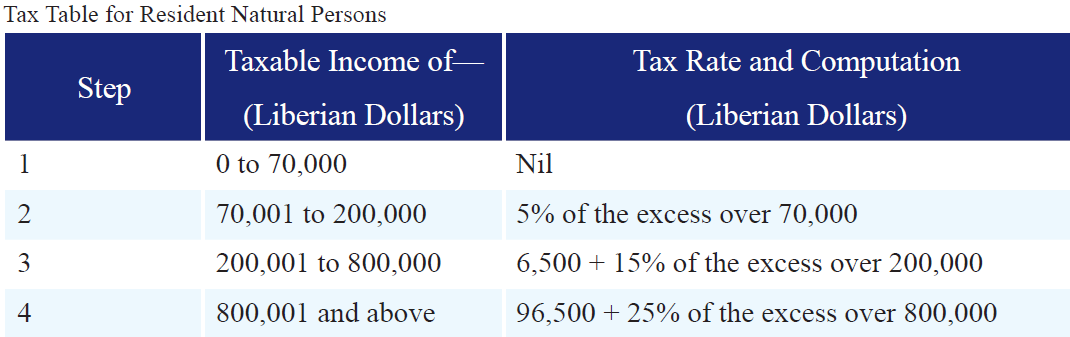
(B) If a natural person is required to file an income tax return under Section 900 and that person is a partner in a partnership or a beneficiary of a trust that pays tax under this Part, the amount of tax paid by the partnership or trust is creditable against tax owed by the partners or the beneficiaries and is apportioned among them in accordance with their interests in the partnership or their interest in the trust.
(b) Resident Legal Persons.
(1) An annual income tax is hereby imposed on the annual taxable income of every legal person resident in Liberia.
(2) Tax is imposed on taxable income at the following rates:
(A) For income from activities described in Chapters 6 or 7, as provided in those Chapters;
(B) For income of legal persons that derive more than 30 percent of their business from life insurance, a 4% presumptive income tax on gross in lieu of the income tax;
(C) For income of other legal persons, a regular tax of 25% or a minimum tax of 2% of gross income, whichever is greater.
(i) If the minimum tax applies, the excess of the minimum tax over the regular tax is creditable against regular tax due for the next succeeding tax year.
(ii) If not fully absorbed in that year, the remaining credit is carried forward to succeeding tax years, but not to years after the fifth succeeding tax year.
(iii) A credit carried to a succeeding tax year is not allowed to reduce regular tax for that year below the amount of minimum tax due for that year.
(iv) The minimum tax applies for tax years beginning on or after January 1, 2016.
(v) After consultation with other Ministries, the Minister may make a determination, publish in a regulation, specifying a sector-specific minimum tax rate of 0.5 to 1.5 percent applicable to a specified business sector for which there is demonstrated evidence that the 2 percent rate is inappropriate. The determination is valid for no more than a year, but (subject to the requirements of this paragraph) the Minister may make a new determination for the sector.
(3) The tax is collected during the tax year in accordance with the withholding rules of Section 905 and the advance payment rules of Section 904.
(c) Presumptive Tax for Small Taxpayers. A legal or natural person carrying on a trade or business with turnover of less than $3,000,000 (three million dollars) per year is a “small taxpayer” who is taxable under this subsection in lieu of the regular income tax imposed by subsection (a) or (b).
(1) Tax under this subsection is imposed at the rate of 4% of annual turnover except as specified in
paragraph (4).
(2) A person taxable under this subsection may elect to be taxed under subsection (a) or (b)
(whichever is applicable). A person making the election is required to file a regular income tax return and to comply with all other requirements for income tax filers.
(3) The presumptive tax is collected during the tax year in accordance with the withholding rules of Section 905 and the advance payment rules of Section 904, except that it is a final tax unless the
taxpayer makes the election under (2).
(4) A natural person with annual turnover of less than $200,000 is a petty trader taxable annually under this paragraph at the following rates:
(A) $2,400 if the petty trader conducts trade or business from a fixed structure with a roof and walls (including an office or workstation located within a personal residence).
(B) $1,200 if the petty trader conducts trade or business from a fixed, open structure with a roof.
(C) $480 (or $240 if the conduct of the trade or business is exclusively outside Montserrado County) if the petty trader conducts trade or business other than as described in (A) or (B).
(d) Exempt Persons. Exempt persons (defined in Section 9) are exempt from income taxation under this Part. If an exempt person’s exempt status depends on an international agreement, the exemption from income taxation is available only to the extent permitted under the international agreement.
(e) Regulations. Regulations may specify the procedures to be followed for collection of (i) income tax and petty trader tax imposed under this section, (ii) advance payments under the advance payment provisions of Section 904, and (iii) tax withheld under the withholding provisions of Section 905.
Section 201. Taxable Income
(a) Taxable Income. The taxable income of a person for a tax year is that person’s gross income less—
(1) items of income specifically excluded under this Part;
(2) the amount of deductions allowed by this Part; and
(3) the amount of personal allowances granted to the taxpayer and dependents under this Part.
(b) Gross Income. Gross income means the aggregate of worldwide economic benefits of whatever kind that the taxpayer derives during a tax year. Examples of items included in gross income are:
(1) earnings from employment, including benefits received in the form of noncash property;
(2) receipts from the operation of a business, profession, vocation, trade, or proprietorship;
(3) non-exempt interest, rents, royalties, and non-exempt dividends;
(4) payments received under a pension, retirement, or annuity arrangement;
(5) distributions from a trust or an estate, except as limited by Chapter 6; and
(6) gain on the disposition of property (whether real or personal, tangible or intangible) used in a business or held for investment (including gain sometimes called “capital gain”).
(c) Residents and Nonresidents. The gross income of a resident includes all economic benefits regardless of source. The gross income of a nonresident includes only those economic benefits having a source in Liberia, and is subject to Liberian tax only as provided in Chapter 8, Income Taxation of Nonresidents.
Section 202. Exclusions
(a) Sickness, Disability, or Death Benefits. Payments received on account of illness, injury, or death of
a natural person are excluded from income of the recipient, if the recipient is ill, injured, disabled or
deceased, or related to that person within the meaning of Section 208(b)(1). Payments qualifying for
this exclusion include amounts paid as proceeds of health insurance or disability insurance or benefits; as damages for or in settlement of a claim of damages for injury to a natural person; or as proceeds of a life insurance policy or as a death benefit. This exclusion applies regardless of whether the payments are made in a lump sum or as a series of annuity payments. Amounts used to purchase medical insurance for a person or to pay medical expenses of a person are not excludible under this subsection, but instead are subject to Section 219.
(b) Gifts and Transfers by Death. Property received in a donative transfer or transfer by death is excluded from the income of the recipient.
(c) Noncash Benefits Provided by An Employer. Noncash benefits provided by an employer to an
employee (other than those benefits excluded elsewhere in this Section or benefits subject to Section
219) are valued at 100 percent of fair market value and are excludible from the income of the employee, except for the value that, in the aggregate, is in excess $100,000 per tax year.
(d) Tax-Exempt Government Obligations. Interest on an obligation issued by the Republic of Liberia
and declared by the Government to be a tax-exempt obligation is excluded from the income of the holder of the obligation.
(e) Personal-Use Property. Gains on the sale of personal-use property are excludible from income unless the amount derived from the sale is equal to $1,600,000 or more.
(f) Exclusion of Interest for Small Savers. Interest of less than $200 per year is excluded from income and is not subject to tax withholding under Section 905.
Section 203. Deductions For the Costs of Producing Income
(a) Expenses. A taxpayer is permitted a deduction for the ordinary expenses of producing income during the tax year, as limited under Section 206. Included as an expense of producing income is the annual allowance for depreciation or amortization of capital expenditures permitted under Section 204.
(b) Losses.
(1) Except as limited by subsection (e), a taxpayer is permitted a deduction for losses incurred in a
business and sustained during the tax year, including a loss from the disposition of property used in a business, provided that the loss is not compensated for by insurance or otherwise.
(2) A taxpayer is permitted a deduction for loss incurred on the disposition of property other than
property used in a business if the property is held for investment, but only to the extent that the loss is offset by gain on the disposition of investment property during the tax year. Unused investment loss may be carried forward to future tax years.
(c) Bad Debts. No deduction for bad debts, or for contributions to reserves for bad debts, is permitted except as provided in this subsection.
(1) A taxpayer is permitted a deduction for the amount of a business bad debt that becomes uncollectible and that during the tax year is charged off on the taxpayer’s books of account, provided the amount was previously included in gross income.
(2) A financial institution regulated by the Central Bank is permitted a deduction for additions to a reserve for bad debts in accordance with the rules and regulations of the Central Bank.
(d) Business Interest. A taxpayer is permitted a deduction for interest on business indebtedness, limited to the interest attributable to a tax year and accrued or paid (consistent with the taxpayer’s method of accounting) during that tax year. The deduction for interest payable to any person other than a resident bank is limited to the amount of interest received plus 50 percent of taxable income other than interest income.
(e) Net Operating Loss Carryforward. If the taxpayer’s costs of producing income for a year exceed the taxpayer’s income, the excess loss is carried forward to the next tax year, and if not fully absorbed by income of the business in that year then to succeeding tax years; but no carryforward is allowed to years following the fifth succeeding tax year.
Section 204. Depreciation and Amortization
(a) General Rule. An annual allowance for depreciation or amortization of capital expenditures may be deducted in accordance with this Section for the physical or nonphysical depreciation of depreciable property. Depreciable property is property (other than land and inventory) used in whole or in part to earn taxable income; that when acquired has a useful life longer than one year; and that loses value as a result of use, damage, or prescription.
(b) Categories. Depreciable property shall be divided into the following categories:
(1) Tangible Moveable Property. Tangible properties (not including fixtures) are to be placed in one of two categories, “heavy machinery” or “light machinery.” These categories are to be depreciated by the pooled depreciation method. The rate of depreciation is 30 percent per year for the heavy
machinery pool and 40 percent per year for the light machinery pool. Property not clearly falling into the category of light machinery is to be included in the category of heavy machinery.
(A) Heavy Machinery. The term “heavy machinery” includes tractors, telecommunication towers, power support towers, buses for 20 or more passengers, airplanes, ships, heavy trucks (more than 5 tons empty weight), and similar equipment.
(B) Light Machinery. The term “light machinery” includes passenger automobiles, office furniture, computers, printers, telephones, passenger vans or buses for fewer than 20 passengers, light trucks (less than 5 tons empty weight), and similar equipment.
(2) Tangible Fixed Property. Non-movable property is to be depreciated on an asset-by-asset basis
and by the straight-line method over a 15-year period.
(3) Intangible Property. Patents, copyrights, and other intangible property, including goodwill, are
to be depreciated on an asset-by-asset basis and by the straight-line method over a 15-year period.
(c) Pooled Depreciation Method. The depreciation allowance for each pool is calculated by applying the depreciation rate specified in subsection (b) against the balance of the pool at the end of the tax year.
(1) The balance of the pool at the end of the tax year is the total of —
(A) the balance of the pool at the end of the preceding tax year after allowing for the deductions under this Section for the preceding year of assessment; and
(B) the adjusted tax cost of property added to the pool in the current tax year, reduced, but not below zero, by the amount received from disposal of property in the pool during that year.
(2) Where property owned by a taxpayer ceases to qualify as depreciable property, the taxpayer is deemed to have disposed of the property for its market value.
(3) The adjusted tax cost of property is added to the pool in the year in which the property is placed in service.
(4) Where the amount received from the disposal during the year of property in a pool exceeds the year-end balance of the pool (disregarding the amount realized), the balance of the pool is reduced to zero and the excess is included in income.
(5) If the balance of the pool at year-end (after reduction by the allowance for depreciation), is less
than $10,000, a deduction is allowed for the remaining amount, and the balance is reduced to zero.
(6) If all the property in a pool is disposed of, a deduction is allowed for the balance of the pool at
year-end.
(d) Incentive Deduction.
(1) Deduction. Manufacturing and service businesses, and businesses in sectors eligible for section
16 investment incentives are entitled to deduct an aggregate of up to 30 percent of the purchase
price of a qualifying asset specified in paragraph (2).
(A) An incentive deduction with respect to an asset is permitted only for the tax period in which the asset is placed in service.
(B) The allowances provided in paragraph (2) may be combined with respect to an asset to reach the limit of 30 percent.
(C) The amount allowable as an incentive deduction reduces the asset’s tax cost to arrive at the asset’s adjusted tax cost, which is added to the appropriate depreciation pool for the tax period in which the asset is placed in service.
(2) Allowances.
(A) Manufacturing and service businesses. 20 percent of the purchase price of equipment and machinery.
(B) Manufacturing, agriculture processing, and service businesses (other than tourist facilities) located outside of Montserrado County, outside any Government-owned Industrial Free Zone, and outside any Industrial Park. 10 percent of the purchase price of equipment and machinery.
(C) A business providing tourist facilities, or a transnational corporation that uses Liberia as its regional headquarters. 10 percent of the purchase price of equipment and machinery.
(D) A business in a sector qualifying for Section 16 investment incentives. 10 percent of the purchase price of equipment and machinery; specialized vehicles; capital spare parts, and other specialized capital goods, as specified by Harmonized System codes in a regulation issued under Section 16, regardless of whether the business is conducting an investment activity that qualifies under Section 16.
(e) Apportionment of Purchase Price. If a building or other depreciable property is bought or sold
together with land, the tax cost is to be apportioned reasonably between the property and land to arrive at a separate value of the depreciable property.
(f) Mixed-Use Property. If property is used only in part for the production of income, a depreciation
allowance deduction is permitted only with respect to the percentage of the cost that is equal to the proportion of use for the production of income.
(g) Manufacture. The term “manufacture” means the subjection of physical matter to any process
(including the assembly of parts) that materially changes its substance or character.
Section 205. Other Deductions
(a) Standard Deduction. An annual standard deduction for a natural person, in an amount of up to
$70,000, is reflected in the tax table of Section 200(a) as a zero bracket amount. No additional amount shall be deducted as a standard deduction.
(b) Charitable Contribution Deduction. A deduction is allowed to a taxpayer filing a tax return under
Section 900 or 901 for the amount of a contribution made to a qualifying organization.
(1) Qualifying organizations are the Government, a Government agency designated as an approved
recipient of charitable donations, or a registered charity described in Section 200(d).
(2) When the contribution is in the form of noncash property, the amount of the contribution is
the property’s adjusted tax cost or its fair market value, whichever is lower, except as provided
in Section 207(b)(3)(B). The deduction for charitable contributions is limited to an amount not in
excess of 15 percent of the taxpayer’s taxable income (computed before reduction for charitable
contributions but after inclusion of any gain on the transfer as provided under Section 207(b)).
Section 206. Limitations on Deductions
(a) Personal Expenses. No deduction is allowed for personal expenses, except as provided in Section
203. The term “personal expenses” means the costs of personal consumption, as specified by the
Commissioner General in regulations.
(b) Capital Expenditure. No deduction is allowed for the amount of a capital expenditure, except by
operation of the allowance for depreciation or amortization provided in Section 204. The term “capital expenditure” means the cost of property or services with a useful life of more than a year, unless the value is less than $5,000.
(c) Costs of Producing Excluded Income. No deduction is allowed for the cost of producing income that is excluded from gross income under Section 202.
(d) Tax. No deduction is allowed for the amount of Liberian or foreign income tax; interest relating to
any Liberian tax; any fines or penalties imposed by law, or for bribes or other similar payments.
(e) Inadequate Substantiation. No deduction is allowed for which the taxpayer is unable to provide
adequate substantiation (within the meaning of Section 55).
(f) Withheld Tax. A person who withholds and pays to the government an amount of tax in accordance with Section 806 or Section 905 is not permitted to deduct those amounts as an independent cost of producing income, although a deduction of the payment’s gross amount (not reduced for withheld tax) is deductible if a deduction is otherwise allowed (for example, the gross amount of a $10,000 payment to a contractor for services rendered to produce taxable income is allowed as a deduction). A person whose payment is subject to withholding is not permitted to deduct the amount of tax withheld, although if the person files an income tax return in accordance with Section 900 or Section 901 the amount withheld is creditable against income tax liability.
Section 207. Property Transfers
(a) General Rule. Gain or loss on the disposition of property is includible in taxable income. The amount of gain or loss is determined by subtracting the transferor’s adjusted tax cost for the property from the amount derived on the disposition. Where payment for the transferred property includes noncash property, the transferor’s amount derived is equal to the fair market value of the noncash property plus any cash or cash equivalent the transferor receives or is entitled to receive as a result of the transfer.
(1) if a transfer of property is for no consideration, then for purposes of determining the transferor’s amount derived and the transferee’s acquisition cost, the transferor is treated as having derived an amount equal to the greater of the property’s market value or its adjusted tax cost immediately before the transfer; and the transferee or other person who acquires the property is treated as incurring acquisition costs of an equal amount.
(2) If a transfer of property is for no consideration and is to an unrelated person who is a qualifying
recipient so that a charitable contribution deduction is allowable under Section 205(b), the transferor’s amount derived on the transfer is considered to be equal to the property’s fair market
value and the transferor’s charitable contribution is the same amount; the recipient takes a fair market value tax cost.
(3) If a transfer of property is by death, the transferor’s amount derived on the transfer is considered to be the property’s fair market value, and the deceased’s estate is treated as incurring acquisition costs of an equal amount. special rules.
(1) A transfer of ownership of property by one person to a spouse or a former spouse, made as part
of a divorce settlement or bona fide separation agreement and accompanied by a written statement that the transfer is a rollover pursuant to this paragraph is not subject to the general rule of this Section but is treated as a rollover pursuant to divorce, and:
(A) The transferor is treated as having derived an amount on the transfer equal to the adjusted tax cost of the property immediately before the rollover pursuant to divorce; and
(B) The spouse or former spouse is treated as acquiring the property for an equal amount.
(2) The involuntary destruction or other involuntary transfer of property, followed by the acquisition of replacement property of the same type within one year, is treated as a rollover pursuant to involuntary conversion, and the general rule of subsection (a) is modified as follows:
(A) for purposes of determining the amount derived under the general rule of subsection (a), the transferor is treated as having derived an amount equal to—
(i) the adjusted tax cost of the property immediately before the rollover pursuant to involuntary conversion; plus
(ii) the amount, if any, by which amounts derived on the involuntary conversion exceeds the costs incurred to acquire the replacement asset (without regard to the operation of this rollover rule); and
(B) for purposes of determining the tax cost of the replacement property, the transferor is treated as acquiring the replacement property for an amount equal to—
(i) The adjusted tax cost of the property immediately before the involuntary conversion; plus
(ii) The amount, if any, by which the costs incurred to acquire the replacement asset exceed the amounts derived on the involuntary conversion (without regard to the operation of this rollover rule).
(C) This rollover rule does not apply to property that is depreciated using the pooled depreciation
method under Section 204(c) unless all of the property in a depreciation pool is involuntarily disposed of at the same time.
(3) A transfer of property to a related person is treated as a rollover pursuant to a transfer to a related person, and the general rule of subsection (a) is modified as follows:
(A) If the transferred property is a business asset, an investment asset, or inventory in the hands of the transferor; the transfer is to a related person; and the requirements of subparagraph (D) are met, then—
(i) The transferor is treated as deriving on the transfer an amount equal to the adjusted tax cost of the property immediately before the transfer; and
(ii) The related person is treated as incurring acquisition costs of an equal amount.
(B) If the transferred property is depreciated in a pool under Section 204; the transfer is to a related person; the property constitutes all of the property in the pool; and the requirements of subparagraph (D) are met, then—
(i) The person is treated as deriving on the transfer an amount equal to the balance of the pool pursuant to Section 204(c)(1) at the time of transfer; and
(ii) The related person is treated as incurring acquisition costs of an equal amount.
(C) If the transferred property is personal-use property in the hands of the transferor who is a natural person; the transfer is to a related person; and the requirements of subparagraph (D) are met, then—
(i) The transferor is treated as deriving on the transfer an amount equal to the adjusted tax cost of the property immediately before the transfer; and
(ii) The related person is treated as incurring acquisition costs of an equal amount.
(D) The requirements specified in subparagraphs (A), (B), and (C) are as follows:
(i) the property has the same character (as business property, depreciable property, investment property, or inventory) in the hands of the related person immediately after the transfer as the property had in the hands of the transferor immediately before the transfer, or the transfer is within subsection (b)(3)(C) and is business property, depreciable property, investment property, or inventory in the hands of the related person immediately after the transfer;
(ii) At the time of the transfer, the transferor and the related person are residents;
(iii) At the time of the transfer, the related person (or, in the case of a related partnership, the partnership or any of its partners) is not exempt from tax;
(iv) There is continuity of underlying ownership in the transferred property of at least 50 percent; and
(v) A written election, signed by both the transferor and the related person, making subparagraph (A), (B), or (C) applicable is attached to each person’s tax return for the year in which the transfer begins.
(c) Dispositions for Less than Market Value. If, in any transfer to which subsection (a) applies, the
transfer is for consideration of less than market value but more than zero, the transaction is considered to consist of two transfers, one for market value to the extent of the consideration received in exchange for the transfer, and the other for no consideration. The transferor’s adjusted tax cost for the property is allocated between the market-value transfer and the no-consideration transfer according to a percentage determined by the amount of consideration divided by the property’s market value.
(d) Definitions.
(1) A “disposition” is a sale, exchange, abandonment, destruction, loss, redemption, gift, transfer by
death, or other transfer of property.
(2) The “tax cost” of property is the amount incurred to acquire it.
(3) The “adjusted tax cost” of property is its tax cost or transferred cost reduced by depreciation,
amortization, or depletion taken with respect to the property and increased by the cost of improvements or expenditures associated with the property and not deductible as expenses of
producing income.
(4) The term “underlying ownership” has the following meanings—
(A) In relation to a legal person, the term “underlying ownership” means an interest held in the legal person directly or indirectly through one or more interposed legal persons by a natural person or by a legal person in which no natural person has an interest; or
(B) In relation to property owned by a legal person, “underlying ownership” is determined as
though the property is owned by the persons having underlying ownership of the legal person in proportion to each person’s interest in the legal person.
(5) The term “interest in a legal person” means a right, including a contingent right, to participate in the income or capital of a legal person.
Section 208. Related Persons
(a) General Rule. Where any person, other than as an employee, acts in accordance with the directions, requests, suggestions, or wishes of another person whether or not they are in a business relationship and whether or not those directions, requests, suggestions, or wishes are communicated to the firstmentioned person, as further elaborated in regulations, both persons are treated as related to each other.
(b) Specific Cases. Without limiting the generality of subsection (a), the following persons are treated
as related persons.
(1) a natural person and a relative of the natural person, unless the Commissioner General is satisfied that neither individual acts in accordance with the directions, requests, suggestions, or wishes of the other individual;
(2) a person and a partner of the person, unless the Commissioner General is satisfied that neither
person acts in accordance with the directions, requests, suggestions, or wishes of the other person;
(3) a permanent establishment and its owner; and
(4) a person who is a legal person and—
(A) a person who, either alone or together with a related person or related persons under another
application of this Section, controls or may benefit from fifty per cent or more of the rights to income or capital or voting power of the legal person, as the case requires, either directly or through one or more interposed legal persons; or
(B) a person who, under another application of this Section, is a related person of a person to whom subparagraph (A) applies.
(5) In this Section, “relative” means a natural person who is related to another individual by blood, adoption or marriage and includes a natural person who is a spouse, parent, grandparent, child, grandchild, brother, sister, aunt, uncle, nephew or niece of the other individual, or a spouse of one of these listed natural persons.
Section 209. Finance Leasing
(a) General Rule. If a lessor leases tangible property to a lessee under a finance lease contract, for
purposes of taxation the lessee is treated as the owner of the property, and lease payments are treated as payments made on a loan to the lessee.
(b) Definition. A lease of property is a finance lease if—
(1) the lease agreement provides for transfer of ownership following the end of the lease term, or the lessee has an option to purchase the property after expiration of the lease term for a fixed or presupposed price; or
(2) the lease term exceeds 75 percent of the useful life of the leased property; or
(3) the estimated residual value of the property after expiration of the lease term is less than 20 percent of its fair market value at the commencement of the lease; or
(4) the present value of the minimum lease payments equals or exceeds 90 percent of the fair market value of the property at the commencement of the lease term, unless the lease commences during the last 25 percent of the useful life of the property; or
(5) the leased property is custom-made for the lessee and after expiration of the lease term, it will not be usable by anyone other than the lessee.
(c) Additional Provisions. For purposes of this Section—
(1) the discount rate used to determine the present value of lease payments is equal to the rate of
interest determined under Section 11 (interest rate) on the date the lease is entered into;
(2) the lease term includes any additional periods for which the lessee has an option to renew the lease; and
(3) if the lessor was the owner of the property before commencement of the finance lease, then in
addition to the loan treatment specified in subsection (a) of this Section, the agreement is treated as a disposal by the lessor and a purchase by the lessee.
Section 210. Income Splitting
(a) General Rule. Where a person attempts to split income with another person, the Commissioner
General may adjust amounts to be included or deducted in calculating the income of each person, or in determining the source of income, to prevent any reduction in tax payable as a result of the splitting of income.
(b) Definition of Income Splitting. A person is treated as having attempted to split income where—
(1) the person transfers amounts to be derived by the person, directly or indirectly, to a related person (within the meaning of Section 208); or
(2) the person transfers an asset, directly or indirectly, to a related person with the result that the related person receives or enjoys amounts derived from the asset, and the reason or one of the reasons for the transfer is to lower the total tax payable by the person and the related person.
(c) Payment by Related Persons. In determining whether a person is seeking to split income, the Commissioner General shall consider the market value of any payment, if any, made by a related person to the person for the transfer.
(d) Indirect Transfers. An indirect transfer of property, money, or amounts to be derived from a transaction or arrangement from a person to a related person includes a transfer made through the interposition of one or more legal persons.
Section 211. Transactions Between Related Persons
In any transaction or arrangement between persons who are related persons within the meaning of Section 208, the Commissioner General may distribute, apportion, or allocate amounts to be included or deducted in calculating income and credits granted under this Part between the persons, or determine the source of income, as is necessary to reflect the taxable income or tax payable which would have arisen for the persons if the arrangement had been conducted at arm’s length.
Section 212. Currency Exchange Rate Fluctuations
For the purpose of computing taxable income, nominal gains and losses resulting from foreign exchange fluctuations are recognized only when they are realized through the completion of a transaction, that is, when payment is made or services are performed. If a taxpayer uses a different accounting treatment of foreign currency gains and losses for financial (as opposed to income tax) accounts, a statement reconciling the two sets of figures must accompany the tax return.
Section 213. Foreign Tax Credit
(a) General Rule. Payers of Liberian income tax may claim a foreign tax credit for amounts of income
tax paid to a government other than the Republic of Liberia with respect to income not having a source in Liberia. The amount of foreign tax paid or accrued (consistent with the taxpayer’s method of accounting) is creditable against Liberian income tax otherwise due.
(b) Limitation. The amount of the credit is limited to the amount of tax that would otherwise be charged on that income at the income tax rates in effect for that tax year, using the taxpayer’s average rate of tax paid. The foreign tax credit is determined on a country-by-country basis. Credit is available only for a foreign tax that is an income tax or imposed in lieu of an income tax.
Section 214. Methods of Accounting
(a) Methods Allowed. A taxpayer may account for tax purposes using the cash or accrual method,
provided that the method and its application clearly reflect the taxpayer’s income.
(b) Limitations. A legal person that is not a trust or a partnership must account for income on an accrual basis. In the case of a natural person, trust, or partnership, where the taxpayer’s business income for a tax year exceeds the amount specified in Regulations, the taxpayer must account for business income on an accrual basis in all succeeding tax years.
(c) Requirements for Change of Method. Except for a change from the cash basis to the accrual basis
required under subsection (b), a taxpayer is permitted to change the method of accounting only with
the prior written permission of the Commissioner General. If the taxpayer’s method of accounting is
changed, adjustments to items of income, deduction, or credit, or to other items must be made in the tax year following the change, so that no item is omitted and no item is included more than once.
Section 215. Cash-Method Accounting
A cash-basis taxpayer is required to take income into account when it is received or made available and must take deductions into account when paid.
Section 216. Accrual-Method Accounting
(a) General Rule. An accrual-method taxpayer is required to take an item of income or expense into
account when the amount is “payable” as defined in subsection (b).
(b) Definitions.
(1) Income. An amount is payable to the taxpayer when the taxpayer becomes entitled to receive it, even if the time for discharge of the entitlement is postponed or the entitlement is payable by installments.
(2) Expenses. An amount is treated as payable by the taxpayer when all the events that determine
liability have occurred and the amount of the liability can be determined with reasonable accuracy, but not before economic performance with respect to the amount occurs. For purposes of this
subparagraph, economic performance occurs—
(A) With respect to the acquisition of services or property, at the time the services or property are provided;
(B) With respect to the use of property, at the time the property is used; or
(C) In any other case, at the time the taxpayer makes payment in satisfaction of the liability.
Section 217. Amounts Erroneously Received or Paid
(a) Cash-Method Taxpayer. If a cash-method taxpayer includes in gross income an amount which the
taxpayer is not entitled to receive or claims a deduction for an amount the taxpayer is not obligated to pay, the calculation of taxable income is to be adjusted in the tax year in which the taxpayer refunds the amount received or receives a return of the amount paid.
(b) Accrual-Method Taxpayer. An accrual-method taxpayer is required to include an amount in gross
income or claim a deduction (even if not legally entitled to receive the amount or liable to pay the
deduction) if the taxpayer claims to be legally entitled to receive the amount or to be legally obliged
to pay the deduction. Taxable income is to be adjusted for the tax year in which the taxpayer ceases to claim the right to receive the amount or ceases to claim an obligation to pay the amount.
Section 218. Prepayments
An otherwise allowable deduction for an expense that is not a capital expenditure but that relates to a service or other benefit that extends beyond six months after the end of the tax year is allowed proportionately over the tax years to which the service or other benefit relates.
Section 219. Medical Tax Credit
(a) Credit for Medical Insurance Premium or Medical Expenses. A natural person shall be entitled to
a credit (“the medical tax credit”) against income tax otherwise due for approved medical expenses
(medical insurance premium and the amount of medical care costs, as described in regulations) paid
by any person, including the natural person, during a tax year while the natural person is resident, on
behalf of that person or that person’s resident dependents (providing that the dependents do not claim the credit in respect of such expenses), calculated as provided in subsection (b) and subject to the limit set out in subsection (c).
(b) Amount. The medical tax credit of a person for a tax year is calculated by applying the rate of 50
percent to the amount of approved medical expenses for the year and adding to the result any amount referred to in subsection (d).
(c) Limit. The medical tax credit claimed for any tax year shall not exceed the percentage stated in
subsection (b) multiplied by the reasonable medical insurance premium amount or $120,000.00
whichever is lower. The Minister shall, by regulation, prescribe any other amount.
(d) Carryforward. To the extent to which, for any natural person for any tax year—
(1) the amount referred to in subsection (b) is greater than the limit referred to in subsection (c); or
(2) the natural person cannot use the medical tax credit by reason of lack of income tax payable under for the year, the sum of any excess paragraphs (1) and (2) may be carried forward and added to the amount referred to in subsection (b) for the next tax year.
(e) Employees. A natural person who is an employee may claim the medical tax credit through an
adjustment to tax withheld by the employer. The adjustment is to be substantiated by information
submitted to the employer in a format approved by the Commissioner General. If an employee’s medical care costs or medical insurance premium is paid for by the employer, the amount of the payment is includible in the employee’s income and the medical care credit is credited against tax otherwise due.
Section 220. Long-Term Contracts
(a) General Rule. Income and deductions relating to a long-term contract are taken into account on the basis of the percentage of the contract completed during the tax year. The percentage of completion is determined by comparing costs allocated to the contract and incurred before the end of the tax year with the estimated total contract costs. Example:

(b) Definition. The term “long-term contract” means a contract for manufacture, installation, or
construction, or the performance of related services, which is not completed within the tax year in which work under the contract commenced, other than a contract estimated to be completed within 6 months of the date on which work under the contract commenced.
Section 221. Inventory of Trading Stock
(a) General Rule. A taxpayer who maintains a stock of goods for trade in the ordinary course of business (including consumables used in a manufacturing or production process and goods to be incorporated into a product) must, if necessary to reflect income clearly, establish and maintain inventories.
(b) A deduction is allowed for the cost of inventory sold during the tax year.
(c) The cost of inventory sold in a tax year is determined by adding to the opening inventory the cost
of goods acquired during the year, and subtracting the closing inventory at the end of the tax year (the value of inventory at year-end).
(d) The value of inventory at year-end is the lower of cost or market value at that date.
(e) Where particular items of inventory are not readily identifiable, a taxpayer may account for that
inventory on the first-in-first-out method, the average-cost method, or the last-in-first-out method,
but once chosen, a stock valuation method may only be changed with the written permission of the
Commissioner General.
(f) A cash-basis taxpayer may calculate the cost of inventory on the prime-cost or absorption- cost
method, and an accrual-basis taxpayer must calculate the cost of inventory on the absorption-cost
method.
Section 222. Tax Period
(a) General Rule. The tax period for the purposes of this Chapter is a tax year, which unless otherwise
provided is the calendar year.
(b) Fiscal Year. The Commissioner General may, on written application by a legal person not a trust or
estate, grant permission to the person to use some other 12-month period as the tax year (a fiscal year) upon the person showing a compelling need, subject to any conditions prescribed by the Commissioner General .
(1) Permission to use a fiscal year as the tax year can be withdrawn by written notice issued by the
Commissioner General. A notice issued by the Commissioner General will take effect at the end of the taxpayer’s fiscal year in which the notice is issued.
(2) References to the tax year, in the case of a taxpayer authorized to use a fiscal year, are to be understood as a reference to the taxpayer’s fiscal year.
(c) Transitional Tax Year. Where the tax year for a taxpayer changes from a calendar tax year to a fiscal
year; from a fiscal year to a calendar tax year; or from one fiscal year to another, the period between
the last full tax year prior to the change and the date on which the new tax year commences is to be
treated as a separate tax year known as a “transitional tax year.” References to the tax year, in the case of a taxpayer to which this subsection applies, are to be understood as a reference to the taxpayer’s transitional tax year.
(d) Short Tax Year. A legal person who ceases business operations during a tax year is required to close the books for the tax year as of the end of the second month after the month in which the cessation of business occurs. A person subject to a jeopardy assessment within the meaning of Section 74(a)(4) is required to close the books for the tax year on the date of the jeopardy assessment. In either case, the period between the last full tax year prior to the closing of the books and the date on which the books are closed is to be treated as a separate tax year known as a “short tax year.” In the case of a jeopardy assessment, the period from the date of the jeopardy assessment to last day of the taxpayer’s tax year is also a short tax year.
Sections 223-299. Reserved
Chapter 3. INCOME TAXATION OF PARTNERSHIPS
Section 300. Principles of Taxation for Partnerships
(a) General Rule. A partnership is liable to pay tax on its income as determined under Section 201 for
the partnership’s tax year. Income tax paid by the partnership is creditable to the partners in proportion to their shares of partnership income as determined under Section 301.
(b) Partnership Relationship. The presence or absence of a written partnership agreement is not
determinative as to whether a partnership relationship exists between persons.
(c) Nature of Partner’s Interest. A partner’s interest in a partnership is treated as investment property of the partner.
(d) Elections, Notices, Statements. Any election, notice, or statement required to be filed for tax purposes in relation to a partnership’s activities is to be filed by the partnership. Unless expressly provided to the contrary, filing is accomplished by attaching the appropriate election, notice, or statement to the partnership’s tax return for the relevant tax year of the partnership.
Section 301. Calculation of Partnership Income
The partnership income of a partnership for a tax year is the taxable income of the partnership determined as if the partnership were a resident, less an amount calculated according to the following formula, where “FTC” is the partnership’s total foreign tax credit determined as if the partnership were a resident:

Section 302. Taxation of Partners
(a) Partnership Income. The gross income of a partner includes the partner’s share of partnership income (as determined under Section 301) for the tax year, plus the partner’s share of excludible and exempt income. The gross income of a nonresident partner includes the partner’s share of Liberia-source partnership income for the tax year.
(b) Exclusions and Exemptions. Amounts that are excludible or exempt from income under this Part
retain their excludible or exempt character when attributed to the partners.
(c) Partnership Loss.
(1) Net Operating Loss. The partnership’s net operating loss for a tax year is not passed through to the partners, but is carried forward to future tax years of the partnership in accordance with Section 203(e).
(2) Net Investment Loss. The partnership’s net investment loss is carried forward to future tax years of the partnership, in accordance with Section 203(b)(2).
Section 303. Contribution of Property to a Partnership
(a) General Rule. A contribution of property to a partnership is governed by Section 207.
(b) Exception. If, after a contribution of property to a partnership, the contributing partner’s underlying ownership is less than the percentage in Section 207(b)(3)(D) but at least 20 percent; the
other requirements of Section 207(b)(3)(D) are met; and as limited by regulations the issued by the
Commissioner General, tax on the contributing partner’s gain on the contribution may be deferred for up to five years (subject to payment of interest on the deferred tax).
(c) Definition. Property is contributed to the partnership if it is transferred in exchange for an interest in the partnership. If property is transferred in part for a partnership interest and in part for other consideration, the transfer is treated as made for other consideration to the same extent as the proportion that the fair market value of the other consideration bears to the property’s fair market value.
Section 304. Tax Cost of Partner’s Interest
(a) Acquisition of Interest. A partner’s tax cost of a partnership interest is the amount of cash the partner paid for the interest plus the amount of tax cost attributable to the partner’s contribution of property as determined under Section 207 and Section 303.
(b) Increase. The partner’s tax cost of the interest is increased by the amount of the partner’s share of
the partnership income as determined under Section 301 (including the partner’s share of excludible and exempt income).
(c) Decrease. The partner’s tax cost of the interest is decreased by the value of distributions made by
the partnership to the partner (but not less than zero), and by the amount of the partner’s share of the partnership’s nondeductible expenses (but not capital expenditures).
Section 305. Operating Distributions
(a) Cash. Cash distributions reduce a partner’s tax cost in the partnership (but not below zero).
(b) Property. A distribution of noncash property is treated as a Section 207 disposition of property by the partnership.
(c) Effect on Partner’s Tax Cost. Noncash distributions reduce the adjusted tax cost of the distributee partner’s interest by the partnership’s amount derived, as determined under Section 207.
(d) Distribution In Excess of Partner’s Tax Cost. The amount of a distribution that exceeds the distributee partner’s adjusted tax cost in the partner’s interest is treated as investment gain.
Section 306. Terminating Distributions
(a) General Rule. When a distribution terminates a partner’s interest in the partnership, the rules of
Section 305 apply. If a terminating distribution is in an amount less than the adjusted tax cost of the
retiring partner’s interest, the unrecovered cost is treated as an investment loss.
(b) Definition. A partner’s interest in the partnership is terminated when that partner neither has any
underlying ownership in the partnership nor is related (within the meaning of Section 208) to a person who has an interest in the partnership.
Section 307. Termination by Transfer to New Partner
When a partner’s retirement from the partnership is accomplished by the transfer of the partner’s interest to a new partner, the transfer is a disposition of the retiring partner by the estate and is governed by the rules of Chapter 5.
Section 308. New Partner Buy-In
When a new partner enters the partnership by making a contribution, the rules of Section 303 apply.
Sections 309-399. Reserved
Chapter 4. INCOME TAXATION OF CORPORATIONS
Section 400. Principles of Taxation for Corporations
(a) General Rule. A corporation is liable to pay tax on its income as determined under Section 201.
(b) Dividend from Resident Corporation. Subject to subsection (c), a dividend received by a resident
corporation from another resident corporation is exempt from taxation.
(c) Exception. Subsection (b) does not apply to a dividend received by a corporation by virtue of its
ownership of redeemable shares in the corporation paying the dividend, or if the dividend is paid in a
dividend stripping arrangement as defined in regulations.
Section 401. Disguised Dividends
A transaction by which a corporation confers a direct or indirect benefit on a shareholder is treated for the purposes of this Act as a dividend paid by the corporation to the shareholder, unless otherwise included in the shareholder’s income.
Section 402. Redemption of Stock
A shareholder is treated as having made a disposition (within the meaning of Section 207) of a share of stock that is redeemed, cancelled, or acquired by the issuing corporation.
Section 403. Redemption in Complete Liquidation
A distribution of corporate property in complete or partial liquidation of the corporation is treated as a disposition to which the rules of Section 207 apply.
Section 404. Incorporation Roll-Over
Where a person transfers property (either property not subject to any liability or property subject to a liability that is not in excess of the adjusted tax cost of the property) to a corporation in exchange for voting stock in the corporation; and the requirements of Section 207(b) are met, the transfer is accorded the rollover treatment permitted under Section 207(b)(3).
Section 405. Limitation on Carryforward of Tax Attributes
(a) Change in Control. If, within a period of three years, there is a change of 50 percent or more in
the underlying ownership (within the meaning of Section 207) or control of a corporation (within the
meaning of Section 208), no carryforward is allowed of tax attributes in tax years following the change.
(b) Definition of Tax Attributes. For the purposes of this Section, the term “tax attributes” includes loss
carryforwards from years prior to the change and concessions made as investment incentives.
Section 406. Contribution to Capital
(a) General Rule. A contribution to the capital of a corporation in exchange for a capital interest in the
corporation is not income to the corporation.
(b) Definition. When a corporation issues shares in exchange for money or property, the transfer of
money or property to the corporation is a contribution to capital. If an existing shareholder makes a
payment to the corporation, and the payment is not made because of any other type of obligation to the corporation, it is treated as a contribution to capital and the amount of the contribution increases pro rata the shareholder’s tax cost of the shareholder’s stock.
(c) Re-Issuance of Stock. When a corporation purchases its own stock on a stock exchange or redeems its stock from shareholders, and later re-issues that stock, the re-issuance is treated as a property transfer under Section 207 to the extent that proceeds from the sale are not added to the capital of the corporation for purposes of keeping the corporation’s books of account.
Sections 407-499. Reserved
Chapter 5. INCOME TAXATION OF TRUSTS AND ESTATES
Section 500. Principles of Taxation of Trusts and Estates
(a) General Rule. A trust is liable to pay tax separately from its beneficiaries on its income for a tax year, as determined under Section 201.
(b) Taxation of Beneficiaries. The attributable income of a trust, as determined under Section 501, may
be attributed to and taxed in the hands of the trust’s beneficiaries in the circumstances outlined in Section 503.
(c) Separate Trusts. Separate calculations of the taxable income of a trust shall be made for separate
trusts regardless of whether they have the same trustees.
(d) Amounts Derived or Incurred by Trust. Amounts derived and costs incurred by a trust or a trustee
in the capacity of trustee of a trust (other than as a bare agent), whether or not derived or incurred on behalf of another person and whether or not any other person is entitled to such an amount or income constituted by such an amount, are treated as derived or incurred by the trust and not any other person.
(e) Property and liabilities. Property owned and liabilities owed by a trust or a trustee in the capacity of trustee of a trust are treated as owned or owed by the trust and not any other person.
(f) Foreign Income Tax. Foreign income tax paid with respect to the income of a trust, whether paid by a trustee, a beneficiary, or the trust, is treated as paid by the trust.
(g) Transactions between Trust and Beneficiary. Subject to recharacterization and adjustment in accordance with this Code, transactions between a trust and its trustee and beneficiaries shall be respected.
Section 501. Attributable Income of a Trust
(a) General Rule. The attributable income for a tax year of a resident or nonresident trust is the taxable income of the trust for the year determined as if the trust were a resident trust, without regard to Section 502(a), and less an amount calculated according to the following formula, where “FTC” is the trust’s total foreign tax credit determined as if the trust were a resident:

(b) Loss. Loss of a trust for a tax year is not attributable to the beneficiaries of the trust.
(1) Net Operating Loss. The trust’s net operating loss for a tax year is not attributable to the beneficiaries of the trust, but is carried forward to future tax years of the trust in accordance with Section 203(e).
(2) Net Investment Loss. The trust’s net investment loss is not attributable to the beneficiaries of the trust, but is carried forward to future tax years of the trust in accordance with Section 203(b)(2).
Section 502. Deduction for Amounts Attributed to Beneficiary
(a) General Rule. Subject to this Code, where an ascertained resident beneficiary of a trust—
(1) acquires a vested right to an amount included in calculating the attributable income of the trust
during the tax year of the trust in which the amount constitutes or is included in calculating the
attributable income of the trust; and
(2) has the same tax year as the trust, the amount shall be deducted in calculating the income of the
trust for the year.
(b) The Manner of Acquisition of Right. Subsection (a) applies regardless of whether the beneficiary
acquires the vested right as a result of the exercise by a trustee of a discretion vested in the trustee or the happening of some other event.
Section 503. Taxation of Beneficiaries
(a) General Rule. No amount shall be included in calculating a beneficiary’s income from a trust
otherwise than as provided for by subsection (b) or (c).
(b) Inclusions. Notwithstanding Section 500(d), the gross income of the beneficiary shall include any
amount included in calculating the attributable income of the trust for a tax year of the trust ending
within the tax year of the beneficiary—
(1) to which the beneficiary has a vested right and which is deductible in ascertaining the income of the trust under Section 502(a); or
(2) to which the beneficiary is or has become entitled otherwise than in the manner referred to in paragraph (1) within 30 days of the end of the trust’s tax year; or
(3) which is distributed to or applied to the benefit of the beneficiary in cash or in-kind within 30 days of the end of the trust’s tax year.
(c) Additional Inclusions for Beneficiary of Nonresident Trust. Where subsection (b) does not apply,
the gross income of the beneficiary of a nonresident trust for a tax year of the beneficiary shall include any amount included in calculating, for any tax year of the trust, the attributable income of the trust—
(1) to which the beneficiary is or has become entitled during the tax year of the beneficiary; or
(2) which is distributed to or applied to the benefit of the beneficiary in cash or in-kind during the tax year of the beneficiary.
(d) Attributable Income of a Trust. On allocation to beneficiaries under subsections (b), or (c) attributable income is treated as an amount derived from an investment of the beneficiary.
(e) Timing. Where subsection (b) or (c) applies, the beneficiary is treated as deriving the amount at the time it vests; the time the beneficiary becomes entitled to it; or the time it is applied, as the case requires; but, in the case of subsection (b), not later than the end of the trust’s tax year.
(f) Credit for Tax Paid. Where attributable income of a trust is allocated to a beneficiary of a trust under subsection (b), any Liberian income tax paid by the trust with respect to the allocated income is credited to the beneficiary.
Section 504. Incapacitated Persons
For the purposes of determining whether an amount vests in a beneficiary of a trust under Section 502(a) or whether a beneficiary of a trust is entitled to an amount under Section 503(a), a lack of legal capacity of the beneficiary is ignored.
Section 505. Deceased Individuals
(a) Interest of Heir or Legatee. For the purposes of Section 502(a) and Section 503(a), an ascertained
heir or legatee of a deceased natural person is treated as having a vested interest in an amount included in calculating the attributable income of the deceased’s estate to the extent that income is derived by the executor of the estate for the immediate or future benefit of the heir or legatee.
(b) Valuation of Property. Where a beneficiary receives a distribution of property from an estate, and the distributed property was acquired by the estate in a transfer-by-death to which Section 207(a)(3) applies, then if the distribution to the beneficiary occurs within one year of the deceased’s death, the property’s fair market value for purposes of determining the estate’s Section 207 amount derived on the transfer is considered to be the same as the property’s fair market value at the time of the Section 207(a)(3) transfer.
Section 506. No Adjustment to Tax Cost of Beneficiary’s Interest in a Trust
A distribution by a trust to a beneficiary out of attributable income, exempt amounts, amounts represented by the reduction in calculating attributable income by reason of the formula in Section 501(a), or payments subject to final withholding tax does not decrease tax cost with respect to the property that is the beneficiary’s interest in the trust.
Sections 507-599. Reserved
Chapter 6. INCOME TAXATION OF AGRICULTURE AND RENEWABLE RESOURCES
Section 600. Definitions
(a) Renewable Resources. Renewable resources include the uncultivated forest, cultivated trees
(for example, rubber or palm), other growing plants (including food and tree crops), the raising and
subsequent harvesting of fish or livestock, the sea, the sun, wind, rivers, and other similar resources
that are not exhausted if their energy is captured or their products are prudentially harvested, but do not include cultivated forest or uncultivated trees if used in forestry.
(b) Extraction of Renewable Resource Product. The extraction of renewable resource product means the harvesting of a product of a renewable resource or the production of energy or other valuable commodity from a renewable resource.
(c) Renewable Resource Contract. A renewable resource contract is an agreement with the Government of Liberia, acting through an authorized renewable resource development agency, for extraction of renewable resources or for management of the renewable resource contract area described in the contract. Examples are—
(1) Agricultural Concession Agreement (Ministry of Agriculture)
(2) Rice Plantation Concession Agreement (Ministry of Agriculture)
(d) Renewable Resource Project. A renewable resource project is a venture for the extraction of a
renewable resource product subject to a renewable resource contract, including the use of land for
agricultural purposes under an agricultural concession agreement.
(e) Operations. For the purpose of determining when a renewable resource project has begun operations, the term “operations” includes the acquisition of carbon credits with respect to a resource area.
(f) Commercial Production. For the purpose of determining when a renewable resource project has begun commercial production, the term “commercial production” includes the production of carbon
credits with respect to a renewable resource contract area. A project begins “commercial production” on the date of the first shipment of product extracted from a renewable resource contract area as part of a regular program of profit-seeking activity.
(g) Production Development Expenditures. Production development expenditures are costs associated with the development of a renewable resource contract area, or a part thereof, to prepare it for commercial production.
(h) Contractor. A “contractor” is a person who holds a renewable resource contract subject to Chapter 6.
Section 601. Scope of Chapter
(a) Income Taxation. Income tax is imposed on taxable income from agricultural production and
renewable resource projects (as defined in Section 600).
(1) Income from agricultural production not under an agricultural concession agreement (“general
agricultural production”) is subject to the general rules of Part II, except as expressly provided
otherwise in this Chapter.
(2) Income from renewable resource projects or from agricultural production under an agricultural
concession agreement is subject to rules of this Chapter. In the absence of a specific rule, the general rules of Part II apply.
(b) Rate of Tax. Taxable income from a renewable resource project is subject to income tax at the rate stated in Section 602.
(c) Form of Organization Disregarded. Regardless of the legal form of organization adopted by one
or more persons having an interest in a renewable resource project, a person’s taxable income shall be determined separately for each project, and a person with an interest in more than one project shall not be permitted to consolidate income or loss of one project with that of any other.
(1) For purposes of determining income tax, income from a renewable resource project is
considered to be income of a resident legal person or of a Section 803 permanent establishment
taxable according to rules applicable to a resident legal person. Taxable income and income tax
liability are determined under provisions of the regular income tax of Chapter 2, subject to special
rules provided in this Chapter.
(2) In accordance with Section 10(dd), a contractor who holds a renewable resource contract granted by a renewable resource development agency is considered to have an interest in the renewable resource project that is the subject of the renewable resource contract, and is the taxpayer legally responsible for paying tax with respect to income of the project. If the contractor is organized as a partnership or similar form of unincorporated joint venture, each partner shall be considered a taxpayer with respect to the activities of the project.
(3) The Chapter 9 filing and advance payment rules for the regular income tax apply to a contractor
with income from a renewable resource project.
(d) Renewable Resource Laws and Authorities.
(1) Rubber. The Rubber Industry Rehabilitation and Development Fund Act governs non-tax terms of extraction of rubber-tree resources in Liberia. The Ministry of Agriculture is the renewable resource development agency for rubber-tree resources.
(2) Palm Oil. The Oil Palm Development Fund Act governs non-tax terms of extraction of palm-oil
resources in Liberia. The Ministry of Agriculture is the renewable resource development agency
for palm-oil resources.
(3) Tree Crops, including coffee and cocoa. The Ministry of Agriculture is the renewable resource development agency for tree crop resources.
(4) Food Crops. The Ministry of Agriculture is the renewable resource development agency for food crops.
(5) Rice. The Ministry of Agriculture is the renewable resource development agency for rice.
(6 ) Non-Palm Bio-Diesel. Reserved.
(7) Solar. Reserved.
(8) Wind. Reserved.
(9) Sea. Reserved.
(10) Geothermal. Reserved.
(11) Carbon Credits. Reserved.
(e) US Dollar Accounting. Books and records of a renewable resource project may be kept in Liberian or US Dollars, but a project’s tax and taxable income shall be determined in US Dollars.
(f) Consolidated Account. An amount that a contractor is required to contribute to a development fund or other fund specified in this Chapter is to be paid into the consolidated account.
(g) Compliance. An amount due or amount in default under a renewable resource contract is treated as a tax liability under this Code, and is subject to the same procedural requirements (including penalties, fees, and interest).
Section 602. Rate of Tax
The rate of tax on taxable income from extraction of renewable resources, with the exception of rice
production project, shall be 25 percent. The rate of tax on taxable income for rice production projects shall be 15 percent.
Section 603. Valuation
(a) General Rule. Resources extracted by a renewable resource project are valued for all purposes at fair market value (f.o.b.) Liberia without reduction for claims, counterclaims, discounts, commissions, or any other asserted offset or deduction.
(b) Cross-Reference. The fair market value (f.o.b.) Liberia is determined for the day of shipment in
accordance with Section 10(gg), and in the case of a product for which there is a reliable international
price index, as specified in regulations referencing that index.
(c) Advance Pricing Agreement. The Government of Liberia and a contractor may agree to a transfer
pricing methodology in an advance pricing agreement in accordance with Section 18.
Section 604. Surface Rent and Royalties
(a) Surface Rent. A contractor must pay an annual surface rent of US $2 (Two United States Dollars)
per acre for developed land and US $1 (One United States Dollar) per acre for undeveloped land,
irrespective of the value of the assets contained thereon. The valuation of and the payment for the value of the assets in a proposed concession area may be made a biddable item in the concession procurement process.
(1) Annual payments are due on or before the effective date of the agreement and thereafter on the
agreement anniversary date.
(2) Surface rent amounts stated in this section are subject to inflationary adjustment in accordance with the GDP Implicit Price Deflator as published and revised from time to time by the U.S. Department of Commerce, Bureau of Economic Analysis (“the deflator”). The inflation-adjusted rent shall be effective January 1 of each calendar year based on the ratio of the value of the revised deflator for the second quarter of the immediately preceding calendar year to the value of the revised deflator for the second quarter of 2008.
(b) Royalty for Carbon Credits. A contractor who has entered into renewable resource contract and who obtains carbon credits must pay a carbon credit royalty equal to 10 percent of the value of the credits.
Regulations may specify a calculation method for determining the value of carbon credits of a type not traded on an exchange or not otherwise easily convertible into currency. The Commissioner General does not have regulatory authority to reduce the royalty rate below the rate specified in this subsection.
(c) Fees Payable Under Non-Tax Laws. Fees payable under non-tax laws specified in Section 601(d),
including payments to a community or industry development fund, are treated as a cost of producing
income and are deductible as specified in Section 605(b).
Section 605. Determination of Taxable Income from Renewable Resource Projects
(a) Gross Income. The gross income of a renewable resource project includes
(1) All revenues resulting from production and other operations carried out under the project’s
contract;
(2) Any other income that the project receives from business activity or investment accruing in,
derived from, brought into or received in, Liberia, including currency gains when realized (but not
gains from hedging transactions), less the deductions set forth in subsection (b).
(b) Deductions Allowed from Gross Income. In accordance with the rules of Chapter 2, all expenditures incurred during the tax period wholly, exclusively, and necessarily in connection with project operations (including non-capital operating costs but excluding capital costs except to the extent of the annual allowance for depreciation), are allowed as deductions, including but not limited to the following items:
(1) Surface rent and other fees specified in Section 604, including non-tax fees paid in accordance
with an applicable renewable resource law, limited in any period to the amount paid during or prior
to the period and in the amount attributable to the period.
(2) An allowance for depreciation of plant and equipment in accordance with the depreciation rules
of Chapter 2, subject to the special rule of Section 610.
(3) A carryforward of net operating loss from a prior year to the extent permitted under Section
203(e), as modified by the special rule of Section 611.
(4) Interest on any indebtedness of the project, and other financing costs incurred in connection with operations and paid to an affiliate or to a third party, for the tax period incurred.
(5) Production development expenditures defined in Section 600.
(6) Subject to the provisions of Chapter 2, management fees paid, whether to an affiliate or to a
third party, but not the amount in excess of 2 percent of other operating expenses incurred for the
tax period.
(7) Subject to the provisions of Section 203(c), the amount of bad debt incurred, so long as that
amount was subject to income taxation in a prior tax period.
(8) Charitable contributions made in Liberia to a qualifying organization within the meaning of
Section 205(b) for educational or community development projects, social welfare, or medical
purposes or for the provision of other social services.
(9) Expenses related directly to the project’s “other income” under subsection (a)(2), to the extent
otherwise allowable as a deduction under Chapter 2 and this Chapter.
(c) Deductions Not Allowed. The following expenses are not allowed as a deduction from gross income:
(1) A payment to an expatriate employee as reimbursement for taxes and duties paid by the employee to the Government.
(2) A loss from a hedging transaction.
(3) An incentive deduction allowed by Section 204(d).
(4) An amount otherwise allowable as a special tax incentive deduction by Section 16.
Sections 606-609. Reserved
Section 610. Special Rule for Depreciation
(a) Commencement of Period. For property placed in service before commercial production begins,
the period for depreciation of property described in Section 204(b) shall begin in the first tax period in which commercial production begins.
(1) Up-front payments that are mandatory under a contract are treated as the cost of property placed in service before commercial production begins, and are to be amortized over a period of 10 years.
(2) The costs of community development contributions or social contributions that are mandatory
under a contract are deductible in the year incurred.
(b) Tangible Moveable Property. The cost of tangible moveable property shall be recovered over the period and by the method described in Section 204(b)(l ).
(c) Tangible Fixed Property used in Agriculture. Buildings and fixed tangible assets used in agricultural production are to be pooled and depreciated at 20 percent each year. The cost of planting trees or palms is to be treated as the cost of a fixed tangible asset and included in the pool.
(d) Cost of Clearing Land. A contractor’s cost of land clearing, excavation of irrigation channels,
establishing access roads, and similar activities is a deductible expense.
(e) Food Crops. In the case of an agricultural concession contract for food crop production, capital
expenditures are deductible in the year the capital item is placed in service.
(f) Special Incentive Deduction. A special incentive deduction is allowed in the first year in which an
agricultural asset (tangible equipment or tangible fixed property) is placed in service in an economically deprived zone. No deduction is allowed under this subsection for an expenditure that is deductible under subsection (e). The amount of the deduction under this subsection is the specified percentage of the cost of the asset, as follows—
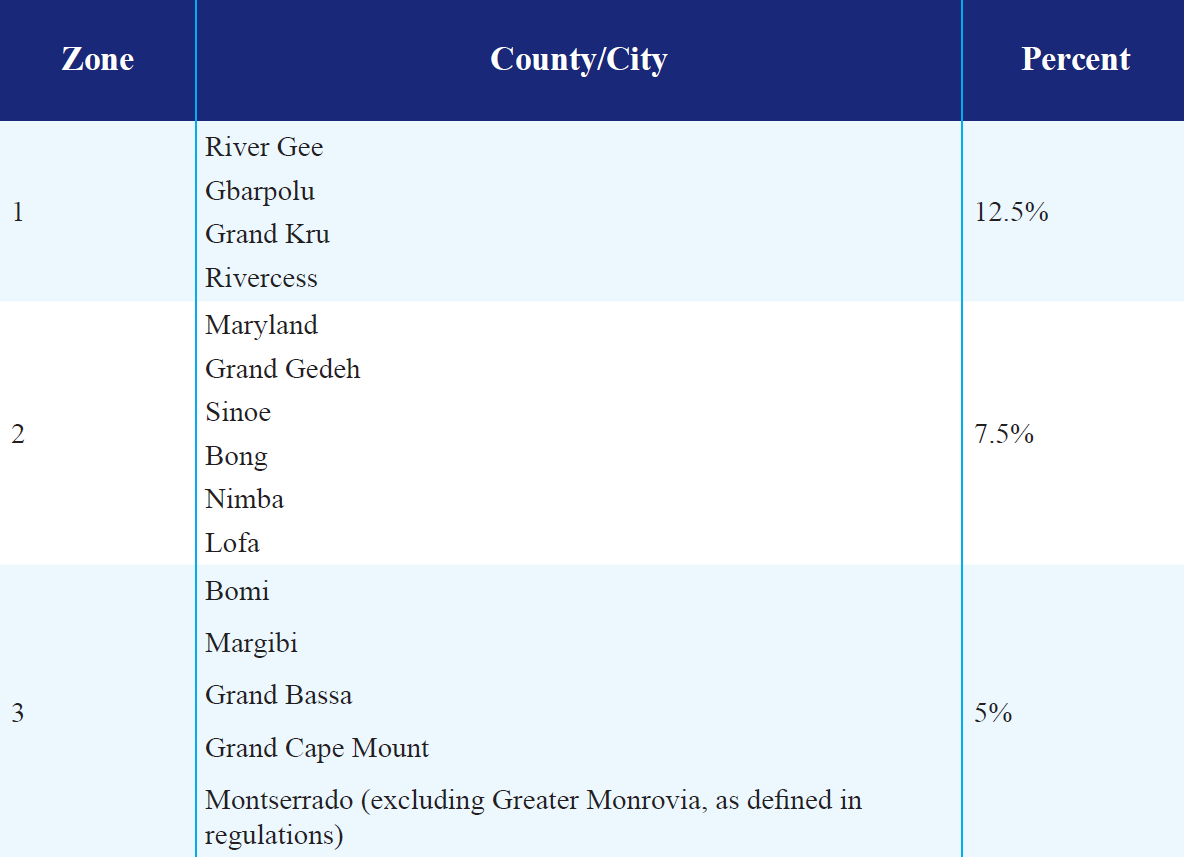
Section 611. Special Rule for Net Operating Loss Carryforward
For the purpose of determining a contractor’s taxable income from a renewable resource project, the Section 203(e) period for carryforward of net operating loss shall begin with the first tax period in which commercial production begins and shall be seven years.
Section 612. Special Rule for Interest Deduction
(a) Carryforward Allowed. Interest incurred in a tax period and subject to the limitation of Section
203(d) may be carried forward to the next tax period.
(b) Treatment. The amount of the carryforward is treated as interest incurred in the subsequent period, and is deductible to the extent permitted under Section 203(d).
(c) No Expiration. The interest carryforward allowed by this Section does not expire.
Sections 613-619. Reserved
Section 620. Transactions Between Related Persons
(a) General Rule. A renewable resource project’s gain, loss, and other tax consequences in transactions with related persons are determined in accordance with the definitions in Section 10 (in Part I, General Provisions), and the provisions of this Part, especially Section 207, Property Transfers; Section 208, Related Persons; Section 209, Finance Leasing; Section 210, Income Splitting; and Section 211, Transactions Between Related Persons.
(b) Disclosure. A contractor must—
(1) Disclose the existence of related-party transactions and contemporaneously document the manner in which prices are set in transfers to related persons;
(2) Notarize an agreement governing a related-party transaction in accordance with the law of the
related person’s country of residence; and
(3) Upon request of the Liberia Revenue Authority, provide copies of agreements and other documents substantiating the existence of related-party transactions and the manner by which prices are set.
(c) Advance Pricing Agreement. The Government of Liberia and a contractor may agree to a transfer
pricing methodology in an advance pricing agreement in accordance with Section 18.
(d) Regulations. The Commissioner General is required to issue regulations clarifying, to the degree
feasible, the reference prices, comparable, and standards that will be used to evaluate transfer prices.
Regulations are required to take into account the Guidelines described in Section 18(b).
Section 621. Partnerships and Joint Ventures
(a) Pass-Through of Tax Attributes. If a contractor is organized as a partnership or similar form of
unincorporated joint venture, the renewable resource project’s income, expenses, loss, credits, and
character of income or loss shall be attributed to the partners in accordance with their interests (including the items specified in Section 605) for the purpose of determining taxable income, loss, credits, and tax liability separately for each partner.
(b) Application of Other Rules. If subsection (a) applies-
(1) The provisions of this Chapter shall apply separately to each partner;
(2) Each partner shall be considered a taxpayer for purposes of this Part (Part II, Income Tax) and a contractor for purposes of this Chapter, and shall be liable for income tax as determined under this Chapter.
Section 622. Treatment of Property Transfers
(a) General Rule. Unless an exception applies under this Chapter, a renewable resource project’s gain or loss on the transfer of depreciable property used by the project is treated in accordance with section 204.
A project’s transfer of non-depreciable property used in the business, or of property other than property connected with a renewable resource project, is determined in accordance with the property transfer rules of Section 207.
(b) Special Cases.
(1) Hedging. Hedging transactions by a renewable resource project are taxable as a separate business
activity, and hedging gains and losses incurred are not includible or deductible in determining taxable income of the project or for the purposes of Section 605.
(2) Investment Gain. Gain on property a renewable resource project holds for investment is
determined under Section 207 and is includible in income of a project, except to the extent reduced by investment loss under the rule of Section 203(b)(2).
Section 623. Successor Agreement; Transfer of Interest in Project
(a) Successor Agreement. If the development agreement for a renewable resource project (the “original agreement”) is terminated and a new agreement (the “successor agreement”) is entered into with the same contractor for the same contract subject (the “successor project”), the project’s loss carryforward existing at the termination date of the development agreement is deductible in the first tax period of the successor project under the successor agreement, provided:
(1) The whole of the geographic area covered by the contract area of the successor agreement is within the contract area of the original agreement; and
(2) The successor agreement entered into force within one month following the termination of the
original agreement.
(b)Transfer of Interest. If the holder of an interest in a renewable resource project transfers that interest—
(1) The taxable income of the project shall continue to be determined using the tax cost and other tax attributes applicable at the date of the interest transfer; and
(2) The transferer of the interest shall determine gain or loss under Section 207, which also applies to determine the transferee’s tax cost in the interest.
Sections 624-699. Reserved
Chapter 7. INCOME TAXATION OF NATURAL RESOURCES
Section 700. Definitions
(a) Producer. The term “producer” means a “mining project producer” or a “petroleum project producer” as specified in subsections (b) and (c).
(b) Mining Project.
(1) Producer. A “mining project producer” (or the short form “producer,” used for convenience when the context is clear) is a person who—
(A) Carries out mineral exploration under a mineral exploration license issued under the Mining Law; or
(B) Carries out mineral exploration, development, or production activity under a mineral development agreement or a Class A mining license issued in accordance with the Mining Law.
(2) Mineral Exploration License Area. A “mineral exploration license area” is the geographic area
covered by a mineral exploration license.
(3) Mining License Area. A “mining license area” is the geographic area covered by a Class A mining license.
(4) Mining Project. The term “mining project” means mineral exploration, mineral development, or mining carried out by a mining project producer within a mineral exploration license area or a mining license area.
(5) Mining Production Project. The term “mining production project” means mineral development,
mining, or related activities carried out by a mining project producer within a mining license area.
(6) Other Mining Activity. Mineral exploration, mining development, mining, or related activities carried out under any category of license issued in accordance with the Mining Law other than a mining exploration license or a Class A mining license is not a “mining project” and is taxable under the general rules of Chapter 2 rather than as a “mining project” under this Chapter, except that the royalty rates of Section 704 apply to the sale or other disposition of minerals mined under a license other than a Class A license.
(c) Petroleum Project.
(1) Petroleum Project Producer. A “petroleum project producer” (or the short form “producer,” used for convenience when the context is clear) is a person who has entered into an agreement with the Government of Liberia to carry out petroleum exploration, development, or production of petroleum in accordance with the Petroleum Law.
(2) Petroleum Agreement. A “petroleum agreement” is any agreement described in paragraph (1).
(3) Petroleum Area. A “petroleum area” is the geographic area that is the subject of a petroleum agreement.
(4) Petroleum Project. The term “petroleum project” means petroleum exploration, petroleum development, petroleum extraction, production of petroleum, or related activities within a petroleum area.
(5) Petroleum Production Project. The term “petroleum production project” means petroleum development, petroleum extraction, petroleum production, and related activities under a petroleum agreement governing the sharing of produced petroleum between the petroleum project producer and the Government of Liberia.
(d) Capital Goods. For purposes of this Chapter, the term “capital goods” has the same meaning as in Section 1001(g)(5).
(e) Commercial Production.
(1) A mining or petroleum project begins “commercial production” on the date of the first shipment of mineral or petroleum extracted from a mining license area or petroleum area as part of a regular program of profit-seeking activity.
(2) Commercial production ends on the last day of a tax period in which the number of shipments is less than one-tenth of the average shipments during the first three years of commercial production.
(f) Exploration Expenditures.
(1) Mining. “Mineral exploration expenditures” are costs associated with exploration of a mineral exploration license area to determine whether it is possible to develop the area for production of minerals.
(2) Petroleum. “Petroleum exploration expenditures” are costs associated with exploration of a petroleum area to determine whether it is possible to develop the area for the production of petroleum.
(g) Development Expenditures.
(1) Mining. “Mining development expenditures” are costs associated with the development of a mining license area, or a part thereof, to prepare it for commercial production.
(2) Petroleum. “Petroleum development expenditures” are costs associated with the development of a development site identified in a petroleum agreement for petroleum development, extraction, and production.
(h) Attribution of Expenditures. Exploration, development, and capital goods expenditures incurred prior to a project’s first tax period are attributable to it for income tax purposes as follows—
(1) Mining Project. In the case of a mining project, expenditures incurred prior to the existence of any mining production project within a mineral exploration license area are attributable to the first mining production project established within the first mining license area within a mineral exploration license area. Subsequent expenditures in the mineral exploration license area after the date of the first Class A mining license, but outside the first mining license area, are attributed
to subsequent mining production projects under subsequent Class A mining licenses issued for the mineral exploration license area. Exploration, development, and capital goods expenditures not attributable to a mining production project described in this paragraph are not deductible in determining taxable income.
(2) Petroleum Project. In the case of a petroleum project, exploration expenditures incurred prior to the identification of a site for development are attributable to the first development site established under a petroleum agreement and leading to commercial production. Subsequent exploration expenditures within the petroleum area are attributed in the same fashion to any subsequent development site leading to commercial production. Exploration, development, and capital goods expenditures not attributable to a petroleum project described in this paragraph are not deductible in determining taxable income.
Sub-Chapter A. Mining
Section 701. Scope of Sub-Chapter
(a) Income Taxation. In accordance with the provisions of Part II (to the extent applicable) and as
specifically provided in this Chapter, income tax is imposed on taxable income from a mining project (as defined in Section 700). In case of inconsistency with other provisions of Part II, the provisions of this Sub-Chapter are determinative.
(b) Rate of Tax. Taxable income from a mining project is subject to income tax at the rate stated in
Section 702.
(c) Form of Organization Disregarded. Regardless of the legal form of organization adopted by one or more persons having an interest in a mining project, a producer’s taxable income shall be determined separately for each mining production project, and a person with an interest in more than one mining production project shall not be permitted to consolidate income or loss of one mining production project with that of any other.
(1) For purposes of determining income tax, income from a mining project is considered to be income of a resident legal person or of a Section 803 permanent establishment taxable according to the rules applicable to a resident legal person. Taxable income and income tax liability are determined under provisions of the regular income tax of Chapter 2 subject to special rules provided in this Chapter.
(2) In accordance with Section 10(dd), a producer who holds a Class A mining license (“license”)
granted under the Mining Law is considered to have an interest in the mining project that is the
subject of the license and is the taxpayer legally responsible for paying tax with respect to income of the project.
(3) The Chapter 9 filing and advance payment rules for the regular income tax apply to a producer with income from a mining project.
(d) Mining Law. The Mining Law governs non-tax terms of extraction of minerals in Liberia, including licenses and fees.
(e) Valuation of Minerals. Extracted minerals shall be valued for all purposes of this Code using the
valuation method described in Section 703.
(f) US Dollar Accounting. Books and records of a mining project may be kept in Liberian or US Dollars, but a mining project’s tax and taxable income shall be determined in US Dollars.
(g) Consolidated Account. An amount that a producer is required to contribute to a development fund or other fund specified in this Chapter, or a payment a producer is required to make under the Mining Law, is to be paid into the consolidated account.
(h) Compliance. An amount due or amount in default under an agreement between a mining project producer and the Government of Liberia is treated as a tax liability under this Code, and is subject to the same procedural requirements (including penalties, fees, and interest).
Section 702. Rate of Tax
(a) Rate. The rate of tax on taxable income from a mining project shall be 30 percent.
(b) Surtax on Income from High-Yield Projects. Income from a high-yield mining project, as defined in Section 730, shall be subject to a higher marginal rate of income tax on taxable income under the conditions and using the calculation method set out in that section.
Section 703. Valuation
(a) General Rule. Minerals extracted by a mining project are valued for all purposes at fair market value f.o.b. Liberia without reduction for claims, counterclaims, discounts, commissions, or any other asserted offset or deduction.
(b) Cross-Reference. The fair market value (f.o.b.) Liberia is determined for the day of shipment in
accordance with Section 10(gg), and in the case of a product for which there is a reliable international
price index, as specified in regulations referencing that index.
(c) Gold. The fair market value of gold f.o.b. Liberia is the London afternoon gold price fixing (“London PM Fix”) for the day the gold is shipped from Liberia.
(d) Advance Pricing Agreement. The Government of Liberia and a producer may agree to a transfer
pricing methodology in an advance pricing agreement in accordance with Section 18.
Section 704. Royalties and Surface Rent
(a) Royalties. A royalty is due and payable to the Government of Liberia at the time of each shipment
and in the amount of the stated percent of the value of commercially shipped mineral, regardless of
whether the shipment is a sale or other disposition:
(1) Iron ore. 4.5 percent.
(2) Gold and other base metals. 3 percent.
(3) Commercial diamonds. 5 percent.
(4) all other mineral 2-3percent
(b) Surface Rent. A producer who has a mineral exploration license or a Class A mining license shall pay an annual surface rent.
(1) The surface rent is:
(A) Land within a mineral exploration license area. US $0.20 (Twenty United States Cents) per acre.
(B) Land within a mining license area.
(i) Year 1-10 US $5.00 per acre.
(ii) Year 11-25 US $10.00 per acre.
(2) Annual payments are due on or before the effective date of the agreement and on the agreement
anniversary date thereafter.
(3) Surface rent amounts stated in this section shall be subject to inflationary adjustment in accordance with the GDP Implicit Price Deflator as published and revised from time to time to time by the U.S. Department of Commerce, Bureau of Economic Analysis (“the deflator”). The inflationadjusted rent shall be effective January 1 of each calendar year based on the ratio of the value of the revised deflator for the second quarter of the immediately preceding calendar year to the value of the revised deflator for the second quarter of 2008.
Section 705. Determination of Taxable Income of Mining Projects
(a) Gross Income. The gross income of a mining project includes—
(1) All revenues resulting from production and other operations carried out under the project’s
mining license;
(2) Any other income that the project receives from business activity or investment accruing in,
derived from, brought into or received in Liberia, including currency gains when realized (but not
gains from hedging transactions), less the deductions set forth in subsection (b).
(b) Deductions Allowed from Gross Income. In accordance with the rules of Chapter 2, all expenditures incurred during the tax period wholly, exclusively, and necessarily in connection with project operations (including non-capital operating costs but excluding capital costs except to the extent of the annual allowance for depreciation), are allowed as deductions, including but not limited to the following items:
(1) Royalties and surface rent (as specified in Section 704), and fees and rent paid for the privilege of a mining exploration license or a Class A mining license in accordance with the Mining Law.
(2) An allowance for depreciation of mining plant and equipment in accordance with the depreciation rules of Chapter 2, subject to the special rule of Section 706.
(3) A carryforward of net operating loss from a prior year to the extent permitted under Section 203(e) as modified by Section 707.
(4) Interest on any indebtedness of the mining project, and other financing costs incurred in
connection with operations and paid to an affiliate or to a third party, for the tax period incurred,
subject to the special rule of Section 708.
(5) Exploration and development expenditures as specified in Section 709.
(6) Payments to a Government-approved trust fund for mining reclamation, subject to the specific
limitations set out in Section 710.
(7) Any taxation amount determined under Section 730 and paid during the tax period.
(8) Subject to the provisions of Chapter 2, management fees paid, whether to an affiliate or to a
third party, but not the amount in excess of 2 percent of other operating expenses incurred for the
tax period.
(9) Subject to the provisions of Section 203(c), the amount of bad debt incurred, so long as that
amount was subject to income taxation in a prior tax period.
(10) Charitable contributions made in Liberia to a qualifying organization within the meaning of
section 205(b) for educational or community development projects, social welfare, or medical
purposes, or for the provision of other social services.
(11) Expenses related directly to the mining project’s “other income” under subsection (a)(2), to the
extent otherwise allowable as a deduction under Chapter 2 and this Chapter.
(c) Deductions Not Allowed. The following expenses are not allowed as a deduction from gross income:
(1) A payment to an expatriate employee as reimbursement for taxes and duties paid by the employee to the Government.
(2) A loss from a hedging transaction.
(3) An incentive deduction allowed by Section 204(d).
(4) An amount otherwise allowable as a special tax incentive deduction by Section 16.
Section 706. Special Rule for Depreciation
(a) Commencement of Period. For property placed in service before commercial production begins,
the period for depreciation of property described in Section 204(b) (the cost of which is attributable
to a mining production project) begins in the first tax period in which the mining production project’s
commercial production begins.
(1) Up-front payments that are mandatory under a contract are treated as the cost of property placed
in service before commercial production begins, and are to be amortized over a period of 10 years.
(2) The costs of community development contributions or social contributions that are mandatory
under a contract are deductible in the year incurred.
(b) Tangible Moveable Property. The cost of tangible moveable property shall be recovered over the
period and by the method described in Section 204(b)(1).
(c) Five-Year Cost Recovery Period.
(1) In place of the 15-year period set out in Section 204(b)(2) and (3) for recovering the cost of
tangible fixed property and intangible property, a mining project is allowed to recover the cost of a
mining production asset on an asset-by-asset basis using the straight-line method over a five-year
period at the rate of 20 percent per year.
(2) The term “mining production asset” means—
(A) Tangible fixed property used directly in the mining and quarrying of metallic and nonmetallic minerals and the milling, beneficiation, and other primary preparation of minerals, but not equipment used to smelt, reduce, refine, or process minerals or mineral ores; and
(B) Intangibles acquired to develop the site, for example the cost of ground-cover stripping, preparation of waste dumps, emplacement of haulage roads, and similar pre-development expenditures.
(d) 15-Year Cost Recovery Period. A mining project’s other tangible fixed property and intangible property shall be depreciated on an asset-by-asset basis over a 15-year period or the expected period of commercial production (whichever is shorter) using the straight-line method.
(e) Termination of Project. If a mining project is terminated before the end of the cost recovery period, the remaining unrecovered cost is treated as an expense deduction in determining taxable income for the tax period in which the project is terminated.
Section 707. Special Rule for Net Operating Loss Carryforward
For the purposes of determining taxable income of a mining project, the Section 203(e) period for
carryforward of net operating loss shall begin with the first tax period in which commercial production begins and shall be seven years.
Section 708. Special Rule for Interest Deduction
(a) Carryforward Allowed. Interest incurred in a tax period and subject to the limitation of Section
203(d) may be carried forward to the next tax period.
(b) Treatment. The amount of the carryforward is treated as interest incurred in the subsequent period, and is deductible to the extent permitted under Section 203(d).
(c) No expiration. The interest carryforward allowed by this section does not expire.
Section 709. Special Rule for Mining Exploration and Development Expenditures
Mining exploration expenses and mining development expenses are attributable to a mining production project under the rules of Section 700 and are deductible in the first tax period in which commercial production begins.
Section 710. Special Rule for Decommissioning Expenses
(a) Qualification. A mining project’s payment for decommissioning expenses is deductible from gross
income under Section 705(b) only in the amount paid during the tax period—
(1) To defray reclamation or decommissioning expenses upon cessation of commercial production,
and remedying damage caused to land used by the project or environmental damage the project may have caused (including damage that extends beyond the mining license area), but not if drawn from a trust fund described in paragraph (2); or
(2) To an approved trust fund established to defray future expenses of the type specified in paragraph (1), subject to any limitations or requirements specified in regulations.
(b) Recapture. An amount taken as a deduction under subsection (a) but not used for the specified
purpose—
(1) If remaining after the tax period in which commercial production ends, shall be included in income for the following tax period; or
(2) If used for another purpose, shall be included in income in the tax period within which the amount is so used.
Section 711. Treatment of Property Transfers
(a) General Rule. Unless an exception applies under this Chapter, a mining project’s gain or loss on the transfer of depreciable property used by the project is treated in accordance with section 204. Transfer of non-depreciable property used in the business, or transfer of property other than property connected with mining, is determined in accordance with the property transfer rules of Section 207.
(b) Special Cases.
(1) Hedging. Hedging transactions by a mining project are taxable as a separate business activity, and hedging gains and losses incurred are not includible or deductible in determining taxable income of the project or for the purposes of Section 730.
(2) Investment Gain. Gain on property the project holds for investment is determined under Section
207 and is includible in income of a project, except to the extent reduced by investment loss under the rule of Section 203(b)(2).
Section 712. Successor Agreement; Transfer of Interest in Mining Project
(a) Successor Agreement. If an agreement for a mining project (the “original agreement”) is terminated and a new agreement (the “successor agreement”) is entered into with the same producer for the same geographic area (the “successor project”), the project’s loss carryforward existing at the termination date of the development agreement is deductible in the first tax period of the successor project under the successor agreement, provided:
(1) The whole of the geographic area covered by the contract area of the successor agreement is
within the contract area of the original agreement; and
(2) The successor agreement entered into force within one month following the termination of the
original agreement.
(b) Transfer of Interest. If the holder of an interest in a mining project transfers that interest—
(1) The taxable income of the project shall continue to be determined using the tax cost and other tax attributes applicable at the date of the interest transfer; and
(2) The transferor of the interest shall determine gain or loss under Section 207, which also applies to determine the transferee’s tax cost in the interest.
(c) Contract Area. For the purposes of subsection (a), the term “contract area” means mineral exploration license area or mining license area, whichever is applicable.
Section 713. Transactions Between Related Persons
(a) General Rule. A mining project’s gain, loss, and other tax consequences in transactions with related persons are determined in accordance with the definitions in Section 10 (in Part I, General Provisions), and the provisions of this Part, especially Section 207, Property Transfers; Section 208, Related Persons; Section 209, Finance Leasing; Section 210, Income Splitting; and Section 211, Transactions Between Related Persons.
(b) Disclosure. A mining project producer must—
(1) Disclose the existence of related-party transactions and contemporaneously document the manner in which prices are set in transfers to related persons;
(2) Notarize an agreement governing a related-party transaction in accordance with the law of the
related person’s country of residence; and
(3) Upon request of the Ministry, provide copies of agreements and other documents substantiating
the existence of related-party transactions and the manner by which prices are set.
(c) Advance Pricing Agreement. The Government of Liberia and a producer may agree to a transfer pricing methodology in an advance pricing agreement in accordance with Section 18.
(d) Regulations. The Commissioner General is required to issue regulations clarifying, to the degree feasible, the reference prices, comparable, and standards that will be used to evaluate transfer prices.
Regulations are required to take into account the Guidelines described in Section 18(b).
Section 714. Partnerships and Joint Ventures
(a) Pass-Through of Tax Attributes. If a mining project producer is organized as a partnership or similar form of unincorporated joint venture, the mining project’s income, expenses, loss, credits, and character of income or loss shall be attributed to the partners in accordance with their interests (including the items specified in Section 705), for the purpose of determining taxable income, loss, credits, and tax liability separately for each partner.
(b) Application of Other Rules. If subsection (a) applies—
(1) The provisions of this Chapter shall apply separately to each partner;
(2) Each partner shall be considered a taxpayer for purposes of this Part (Part II, Income Tax) and a mining project producer for purposes of this Chapter, and shall be liable for income tax as determined under this Chapter.
Sections 715-729. Reserved
Section 730. Surtax On Income from High-Yield Projects
(a) Purpose. This section applies to determine whether a mining project is sufficiently high-yield to be subject to surtax and, if so, the amount of tax.
(b) Definition of High-Yield. A mining project is considered high-yield and thus subject to surtax when the project’s pre-tax rate of return on total investment is greater than 22.5 percent, the threshold rate of return for application of this Section.
(c) Method to Calculate Yield. A mining project’s accumulated negative net cash flow shall be determined by applying an annual accumulation factor of 1.225 to negative net cash flow carried forward from a prior tax period. At the close of each tax period, accumulated negative net cash flow carried forward from the prior period shall be increased by current negative net cash flow or offset by current positive net cash flow. A project is not high-yield and subject to surtax unless its accumulated net cash flow at the close of a period is positive.
(d) Surtax Rate. Positive net accumulated cash flow at the close of a tax period is taxable at a rate of 20 percent, and the amount of this liability is deductible from gross income for the tax period in accordance with Section 705(b).
(e) Re-Set Accumulation to Zero. Following a tax period for which tax is due under this section, a
mining project’s accumulated negative cash flow is re-set to zero and the method of subsection (d) is re-applied using zero as the starting point for the succeeding tax period.
(f) Steps to Calculate Yield. Beginning with the first tax period in which a mining project has a Class A mining license and has begun construction, the following steps are used to calculate yield in accordance with subsection (c).
(1) Cost. State the expenditures, as specified in Section 731, for the tax period. This is the project’s
cost through the close of the period. Go to Step 2.
(2) Revenues. State the project’s revenues, as specified in Section 732, for the tax period, including
revenues, if any, from the exploration period as defined in Section 700. This amount is the project’s
revenues through the close of the period. Go to Step 3.
(3) Test Net Cash Flow.
(A) Determine net cash flow. Subtract from revenues the amount of cost to arrive at net cash flow (R - C = NCF).
(B) Net cash flow zero or negative. If net cash flow is zero or negative, the project is not yet a
high-yield project and the surtax does not apply. Multiply the negative net cash flow by 1.225 to arrive at the project’s accumulated negative net cash flow to be carried to the next tax period. Go to Step 4.
(C) Net is positive. If net cash flow is positive, tax is determined under subsection (d), and this amount is deductible in determining taxable income under Section 703. Accumulated negative net cash flow is re-set to zero in accordance with subsection (e). Go to Step 4.
(4) Reprise. Re-apply steps (1) through (3) for each succeeding tax period, beginning with the period after the one tested under Step 3
(A) Add costs incurred in the succeeding period to any accumulated negative net cash flow carried from the prior period (zero if re-set) as under Step 1. Go to (B).
(B) State revenues for the succeeding period as under Step 2. Go to (C).
(C) Test net cash flow as under Step 3.
Section 731. Determination of Expenditures for Section 730 Purposes
(a) Expenditures Counted. For the purposes of determining cost under Section 730(f)(1), a mining
project’s expenditures for a tax period is the sum of the following amounts incurred during the period, and does not include the amount of any income tax paid:
(1) Expenses deductible in computing taxable income, but not the allowance for depreciation or interest and finance charges or the surtax deduction under Section 705(b)(7);
(2) Capital expenditures to acquire or construct a tangible or intangible asset for use in mining operations, but not an addition to (or reduction in) working capital; and
(3) Mining exploration expenditures, mining development expenditures, and capital goods expenditures as defined in Section 700. For a project’s first tax period, include expenditures for prior exploration, development, and capital goods attributable to the project under Section 700(h).
(b) Transfer of Interest. Consideration paid for transfer of an interest in a mining project is disregarded in determining the project’s total expenditures.
(c) Only Production Expenditures. If an amount referred to in subsection (a) is related to commercial production as well as to some other non-production activity of a mining project, only the amount
attributable to commercial production is included in determining the project’s total expenditures.
Section 732. Determination of Total Revenues
(a) Revenues Counted. For purposes of Section 730(f)(2), a mining project’s total revenues for a tax
period is the sum of the following amounts:
(1) The project’s gross income for income tax purposes for the tax period, including amounts from
hiring or leasing-out property or the granting of rights to use property (but not including interest
income);
(2) The project’s consideration received for the tax period for the disposal, destruction, or loss of any property (including materials, equipment, plant, facilities, and intellectual property or rights) used in mining operations if the expenditure incurred in acquiring the property was deducted in computing the project’s net cash flow for any tax period;
(3) Any amount received for the tax period for provision of information or data obtained from any survey, appraisal, or study relating to mining operations, if the expenditure incurred in undertaking
the survey, appraisal, or study was previously deducted in computing the project’s net cash flow for any tax period;
(4) Any other amount received for the tax period that is a reimbursement, refund, or other recoupment of an amount previously deducted in computing the net cash flow of the project for any tax period; and
(5) If property used in mining operations has been destroyed or lost, any compensation, indemnity, or damages the project received in respect of the property under an insurance policy, indemnity agreement, settlement, condemnation action, or judicial decision.
(b) Transfer of Interest. Consideration received for transfer of an interest in a mining project is not
included in the project’s total revenues.
(c) Only Production Revenues. If an amount referred to in subsection (a) is related to commercial
production as well as to some other non-production activity of a mining project, only the amount
attributable to commercial production is included in determining the project’s total revenues.
Sections 733-739. Reserved
Sub-Chapter B. Petroleum
Section 740. Scope of Sub-Chapter
(a) Income Taxation. In accordance with the provisions of Part II (to the extent applicable) and as
specifically provided in this Chapter, income tax is imposed on taxable income from a petroleum project (as defined in Section 700). In case of inconsistency with other provisions of Part II, the provisions of this Sub-Chapter are determinative.
(b) Rate of Tax. Taxable income from a petroleum project is subject to income tax at the rate stated in Section 741.
(c) Form of Organization Disregarded. Regardless of the legal form of organization adopted by one or more persons having an interest in a petroleum project, a petroleum producer’s taxable income shall be determined separately for each petroleum production project, and a person with an interest in more than one project shall not be permitted to consolidate income or loss of one project with that of any other.
(1) For purposes of determining income tax, income from a petroleum project is considered to be
income of a resident legal person or of a Section 803 permanent establishment taxable according to rules applicable to a resident legal person. Taxable income and income tax liability are determined under provisions of the regular income tax of Chapter 2 subject to special rules provided in this Chapter.
(2) In accordance with Section 10(dd), a producer who holds a petroleum agreement is considered
to have an interest in the petroleum project that is the subject of the petroleum agreement, and is the taxpayer legally responsible for paying tax with respect to income of the project.
(3) The Chapter 9 filing and advance payment rules for the regular income tax apply to a producer
with income from a petroleum project.
(d) Petroleum Law. The Petroleum Law governs non-tax terms of extraction of petroleum in Liberia, including the sharing of production under a petroleum agreement, which determines the petroleum producer’s share of income from petroleum extraction.
(e) US Dollar Accounting. Books and records of a petroleum project may be kept in Liberian or US
Dollars, but a project’s tax and taxable income shall be determined in US Dollars.
(f) Consolidated Account. An amount a producer is required to contribute to a development fund or other fund specified in this Chapter, or a payment a producer is required to make pursuant to the Petroleum Law, is to be paid into the consolidated account.
(g) Compliance. An amount due or amount in default under a petroleum agreement is treated as a tax liability under this Code, and is subject to the same procedural requirements (including penalties, fees, and interest).
Section 741. Rate of Tax
The rate of tax on taxable income from a petroleum project shall be 30 percent.
Section 742. Valuation
(a) General Rule. Petroleum and petroleum products extracted by a petroleum project are valued for
all purposes at fair market value as determined in an arm’s length transaction f.o.b. Liberia without
reduction for claims, counterclaims, discounts, commissions, or any other asserted offset or deduction.
(b) Cross-Reference. The fair market value (f.o.b.) Liberia is determined for the day of shipment in
accordance with Section 10(gg), and in the case of a product for which there is a reliable international
price index, as specified in regulations referencing that index.
(c) Advance Pricing Agreement. The Government of Liberia and a producer may agree to a transfer
pricing methodology in an advance pricing agreement in accordance with Section 18.
Section 743. Determination of Taxable Income of Petroleum Project
(a) Gross Income. The gross income of a petroleum project includes—
(1) The petroleum producer’s cost share and profit share of income from a petroleum project as specified in the Petroleum Law or the applicable petroleum agreement;
(2) Any other income that the petroleum project receives from business activity or investment accruing in, derived from, brought into or received in Liberia, including currency gains when realized, less the deductions set forth in subsection (b).
(b) Deductions Allowed from Gross Income. In accordance with the rules of Chapter 2, all expenditures incurred during the tax period wholly, exclusively and necessarily in connection with the operations of a petroleum project (including non-capital operating costs but excluding capital costs except to the extent of the annual allowance for depreciation), are allowed as deductions, including but not limited to the following items:
(1) An allowance for depreciation of plant and equipment in accordance with the depreciation rules
of Chapter 2, subject to the special rule of Section 744.
(2) A carryforward of net operating loss from a prior year to the extent permitted under Section 203(e) as modified by Section 745.
(3) Interest on any indebtedness of the project, and other financing costs incurred in connection with operations and paid to an affiliate or to a third party, for the tax period incurred, subject to the
special rule of Section 746.
(4) Exploration and development expenditures incurred that are attributable to the project, to the
extent allowed by Section 747.
(5) Payments to a Government-approved trust fund for reclamation and decommissioning, subject to the specific limitations set out in Section 748.
(6) Subject to the provisions of Chapter 2, management fees paid, whether to an affiliate or to a third party, but not the amount in excess of 2 percent of other operating expenses incurred for the
tax period.
(7) Subject to the provisions of Section 203(c), the amount of bad debt incurred, so long as that amount was subject to income taxation in a prior tax period.
(8) Charitable contributions made in Liberia to a qualifying organization within the meaning of section 205(b) for educational or community development projects, social welfare, or medical purposes or for the provision of other social services.
(9) Expenses related directly to the project’s “other income” under subsection (a)(2), to the extent otherwise allowable as a deduction under Chapter 2 and this Chapter.
(c) Deductions Not Allowed. The following expenses are not allowed as a deduction from gross income:
(1) A payment to an expatriate employee as reimbursement for taxes and duties paid by the employee to the Government.
(2) A loss from a hedging transaction.
(3) An incentive deduction allowed by Section 204(d).
(4) An amount allowed as a special tax incentive deduction by Section 16.
Section 744. Special Rule for Depreciation
(a) Commencement of Period. For property placed in service before commercial production begins,
the period for depreciation of property described in Section 204(b) shall begin in the first tax period in which commercial production begins.
(b) Tangible Moveable Property. The cost of tangible moveable property shall be recovered over the
period and by the method described in Section 204(b)(1).
(c) Five-Year Cost Recovery Period. In place of the 15-year period set out in Section 204(b)(2) &(3)
for recovering the cost of tangible fixed property and intangible property, a petroleum project shall be entitled to recover the cost of this property on an asset-by-asset basis using the straight-line method over a five-year period at the rate of 20 percent per year.
(d) 15-Year Cost Recovery Period. A petroleum project’s tangible fixed property outside the project’s
production area (or beginning inside and extending outside) shall be depreciated on an asset-by-asset basis over a 15-year period or the expected period of commercial production (whichever is shorter) using the straight-line method.
(e) Termination. If a petroleum project is terminated before the end of the cost recovery period, the
remaining unrecovered cost is treated as an expense deduction in determining taxable income for the tax period in which the project is terminated.
Section 745. Special Rule for Net Operating Loss Carryforward
For the purposes of determining taxable income of a petroleum project, the Section 203(e) period for
carryforward of net operating loss begins with the first tax period in which commercial production
begins and is a seven-year period.
Section 746. Special Rule for Interest Deduction
(a) Carryforward. Interest incurred in a tax period and subject to the limitation of Section 203(d) may be carried forward to the next tax period.
(b) Treatment. The amount of the carryforward is treated as interest incurred in the subsequent period, and is deductible to the extent permitted under Section 203(d).
(c) No Expiration. The interest carryforward allowed by this section does not expire.
Section 747. Special Rule for Petroleum Exploration Expenditures
Petroleum exploration expenses and petroleum development expenditures are attributable to a petroleum project under the rules of Section 700(h) and are deductible in the first tax period in which commercial production begins.
Section 748. Special Rule for Decommissioning Expenses
(a) Qualification. A petroleum project’s payment for decommissioning expenses is deductible from
gross income under Section 743(b) only in the amount paid during the tax period—
(1) To defray reclamation or decommissioning expenses upon cessation of commercial production, and remedying damage caused to land used by the project or environmental damage the project may have caused (including damage that extends beyond the petroleum area), but not if drawn from a trust fund described in paragraph (2).
(2) To an approved trust fund established to defray future expenses of the type specified in paragraph (1), subject to any limitations or requirements specified in regulations.
(b) Recapture. An amount taken as a deduction under subsection (a) but not used for the specified purpose—
(1) If remaining after the tax period in which commercial production ends, shall be included in income for the following tax period; or
(2) If used for another purpose, shall be included in income in the tax period within which the amount is so used.
Section 749. Treatment of Property Transfers
(a) General Rule. Unless an exception applies under this Chapter, a petroleum project’s gain or loss on the transfer of depreciable property used by the project is treated in accordance with section 204.
Transfer of non-depreciable property used in the business, or transfer of property other than property
connected with petroleum, is determined in accordance with the property transfer rules of Section 207.
(b) Special Cases.
(1) Hedging. Hedging transactions by a petroleum project are taxable as a separate business activity, and hedging gains and losses incurred are not includible or deductible in determining taxable income of the project.
(2) Investment Gain. Gain on property a petroleum project holds for investment is determined under
Section 207 and is includible in income of the project, except to the extent reduced by investment loss under the rule of Section 203(b)(2).
Section 750. Successor Agreement; Transfer of Interest In Project
(a) Successor Agreement. If a petroleum agreement (the “original agreement”) is terminated and a new agreement (the “successor agreement”) is entered into with the same producer for the same petroleum area (the “successor project”), the project’s loss carryforward existing at the termination date of the petroleum agreement is deductible in the first tax period of the successor project under the successor agreement, provided:
(1) The whole of the geographic area covered by the petroleum area of the successor agreement is
within the petroleum area of the original agreement; and
(2) The successor agreement entered into force within one month following the termination of the
original agreement.
(b) Transfer of Interest. If the holder of an interest in a petroleum project transfers that interest—
(1) The taxable income of the project shall continue to be determined using the tax cost and other tax attributes applicable at the date of the interest transfer; and
(2) The transferer of the interest shall determine gain or loss under Section 207, which also applies to determine the transferee’s tax cost in the interest.
Section 751. Transactions Between Related Persons
(a) General Rule. A petroleum project’s gain, loss, and other tax consequences in transactions with
related persons are determined in accordance with the definitions in Section 10 (in Part I, General
Provisions), and the provisions of this Part, especially Section 207, Property Transfers; Section 208,
Related Persons; Section 209, Finance Leasing; Section 210, Income Splitting; and Section 211,
Transactions Between Related Persons.
(b) Disclosure. A petroleum producer must—
(1) Disclose the existence of related-party transactions and contemporaneously document the manner in which prices are set in transfers to related persons;
(2) Notarize an agreement governing a related-party transaction in accordance with the law of the
related person’s country of residence; and
(3) Upon request of the Ministry, provide copies of agreements and other documents substantiating
the existence of related-party transactions and the manner by which prices are set.
(c) Advance Pricing Agreement. The Government of Liberia and a producer may agree to a transfer
pricing methodology in an advance pricing agreement in accordance with Section 18.
(d) Regulations. The Commissioner General is required to issue regulations clarifying, to the degree
feasible, the reference prices, comparable, and standards that will be used to evaluate transfer prices.
Regulations are required to take into account the Guidelines described in Section 18(b).
Section 752. Partnerships and Joint Ventures
(a) Pass-Through of Tax Attributes. If a petroleum producer is organized as a partnership or similar form of unincorporated joint venture, the petroleum project’s income, expenses, loss, credits, and character of income or loss shall be attributed to the partners in accordance with their interests (including the items specified in Section 743), for the purpose of determining taxable income, loss, credits, and tax liability separately for each partner;
(b) Application of Other Rules. If subsection (a) applies—
(1) The provisions of this Chapter shall apply separately to each partner;
(2) Each partner shall be considered a taxpayer for purposes of this Part (Part II, Income Tax) and a petroleum producer for purposes of this Chapter, and shall be liable for income tax as determined under this Chapter.
Section 753. Royalty
A petroleum producer, including the National Oil Company of Liberia, engaged in the exploitation or
extraction of petroleum deposits of Liberia is required to pay a royalty at the rate of 10 percent on gross production before the deduction of any cost.
Section 754. Equity Participation
The government of Liberia, either through the National Oil Company of Liberia or other majority-government-owned company nominated by the government of Liberia, shall have the option to take up an equity participating share in a petroleum project to the extent permitted under the Petroleum Law.
Sections 755-799. Reserved
Chapter 8. INCOME TAXATION OF NONRESIDENTS
Section 800. Resident Natural Person
(a) General Rule. A natural person is resident in Liberia for the entire tax year if that natural person—
(1) has a normal place of abode in Liberia and is present in Liberia at any time during the tax year;
(2) is present in Liberia on more than 182 days in a 12-month period that ends during the tax year; or
(3) is an employee or an official of the Government of Liberia posted abroad during the tax year.
(b) Nonresident In Preceding Years. A natural person who was not a resident in the preceding tax year is not treated as a resident for the period preceding the day the natural person was first present in Liberia during the tax year.
(c) Non-Presence. For purposes of this Section, a natural person is not treated as present in Liberia on a day when—
(1) The natural person enters Liberia for the purpose of performing services as an employee in Liberia;
(2) The natural person is in transit between two points outside Liberia;
(3) The natural person is present in Liberia for the purpose of medical treatment or full-time study; or
(4) The natural person is present in Liberia by reason of diplomatic status, or is a dependent of such a natural person.
Section 801. Resident Legal Person
(a) Resident Legal Person. Except as specified in subsections (b) and (c), a legal person is a resident in Liberia for the purposes of this Code if it—
(1) Is incorporated or formed under the laws of Liberia and either:
(A) Has its management and control in Liberia; or
(B) undertakes the majority of its operations in Liberia;
(2) Is a corporation, registered business company, limited liability company, foundation, trust, limited partnership, or similar arrangement that undertakes some business activity in Liberia and has a majority (by vote or value) of direct or indirect shareholders, members, beneficiaries or unit holders resident in Liberia; or
(3) Is a general partnership, joint venture, or trust, and a partner, co-venturer, or trustee is a resident in Liberia.
(b) Exception for Vessel Company. Regardless of subsection (a), a legal person is not a Liberian resident if —
(1) It does one or more of the following:
(A) Secures or maintains registry in Liberia of a ship (not including registration services);
(B) Owns a Liberia flag vessel; or
(C) Conducts activities in Liberia solely related to the operation, chartering or disposition of a ship other than for transportation exclusively within Liberia, and
(2) It carries out no activities in Liberia other than activities described in subsection (b)(1).
(c) Exception for Nonresident Domestic Entity. Regardless of subsection (a), a legal person is not a
Liberian resident if—
(1) It is incorporated or formed in Liberia under the Associations Law and is (i) a nonresident domestic corporation or a nonresident limited liability company, or (ii) a foundation, trust or limited
partnership;
(2) It is not engaged in a business or activities in Liberia other than one or more of the activities described in subsection (e) below; and
(3) The Liberia Revenue Authority has access to information regarding the entity’s incorporation or formation.
(d) Permanent Establishment. A permanent establishment (as defined in Section 803) in Liberia of a
nonresident person is treated as a resident legal person with respect to the person’s income attributable to the permanent establishment, and is subject to income taxation on that income as specified in Part II, Income Tax, including the filing and advance payment requirements of Chapter 9.
(e) Activities in Liberia. For the purposes of subsection (a), a person is not considered to be a resident of Liberia solely because the person does one of the following—
(1) maintains an administrative, management or statutory office in Liberia;
(2) Holds meetings of directors, shareholders, members or limited partners in Liberia;
(3) Invests in stock (or other equity ownership interests) or securities in a resident legal person
(unless the investment is in an entity that provides to the investor a distributive share of adjusted
income consisting of income derived from operations carried on in Liberia);
(4) Maintains a bank account in Liberia;
(5) Maintains a resident agent as required by the provisions of the Associations Law or other similar
provisions of the Liberian Code of Laws.
(f) Effective Date of Amendments. The amendments to this section made by the Consolidated Tax
Amendments Act of 2011 shall be effective as if such amendment had been enacted along with the
enactment of this Act (An Act to Repeal An Act Adopting A New Revenue and Finance Law of 1977,
and All The Acts Amendatory Thereto, and to Enact the Revenue Code of Liberia, Phase One of the
Reform Tax Code of Liberia, A.D. 2000).
Section 802. Nonresident Person
A nonresident person is a person who is not a resident during the tax year.
Section 803. Permanent Establishment
(a) Definition. The permanent establishment of a nonresident person in the Republic of Liberia is the
establishment through which it carries on business activity in Liberia, in full or in part, for a period of
no less than 90 days during the tax year, including activity carried out through an agent.
(b) Examples. Any of the following activities, for example, if carried out so as to meet the conditions
stated in (a), is a permanent establishment:
(1) A branch office of a nonresident legal person;
(2) A construction site, an assembly or batching facility or the exercise of supervisory activities connected with the site or facility;
(3) A site, drilling equipment, or ship used for prospecting for natural resources or the exercise of supervisory activities connected with the site, equipment, or ship;
(4) A ship used for fishing in Liberian waters;
(5) A place used by a nonresident natural person for business activity.
(c) Cross-Reference. Although a person who carries on activities specified in Section 801(e) is not
deemed a resident because of those activities, the activities may be considered to contribute to the
person’s permanent establishment in Liberia.
Section 804. Imposition of Tax
(a) General Rule. A nonresident person is subject to tax on Liberia-source income (defined in Section 805). In lieu of the generally applicable income tax of Part II, The Personal and Business Income Tax, tax is collected by withholding on payments as specified in Section 806.
(b) Exception. An entity described in Section 801(c) is not subject to tax.
Section 805. Source of Income
(a) Income from a Liberian Source. Income is from a source in Liberia if it is:
(1) Derived from an activity which occurs in Liberia;
(2) derived in respect of the performance of services or employment exercised in Liberia whether or
not the gains or profits from the services or employment are received in Liberia;
(3) derived from real property located in Liberia, including gains from the disposal of an interest in such real property and from the disposal of shares in a company the property of which consists directly or indirectly principally of interests in such real property;
(4) Derived from the disposal of the interest of a shareholder, partner, or beneficiary in a company, partnership, or trust, resident in Liberia;
(5) Derived from the rental of personal property used in Liberia;
(6) derived from the sale or license of industrial or intellectual property used in Liberia;
(7) Interest where —
(A) The debt is secured by real or personal property located in Liberia;
(B) The borrower is resident in Liberia (other than a temporarily resident individual); or
(C) The borrowing relates to a business carried on in Liberia;
(8) A dividend, management fee, or director’s fee paid in respect of a legal person resident in Liberia;
(9) A pension or annuity where the pension or annuity is paid by the Government of, or by a resident
of, Liberia; or
(10) A natural resource payment for a natural resource taken from Liberia.
(b) Vessels. Regardless of subsection (a), income derived from the sale, operation, rental or chartering of a vessel is not from a source in Liberia except to the extent such income is derived from transportation or use exclusively within Liberia.
(c) Income from a Non-Liberian Source. Any income that is not from a source in Liberia is foreign-source income.
Section 806. Tax Withholding on Payments to Nonresidents
(a) Payments. A person listed in this subsection who makes a payment of the kind specified in this section is required to withhold tax at the rate specified in this section. The payor is treated as a withholding agent for all purposes of this Code. This subsection applies to the following types of persons:
(1) A resident legal or natural person;
(2) A nonresident’s permanent establishment in Liberia;
(3) A government agency;
(4) Unless expressly exempted by international agreement or treaty, a nongovernmental organization operating in Liberia or a diplomatic mission to Liberia;
(5) a person specified in regulations.
(b) Interest, Dividends, Royalties, License Fees, and Similar Payments. A payor who makes a payment to a nonresident of Liberia-source non-exempt interest, dividends, royalties, license fees, a payment in respect of mineral rights, or other income (except rent) derived from rights in property (including any form of intellectual property) is required to withhold tax at a rate of 15 percent of the amount of the payment.
(c) Gaming Winnings. A payor who makes a payment to a nonresident of winnings from gaming within Liberia is required to withhold tax at a rate of 20 percent of the amount of the payment.
(d) Payers of Rent. A payor who makes a payment to a nonresident of Liberia-source rent is required to withhold tax at a rate of 15 percent of the amount of each payment.
(e) Payments for Services Rendered. A payor who makes a payment to a nonresident for services
rendered is required to withhold tax at the rate of 15 percent of the amount of the payment if payment is of a sort that, if made to a resident, would be includible in gross income under Section 201 (including Board fees, management fees, commissions, and the like).
(f) Special Rule for Payments by Mining Projects, Petroleum Projects, and Renewable Resource
Projects. In lieu of the rates otherwise applicable under this section, in the case of the following types of payments made to a nonresident by a mining project producer, petroleum project producer, or renewable resource project contract holder, the withholding rates stated below apply to the following withholding obligations—
(1) Interest, 5 percent.
(2) Dividends, 5 percent.
(3) Payments for services, 6 percent.
(g) Payments of Acquisition Price. Upon the payment to a nonresident of the acquisition price for an interest in an investment asset in Liberia, the payor is required to withhold tax at the rate of 15 percent of the amount of the payment and pay it over to the Government of Liberia in accordance with the rules of subsection (h).
(1) For purposes of this subsection, the term “investment asset” means a direct or indirect interest in real property located in Liberia, shares of stock in a resident legal person, or an ownership interest or rights in a partnership, joint venture, or similar arrangement that has significant operations, property, or property rights in Liberia.
(2) This subsection does not apply if the investment asset is an ownership interest in a legal person
described in Section 801(b) or (c).
(h) Withholding Requirements, Remittance, and Statement. Within 10 days after the last day of a
month, a payor who has made a payment to a nonresident is required to remit to the tax authorities the total amount required to be withheld during that month. Each remittance of tax under this section must be accompanied by a statement specifying the name and address of each nonresident to whom a payment was made, the type and amount of each payment, and the amount of tax withheld (and, if the Commissioner Generals requests, underlying documentation in accordance with Section 55, including contracts). If the withholding agent is a resident, the place for remittance is the withholding agent’s filing location (as designated in Section 50). If the withholding agent is a nonresident, the place of remittance is the Liberia Revenue Authority.
(i) Election. A nonresident subject to tax under this section may elect to file an income tax return by
submitting it at the time and in the manner required by Part I and Chapter 9 of this Code, and is thereby required to pay the amount of income tax on taxable income specified in Section 200 or Section 201. An amount of tax withheld pursuant to Section 806 is creditable against income tax liability and refund of an overpayment may be available as described in Section 72. A nonresident’s election to file an income tax return is effective for the tax period for which the election is made and for the next four succeeding tax periods.
(j) Payments by Government Agency. A government agency that makes a payment to a nonresident in circumstances other than those governed by subsections (a) through (g) is required to withhold a portion of the payment as specified in regulations, but not more than 4%.
Sections 807-899. Reserved
Chapter 9. ADMINISTRATIVE PROVISIONS OF THE INCOME TAX
Section 900. Filing Requirements for Resident Natural Persons
(a) Resident Natural Persons Required to File. Except as set forth in subsection (b), a resident natural
person who has taxable income (as computed under Section 201) for a tax period is required to file an income tax return for that period.
(b) Resident Natural Persons Election to File. A resident natural person is not required to file an income tax return for a period if, for that period, a person-
(1) derives 90 percent or more of gross income for a tax period from employment income (including
salary, wages, and benefits) subject to withholding;
(2) is taxable under Section 200(c).
(c) Small Taxpayers. A resident natural person who for a tax period is taxable under Section 200(c) as a “small taxpayer” is not required to file a regular income tax return, but must comply in one of the following ways—
(1) A small taxpayer who qualifies as a petty trader is required to apply annually for a trading license badge and to pay the fee specified in Section 200(c)(4). The trader must wear the badge while engaged in trade or business or display the badge prominently in the business premises.
(2) A small taxpayer who does not qualify as a petty trader must file a presumptive tax return for the period using a simple form supplied by the Liberia Revenue Authority.
(d) Election to File Tax Return. If a natural person not otherwise required to file an income tax return desires to claim a net operating loss, loss carryforward, or any other loss, deduction, credit, or allowance under this Code, that person may elect to file an income tax return for the tax period in which the loss, deduction, or credit was generated. The rules of Section 72 apply to an overpayment of tax.
Section 901. Filing Requirements for Resident Legal Persons
(a) Trusts and Estates. A trust or estate that has taxable income for a tax period, as computed under
Section 201, is required to file an income tax return for the period. If a trust or estate is required to file an income tax return, the information provided in the return is to include the name, address, and telephone number, and (if a resident) the tax identification number of each beneficiary, as well as a statement of each beneficiary’s attributable income.
(b) Partnerships. A partnership that has taxable income for a tax period, as computed under Section 201, is required to file an income tax return for such tax period. If a partnership is required to file an income tax return, the information provided in the return is to include the name, address, and telephone number, and (if a resident) the tax identification number of each partner, as well as a statement of each partner’s share of the partnership income.
(c) Corporations. A corporation that has taxable income for a tax period, as computed under Section 201, is required to file an income tax return for the period.
(d) Election to File Tax Return. If a legal person not otherwise required to file an income tax return desires to claim a net operating loss, loss carryforward, or any other loss, deduction, credit, or allowance under this Code, that person may elect to file an income tax return for the tax period in which the loss, deduction, or credit was generated. The rules of Section 72 apply to an overpayment of tax.
Section 902. Due Date for Filing Income Tax Return and Making Payment
A taxpayer’s income tax return is due by the last day of the third month following the end of the taxpayer’s tax year. For calendar taxpayers, that due date is March 31 of the year following the end of the tax year in question. Payment of income tax is due on or before the due date.
Section 903. Due Date for Filing Presumptive Tax Return
A taxpayer’s presumptive tax return is to accompany the last quarterly advance payment for the taxpayer’s tax year, and is to be made at the place and time designated for making advance payments under Section 904.
Section 904. Advance Payments of Income Tax
(a) Advance Payment Requirement for Income Tax Filers. All persons who are required to file an income tax return for a tax period are required to make advance payments of the income tax liability for the period.
(1) Advance payments are due quarterly in an amount equal to 2 percent of the gross income for the quarter, and are creditable against the total income tax liability for the tax period.
(2) Income tax withheld on the payee’s behalf on a payment or payments made by a person who has a tax withholding obligation under Section 905 is creditable against the payee’s advance payment obligation, provided that the payee supplies the payer with a Tax Identification Number, as defined in Section 53, at the time of or before the payment subject to withholding.
(3) If minimum tax liability for a prior tax period produced a carryforward amount under Section
200 (b)(2)(C) that is creditable against regular tax liability for the current year, the carryforward is
not creditable against advance payments for the current year.
(4) With the following exceptions, if the sum of advance payments made for a tax period plus
withheld tax under paragraph (2) exceeds the income tax liability shown or required to be shown on an income tax return filed by the person for that tax period, excess tax paid is subject to the refund provisions under Section 72 and interest on overpayments under Section 14 (b).
(A) For a tax year that includes the period October 15, 2013 through December 31, 2015, if a person made advance payments of income tax in excess of income tax liability, the excess is creditable but not refundable under Section 72 (a)(2). The excess tax paid is carried forward and is available as a credit against regular income tax liability in succeeding tax years without limitation, but is not permitted to reduce income tax due below the minimum tax due for the succeeding tax year.
(B) If subparagraph (A) applies to an overpayment, Section 14(b) interest is not payable with respect to the overpayment.
(5) In this Section, the term “tax liability” refers to income tax liability for a tax period taking into account all Section 74(a) assessments with respect to the tax period and not only the tax liability
derived from the taxpayer’s self-assessment.
(b) Advance Payment Requirement for Presumptive Tax Filers. A person who is required to pay
presumptive income tax of 4 percent is required to make quarterly advance payments equal to 4 percent of the gross income received during the quarter.
(c) Quarterly Payments. Advance payments are to be made quarterly. Except as otherwise permitted
by subsection (a), each payment is to be in an amount equal to at least 25 percent of the total advance payment due for the year as determined under subsection (a)(3), but the amount may be reduced by the sum of payments described in subsection (a)(2).
(d) Timely Payment. An advance payment is timely made if payment is made at the designated hour and place for payment in accordance with Section 50 and if payment is made by the 15th day following the end of each quarter of the taxpayer’s tax year. For a calendar-year taxpayer, the payments are due on April 15, July 15, October 15, and January 15. Failure to make timely payment is subject to the rules of Section 13 and Section 51.
(e) Statement. Each advance payment shall be made with an approved standard form. The Commissioner General is required to make available an approved standard form for the payment of advance payments. The approved standard form for the payment of advance payments is a tax return within the definition under Section 10(dd).
(f) Penalties for payment and filing failures. Any person who has an advance payment obligation and who fails to pay the amount of tax required to be paid by advance payment is subject to the payment of interest required by Section 14 and to the Section 52 penalties for late payment and failure to pay. Failure to submit a required statement or payment voucher by the advance payment due date is subject to the Section 51 penalties for late filing and failure to file. References in Section 51 to the filing due date and in Section 52 to the payment due date are to be understood for this purpose as referring to the advance payment due date under this Section.
(g) Penalties for Willful Failure to Pay. A taxpayer who determines advance payments based on an
estimate of tax liability as permitted in subsection (a)(3) and who underpays advance payments as a
result of willful underestimation of tax liability shall be subject to the criminal penalties provided in
Section 52 for willful failure to pay tax.
Section 905. Withholding of Tax on Payments to Residents
(a) Payments. A person listed in this subsection who makes a payment of the kind specified in this section is required to withhold tax at the rate specified in this section. The payor is treated as a withholding agent for all purposes of this Code. This subsection applies to the following types of persons:
(1) A resident legal or natural person;
(2) A non-resident with a branch in Liberia or doing business in Liberia;
(3) A government agency; or
(4) Unless expressly exempted by international agreement or treaty, a nongovernmental organization operating in Liberia or a diplomatic mission to Liberia.
(b) Interest, Dividends, Royalties, License Fees, and Similar Payments. A payor who makes a payment to a resident of non-exempt interest, dividends, royalties, license fees, or other income (except rent) derived from rights in property (including any form of intellectual property), including a payment in respect of mineral rights, is required to withhold tax at a rate of 15 percent of the amount of the payment.
(c) Gaming Winnings. A payor who makes a payment to a resident of winnings from gaming within
Liberia is required to withhold tax at a rate of 20 percent of the amount of the payment.
(d) Payers of Rent. A payor who makes a payment to a resident of rent is required to withhold tax at a rate of 10 percent of the amount of each payment if the total amount of rental payments made during a 12-month period is expected to be $70,000 or more.
(e) Payments of Wages or Salary to Employees. A payor who makes a payment of wages or salaries to an employee in an amount that during the tax year exceeds the standard deduction amount of Section 205(a) is required to withhold tax from each payment in accordance with the income tax rates specified in Section 200(a).
(f) Payments for Services Rendered.
(1) If a payor makes a payment to a resident for services rendered, and the services are not the subject of a contract of employment, the payor is required to withhold tax at the rate of 10 percent of the amount of the payment.
(2) This subsection applies only if—
(A) the payment is of a sort includible in gross income under Section 201 (including Board fees, management fees, commissions, and the like); and
(B) the payment is $100,000 or more (or of any amount if the total amount of payments made to the payee is (or is expected to be) $1,000,000 or more for the payer’s tax year).
(3) A payment for the acquisition of goods is not a payment for services rendered. If the payment is for a mixture of goods and services, withholding is required only on the portion of the payment that is allocable to the services.
(g) Payments of Acquisition Price. A payor who makes a payment to a resident representing all or part of the acquisition price of an investment asset in Liberia is required to withhold tax at the rate of 10 percent of the amount of the payment.
(1) For purposes of this subsection, the term “investment asset” means a direct or indirect interest in real property located in Liberia, shares of stock in a resident legal person, or an ownership interest or rights in a partnership, joint venture, or similar arrangement that has significant operations, property, or property rights in Liberia.
(2) This subsection does not apply if the investment asset is an ownership interest in a legal person
described in Section 801(b) or (c).
(h) Special Rule for Payments by Mining, Petroleum, and Renewable Resource Projects and Registered Manufacturers. In lieu of the rates otherwise applicable under this section, in the case of the following types of payments made to a resident by a mining project producer, petroleum project producer, or renewable resource project contract holder, the withholding rates stated below apply to the following withholding obligations—
(1) Interest, 5 percent.
(2) Dividends, 5 percent.
(3) Payments for services, 6 percent.
(i) Payments to High-Risk Suppliers. If a payor makes a payment to a high-risk supplier of goods, the payor must withhold tax at the rate (not to exceed 20 percent) specified in regulations. The term “highrisk supplier” means a person in a category of suppliers identified in regulations as presenting a high risk of tax avoidance.
(j) Withholding Requirements, Remittance, and Statement. Within 10 days after the last day of a month, a payor described in (a) is required to remit to the tax authorities the total amount required to be withheld during that month. Each remittance of tax under this section must be accompanied by a statement specifying the name and address of each resident to whom a payment was made, the type and amount of each payment, and the amount of tax withheld (and, if the Commissioner General requests, underlying documentation in accordance with Section 55, including contracts). The place for remittance is the payor’s filing location (designated in Section 50).
(k) Treatment of Withholding. A person who has had tax withheld from a payment during a tax period may claim a credit against income tax due on the income tax return for that period. A person not otherwise required to file an income tax return may elect to file a return to establish entitlement to credit or refund. The rules of Section 72 apply to an overpayment of tax withheld under this section.
(l) Information Reporting for Payments to Resident Legal Person. If a payor described in (a) makes a
payment that would be subject to withholding under subsection (f) if made to a natural person, but is made to a resident legal person, then the payor is required to provide the tax authorities with a statement setting out the name, address, and taxpayer identification number of each payee to whom such payments were made, the amount of the payments, and related information requested on the form specified by the Commissioner General. The statement is due within 15 days after the last day of the month in which a payment is made. The place for filing the statement is the withholding agent’s filing location (designated in Section 50).
(m) Penalties. A person who has a withholding obligation under this section and fails to withhold and remit the amount of tax required to be withheld is subject to the Section 52 penalty for late payment and failure to pay. For the purpose of applying the Section 52 penalty to a failure to withhold and remit tax, references in Section 52 to the “payment due date” are to be understood as referring to the remittance due date under this section. A person who fails to provide the tax authorities with a required statement under subsection (l) is subject to a fine of $10,000 for each required statement not provided.
(n) Payments by Government Agency. A government agency that makes a payment to a resident in
circumstances other than those described in subsections (a) through (i) is required to withhold a portion of the payment as specified in regulations, but not more than 4%.
Section 906. Assessment
Assessment of income tax shall be made in accordance with Section 74.
Section 907. Refunds
The Section 14(b) allowance of interest on overpayments and the Section 72 refund provisions apply to overpayments of tax made as a result of Chapter 9 withholding or advance payments.
Sections 908-999. Reserved
PART III. THE GOODS AND SERVICES TAX (GST)
Chapter 10. GST Provisions
Sub-Chapter A. Goods Tax
Section 1000. Goods Tax Imposed
(a) Imposition of Goods Tax. A goods tax is hereby imposed on:
(1) Every taxable supply, as defined in Section 1001, by a registered manufacturer, and
(2) Every taxable import, as defined in Section 1002.
(b) Rate of Tax.
(1) The rate of goods tax payable on a taxable supply of goods is the percentage specified in paragraph (3) of the taxable amount of the supply.
(2) The rate of goods tax payable on a taxable supply of goods imported or exported is the percentage specified in paragraph (3) of the taxable amount of the import or export.
(3) The rate of goods tax is 10 percent of the Section 1004 taxable amount, except that if the supply
is an export of goods, the rate of tax is zero (0) percent.
(4) For the rate of tax on services, see Section 1021(b).
(c) Person Liable for Tax.
(1) Taxable Supplies. The goods tax payable on a taxable supply is to be accounted for to the Commissioner General by the registered manufacturer making the supply, or
(2) Taxable Import. The goods tax payable on a taxable import is to be paid by the importer, unless
the importer is a registered manufacturer and the import is used to produce the registered person’s
manufactured goods.
(d) Goods Tax Recoverable from Recipient. Notwithstanding anything contained in any law, the goods
tax payable by a registered manufacturer under subsection (c)(1) is recoverable by the manufacturer from the recipient of the supply.
(e) Payment of Goods Tax.
(1) Taxable Supplies. The goods tax payable by a registered manufacturer in respect of taxable supplies made during a tax period is due on the date that the goods tax return for that period is due.
(2) Taxable Imports. The goods tax payable by an importer in respect of a taxable import is due on the date of arrival of the import at the port of entry, and is collected at the same time and subject to
the same conditions as collection of customs duties under the External Tariff Law.
(f) Export of Goods. The term “export of goods” means the delivery of goods to, or the making available of the goods at, an address outside Liberia for use or consumption outside Liberia as evidenced by documentary proof acceptable to the Commissioner General.
Section 1001. Taxable Supply
(a) General Rule. The term “taxable supply” means any supply (other than an exempt supply) of goods by the manufacturer thereof where the manufacture of goods is in Liberia and the supply is made in connection with the carrying on of a business.
(b) Supply of Goods.
(1) The term “supply of goods” means—
(A) any sale, exchange, or other transfer of the right to dispose of the goods as owner, or
(B) an application of goods to own use where the goods were acquired pursuant to an exempt supply, or
(C) the grant of the use or right to use any goods under a lease, hire-purchase agreement, or finance lease.
(2) A supply of services incidental to a supply of goods is part of the supply of the goods.
(3) Subject to paragraph (2), where a supply is a supply of goods and services, the Commissioner
General shall determine on any reasonable basis the extent to which the supply is to be treated as a supply of goods, and if taxable by reason of this Section is not taxable under 1021.
(c) Place of Supply. A supply of goods occurs at the place where the goods are delivered or made
available by the supplier or, if the delivery or making available involves transportation, the place where the goods are when the transportation commences.
(d) In Connection with a Business. A supply is made in connection with the carrying on of a business of a person where the supply is made as part of, or incidental to, any independent economic activity of the person, whatever the purposes or results of that activity.
(e) Exempt Supply. The following supplies are exempt supplies—
(1) A supply of foodstuffs for human consumption (but not when served as a meal or as cooked or prepared food), for the general use of educational, and philanthropic institutions certified as such by the Minister excluding goods for the personal use of the members and employees of such institutions and organizations.
(2) A supply of goods for the relief of distressed persons in the case of natural disasters or other
humanitarian emergencies, to the extent the Minister shall specify by notice at the time of the disaster or emergency;
(3) A supply of a pharmaceutical or medicinal preparation shall be specified by regulation to be issued by the Minister.
(4) A supply of a medical aids or appliances specifically designed for persons with an illness or disability shall be specified by regulation by the Minister.
(5) A supply of textbooks or other instructional materials designed for use in schools or adult education programs, including items specified in regulations;
(6) Subject to subsection (f), a supply made to a registered manufacturer; a renewable resource contractor subject to Part II, Chapter 6 and in the business of agriculture; a mining project producer
or petroleum project producer subject to Part II, Chapter 7; or the holder of a Forestry Resource
License engaged in the business of forestry, if the supply is of—
(A) raw materials or other inputs for use directly in manufacturing;
(B) raw materials for use directly in forestry;
(C) raw materials for use directly in a renewable resource project described in Part II, Chapter 6;
(D) raw materials for use directly in a mining project or petroleum project described in Part II, Chapter 7; and
(E) capital goods.
(7) a supply of goods as part of the transfer of a manufacturing business as a going concern by a registered manufacturer to another registered manufacturer.
(8) The supply of medical and educational equipment and supplies purchased for use directly in or in connection with activities described in by Part II, Chapters 6 or 7, and intended to be placed in service within one year of purchase, if the supply is made to—
(A) a renewable resource contractor subject to Part II, Chapter 6 and in the business of agriculture;
(B) a mining project producer subject to Part II, Chapter 7, Sub-Chapter A; or
(C) a petroleum project producer subject to Part II, Chapter 7, Sub-Chapter B.
(f) Mixed Use. Where a registered manufacturer makes both taxable and exempt supplies, a supply to the manufacturer of raw materials or other inputs, or of capital goods is only exempt under subsection (e)(6) to the extent that the raw materials or other inputs, or capital goods are used by the manufacturer in making taxable supplies.
(g) Definitions. In this Part, unless the context otherwise requires—
(1) Application to Own Use. The term “application to own use” means:
(A) Applying goods to a non-business use, including use by a related person, or
(B) The transfer by a registered manufacturer of that person’s manufactured products for consideration.
(2) Goods. The term “goods” means any tangible movable property.
(3) Manufacture. The term “manufacture” means to subject physical matter to any process that materially changes its substance or character, and includes the assembly of parts.
(4) Manufacturer. The term “manufacturer” means any person who manufactures goods.
(5) Capital Goods. The term “capital goods” means—
(A) Plant or equipment (but not motor vehicles of any kind), and spare parts for these goods, for use exclusively and directly in manufacturing, agriculture, or forestry.
(B) The following goods for a producer’s use exclusively and directly in a mining or petroleum project or in mining or petroleum exploration or development:
(i) Plant or equipment (including four-wheel-drive motor vehicles but not motorcycles, sedans or luxury vehicles as defined by regulation) and spare parts for these goods; and
(ii) From the inception of exploration until the date commercial production begins, intermediate inputs (including but not limited to explosives, drilling mud, grinding balls, tires for trucks used in operations, and similar items specified in regulations).
(h) Transfer of Business. Where a business has been transferred from one registered manufacturer to another pursuant to Subsection (e) (7), the transferee will be considered the manufacturer of any goods transferred that were manufactured by the transferor.
Section 1002. Taxable Import
(a) General Rule. The term “taxable import” means every import of goods that is not an exempt import.
(b) Exempt Import. An import of goods is an exempt import where the import would be an exempt supply if it were a supply of goods in Liberia.
(c) Import.
(1) The term “import of goods” means the bringing of goods into Liberia.
(2) A supply of services incidental to an import of goods is part of the import of the goods. This includes the services giving rise to commission, packaging, transportation, insurance, and warranty costs payable on, or by reason of the import.
(d) Time of Import. An import of goods occurs—
(1) where the goods are entered under the External Tariff Law for home consumption in Liberia, on the same date and at the same time as they are so entered, or
(2) in any other case, on the date on which the goods are brought into Liberia.
Section 1003. Time of Supply
(a) General Rule. A supply of goods occurs on the earlier of—
(1) the date on which the goods tax invoice for the supply is issued, or
(2) the date on which the goods tax invoice is required to be issued under Section 1007.
(b) Application to Own Use. A supply of goods by way of the application of the goods to own use occurs on the date the goods are first applied to own or exempt use.
(c) Hire-Purchase Agreements and Finance Leases. A supply of goods under a hire-purchase agreement or finance lease occurs on the commencement date of the agreement or lease.
Section 1004. Taxable Amount
(a) Taxable Supplies. Except as otherwise provided in this Sub-Chapter, the taxable amount of a taxable supply is the consideration payable for that supply.
(b) Additional Rules for Taxable Supplies. The taxable amount of the following taxable supplies is the
fair market value of the supply –
(1) a taxable supply under a hire-purchase lease agreement, or finance lease,
(2) an application of goods to own use, and
(3) a taxable supply between related persons for no consideration or for a consideration that is less
than the fair market value of the supply.
(c) No Consideration. Except as provided in subsection (b), if a taxable supply is made for no consideration the taxable amount of the supply is zero.
(d) Taxable Imports. The taxable amount of a taxable import is the sum of the following amounts—
(1) The CIF Liberian Port or Customs entry value, whichever is applicable;
(2) If not included in the CIF Liberian Port or Customs entry value, the value of incidental services as defined in Section 1002(c)(2); and
(3) The customs duty, customs service fee, ECOWAS Trade Levy, and excise tax (if any) on import.
(e) Consideration. The term “consideration” in relation to a supply means the total amount in money or kind paid or payable for the supply by any person, directly or indirectly, including any duties, levies, fees, and charges (other than tax imposed under this Sub-Chapter) paid or payable on, or by reason of, the supply, reduced by any price discounts or rebates allowed and accounted for at the time of the supply. Any consideration in kind is valued at fair market value at the time of the supply.
Section 1005. Post-Sale Adjustments
(a) Application of Section. This Section applies where—
(1) a taxable supply by a registered manufacturer is cancelled,
(2) the nature of a taxable supply by a registered manufacturer has been fundamentally varied or
altered,
(3) the consideration for a taxable supply by a registered manufacturer is altered,
(4) the goods (or part thereof) that are the subject of a taxable supply by a registered manufacturer
are returned to the manufacturer, or
(5) a demonstrable mathematical or clerical error is made that causes an error in the amount of
goods tax paid (for example, the misplacement of a decimal point).
(b) Goods Tax Underpaid. Where this Section applies and the goods tax properly chargeable in respect of the supply exceeds the goods tax actually accounted for by the registered manufacturer making the supply, the amount of the excess shall be treated as goods tax payable by the registered manufacturer in respect of a taxable supply made by the manufacturer in the tax period in which the event referred to in subsection (a) occurred, and such excess may be recovered by the manufacturer from the recipient of the supply.
(c) Goods Tax Overpaid. Subject to subsection (d), where this Section applies and the goods tax
actually accounted for by the registered manufacturer making the supply exceeds the goods tax properly chargeable in respect of the supply, the registered manufacturer shall be allowed a credit for the amount of the excess in the tax period in which the event referred to in subsection (a) occurred.
(d) Manufacturer’s Repayment of Excess Goods Tax to Customer. No credit is allowed under subsection (c) until the registered manufacturer has repaid the excess goods tax to the customer who was the recipient of the supply. Repayment may be in cash or, if the customer has a payable outstanding on which goods tax is to be collected, by a credit against the goods tax due on the payable amount; except that, if the manufacturer’s repayment of excess tax is by a credit against goods tax owing on the customer’s payable, the manufacturer’s payment is not deemed to occur until the customer has paid the payable and received the benefit of the credit. No cash tax refund is allowable to a registered manufacturer. Entitlement to the credit permitted under subsection (c) is allowed only upon submission of proof of the manufacturer’s overpayment and the manufacturer’s repayment of the excess to the customer.
Section 1006. Registration of Manufacturers
(a) Persons Required Registering
(1) Subject to this Sub-Chapter, every person who carries on a manufacturing business has an obligation to register –
(A) at the end of any 12-month period during which the person made taxable supplies the total taxable amount of which equalled or exceeded $3,000,000; or
(B) at the beginning of any 12-month period during which there are reasonable grounds to expect that the total taxable amount of taxable supplies to be made by the person during that period will equal or exceed $3,000,000.
(2) In determining whether a person has an obligation to register under paragraph (1), the Commissioner General may include in the person’s taxable supplies the taxable supplies made by another person who is a related person.
(3) In determining whether a person has an obligation to register under paragraph (1), the Commissioner General may include in that person’s taxable supplies of goods any taxable supplies of services the person provides. A person registered by reason of this Section is considered registered for purposes of Section 1026.
(4) Every person who has an obligation to register under paragraph (1) shall apply to the Commissioner General for registration within 21 days of becoming so required.
(b) Voluntary Registration. Any person not required to register under subsection (a) may apply to the Commissioner General for registration if the person makes or intends to make taxable supplies in the course of carrying on a business of manufacturing, subject to conditions set out in subsection (c)(2).
(c) Registration.
(1) The Commissioner General shall register any person who has applied for registration within 21
days from receipt of the application, unless the Commissioner General is satisfied that the person
does not have a registration obligation.
(2) The Commissioner General is not required to register any person in the case of an application for voluntary registration under subsection (b) if either of the following circumstances applies:
(A) The person has no fixed place of abode or business in Liberia, or the Commissioner General has reasonable grounds to believe that the person—
(i) does not have a bank account;
(ii) will not keep proper records; or
(iii) Will not submit regular and reliable goods tax returns.
(B) At the time of the application for voluntary registration, the Commissioner General has announced a temporary suspension of voluntary registrations for administrative feasibility reason, as to be elaborated in regulations.
(3) Registration takes effect –
(A) in the case of an application under subsection (a), from the beginning of the tax period immediately following the time at which the person was required to be registered, or
(B) In the case of an application under subsection (b), from the beginning of the tax period immediately following the period in which the person applied for registration.
(4) Any person who fails to make an application as required under subsection (a) shall be treated as registered from the beginning of the tax period immediately following the time at which the person was required to be registered or such later date as the Commissioner General may determine.
(d) Notification of Changes. Every registered manufacturer shall notify the Commissioner General in writing of any change in the name (including business name), address, place of business, or nature of the business of the person within 21 days of the change occurring.
(e) Cancellation of Registration.
(1) Application for Cancellation. A registered manufacturer—
(A) shall apply in writing to the Commissioner General for cancellation of the person’s registration if the person has ceased to make taxable supplies, or
(B) May apply in writing to the Commissioner General for cancellation of the person’s registration if the value of the person’s taxable supplies during the most recent 12-month period does not exceed the amount specified in subsection (a).
(2) Time Limit. An application under paragraph (1) (B) may be made only after the expiration of 2 years from the date the registration took effect.
(3) Commissioner General to Cancel Registration. Subject to paragraph (5), where the Minister is satisfied that a registered manufacturer who has properly made an application under paragraph (1) ceases to be required to be registered, the Commissioner General shall cancel the person’s registration with effect from the last day of the tax period in which the person ceased to be required to be registered or such other date as the Minister may determine.
(4) Registered Manufacturer Ceases to Make Taxable Supplies. Subject to paragraph (5), where the Commissioner General is satisfied that a registered manufacturer has ceased to make taxable supplies, the Commissioner General shall cancel the person’s registration with effect from the last day of the tax period in which the person ceased to make taxable supplies or such other date as the Commissioner General may determine.
(5) Exception. The Commissioner General shall not cancel the registration of a person where the
Commissioner General has reasonable grounds to believe that, at any time in the next 12 months, the person will make taxable supplies in excess of the amount specified in subsection (a).
(6) Taxable Supply on Cancellation of Registration. If a person’s registration is cancelled under this Section—
(A) the person is treated as having made a taxable supply of any goods (including raw materials) on hand at the time registration is cancelled which have been acquired by the person in a transaction exempt from goods tax,
(B) the taxable supply is treated as having been made immediately before cancellation of the person’s registration, and
(C) the taxable supply is treated as having been made for a value equal to the fair market value of the goods.
(7) Obligations under this Chapter. The obligations and liabilities of a person under this Chapter
(including the filing of goods tax returns) in respect of anything done or omitted to be done while
the person was registered are not affected by cancellation of the person’s registration.
Section 1007. Goods Tax Invoices, Credit Notes, and Debit Notes
(a) Issue of Goods Tax Invoices. Every registered manufacturer making a taxable supply shall provide the recipient with a goods tax invoice for the supply. The invoice shall be provided at the earlier of—
(1) the time of payment or partial payment;
(2) on the delivery date; or
(3) on the shipment date.
(b) Content of Goods Tax Invoice. Unless the Commissioner General provides otherwise, a goods tax invoice shall contain the following particulars –
(1) The words “goods tax invoice” in a prominent place,
(2) The name, address, and taxpayer identification number of the registered manufacturer making the supply,
(3) The individualized serial number and the date on which the goods tax invoice is issued,
(4) The description of the goods supplied (including quantity or volume) and the date on which the
goods were delivered, and
(5) The consideration for the supply and the amount of goods tax charged.
(c) Issue of Debit Notes. Where Section 1009 applies, the registered manufacturer making the supply shall provide the recipient with a debit note in relation to the supply.
(d) Contents of Debit Note. Unless the Commissioner General provides otherwise, a debit note shall
contain the following particulars—
(1) The words “debit note” in a prominent place,
(2) The name, address, and taxpayer identification number of the registered manufacturer making the supply,
(3) The individualized serial number and the date on which the debit note is issued,
(4) A brief description of the circumstances giving rise to the issuing of the debit note, including information sufficient to identify the taxable supply to which the debit note relates, and
(5) the consideration for the supply shown on the goods tax invoice for the supply, the correct amount of the consideration, the difference between these two amounts, and the amount of goods tax that relates to the difference.
(e) Issue of Credit Notes. Where Section 1009 applies, the registered manufacturer making the supply shall provide the recipient with a credit note in relation to the supply.
(f) Contents of Credit Note. Unless the Commissioner General provides otherwise, a credit note shall contain the following particulars—
(1) The words “credit note” in a prominent place,
(2) The name, address, and taxpayer identification number of the registered manufacturer making the supply,
(3) The individualized serial number and the date on which the debit note is issued,
(4) A brief description of the circumstances giving rise to the issuing of the debit note, including information sufficient to identify the taxable supply to which the debit note relates, and
(5) The consideration for the supply shown on the goods tax invoice for the supply, the correct amount of the consideration, the difference between these two amounts, and the amount of goods tax that relates to the difference.
Section 1008. Goods Tax Returns
Every registered manufacturer shall file a goods tax return for each tax period within 21 days after the end of the period, whether or not any goods tax is due for the period, except that no additional return need be made for taxable imports listed on a consumption entry form for purposes of the External Tariff Law and for which the goods tax was paid at the time of entry.
Section 1009. Seizure and Forfeiture of Goods
(a) Power to Seize and Sell Goods. The Commissioner General may seize and sell any goods in respect
of which the Commissioner General has reasonable grounds to believe that goods tax that is, or will
become payable in respect of a taxable supply or taxable import of those goods has not been, or will
not be paid, and such seizure is treated as made pursuant to a jeopardy assessment described in Section 74(a)(4).
(b) Power to Seize and Sell Vehicles. The Commissioner General may seize and sell any vehicle used
in the removal or transportation of goods liable to be seized under subsection (a) unless it is shown that such vehicle was so used without the consent or knowledge of the owner of the vehicle or other person lawfully in possession or charge of the vehicle, such seizure is treated as made pursuant to a jeopardy assessment described in Section 74(a) (4).
(c) Requirements. Seizure and sale of goods are subject to the requirements of Section 65.
Section 1010. Coordination of Customs and Goods Tax Administrations
(a) General Rule. The Commissioner General, while carrying out his responsibilities under the External
Tariff Law, shall collect at the time of import and any goods tax due on an import of goods, under the
same conditions as applies to customs duties.
(b) Application of External Tariff Law. Except where the contrary intention appears, the provisions of the External Tariff Law relating to the import, transit, coastwise carriage, clearance of goods, and payment and recovery of external tariffs shall, with such exceptions, modifications, and adaptations as the Commissioner General may by regulation prescribe, apply to the goods tax payable on the import of goods.
Sections 1011-1019. Reserved
Sub-Chapter B. Services Tax
Section 1020. Definition of Services Provider
In this Sub-Chapter, the term “registered services provider” means any person who is registered or required to be registered under this Sub-Chapter.
Section 1021. Services Tax Imposed
(a) Imposition of Services Tax. A tax (to be known as the “services tax”) is hereby imposed on every
supply of taxable services in Liberia by a registered services provider.
(b) Rate of Tax.
(1) General Rule. The rate of services tax is 10 percent of the taxable amount described in Section 1025.
(2) Exceptions. An additional 5 percent surtax applies to telecommunications services specified in Section 1022(a) (2).
(c) Person Liable for Tax. The services tax on a supply of taxable services is to be accounted for to the
Commissioner General by the registered services provider making the supply.
(d) Services Tax Recoverable from Recipient. Notwithstanding anything contained in any law, the services tax payable by a registered services provider under subsection (c) is recoverable by the provider from the recipient of the supply, except a recipient that is exempt by international conventions and agreement to which Liberia is a Party.
(e) Payment of Services Tax. The services tax payable by a registered services provider in respect of
supplies of taxable services made during a tax period is due on the date that the services tax return for that period is due.
Section 1022. Taxable Services
(a) General Rule. The term “taxable services” means any supply (other than an exempt supply) in
connection with the carrying on of a business by a person of—
(1) Electricity services;
(2) Telecommunications services;
(3) The Provision of water for a fee
(4) Services supplied in carrying on the business of a hotel or similar facility (including board, lodging, and incidental services), and restaurant meals, beverages, and other services supplied on
the premises of a hotel;
(5) Services supplied in carrying on the business of a restaurant or café (including supplies of meals or beverages), and supplies of take-away meals by a restaurant, café, supermarket or similar supplier;
(6) Gambling services—
(A) In a casino;
(B) Lottery ticket sales;
(C) Betting at a track or off-track betting establishment; or
(D) Drawings or other games of chance conducted by telecommunications suppliers or other similar suppliers;
(7) Sale of tickets by international transport services (air, sea, and land);
(8) Services of a travel agency or travel arranger, including the issuing of tickets;
(9) Sporting or game arranger services, including the issuing of tickets; and
(10) Other services (specified in regulations) in the sectors of air travel, vehicle rental, communications, automotive repair services, professional services (excepting medical services), and port-related services.
(b) Supply of Services.
(1) The term “supply of services” means the performance of services for another person.
(2) A supply of goods incidental to a supply of taxable services is part of the supply of the taxable services, and taxable by reason of this Section is not also taxable under Section 1000.
(3) Subject to paragraph (2), where a supply is a supply of taxable services and goods, the Commissioner General shall determine on any reasonable basis the extent to which the supply is to be treated as a supply of taxable services.
(c) Definition.
(1) The term “gambling services” means the supply of chips in a casino, the sale of lottery tickets and the acceptance of a bet at a track or off-track betting establishment, or other goods of chance offered to the public
(2) Subject to the Minister’s authority to provide specificity by regulation, and only for the purpose of the imposition of services tax on mobile communications services (without reference to or limitation upon any definition that may apply under the Liberia Telecommunications Authority Act), the term telecommunications services” means:
(A) The provision of service’s allowing access to voice and data transmission over a telecommunications network (cellular or other technology) (including activation charges; subscription charges; usage charges; the sale of codes allowing usage (including scratch card and alternative method of purchasing codes)); charges for voice and short messages service (SMS) messages; charges for multimedia message service (MMS) messages and similar messages; and charges for data transmission but excluding the supply of equipment and accessories taxable under Sub-Chapter A of this chapter.
(B) The provision of interconnection services that make the telecommunications facilities or services of one service provider available to another so that users of one service provider can communicate with users of the same or another service provider, whether the interconnection is domestic or international.
Section 1023. Place of Supply
(a) Place of Supply. Subject to subsection (b), a supply of taxable services occurs at the place of business from which the services are provided.
(b) Place of Supply of Electricity or Telecommunications. A supply of electricity or telecommunications services occurs at the location where the services are received.
Section 1024. Time of Supply
(a) General Rule. A supply of taxable services occurs on the earlier of –
(1) the date on which the services tax invoice for the supply is issued, or
(2) The date on which the services tax invoice for the supply is required to be issued under Section 1028.
(b) Periodic Supplies. Where taxable services are supplied under an agreement or law that provides for periodic payments, the services are treated as successively supplied for successive parts of the period of the agreement or as determined by such law, and each successive supply occurs on the date on which the payment or partial payment is due or received, whichever is earlier.
Section 1025. Taxable Amount
(a) General Rule. Except as otherwise provided in this Sub-Chapter, the taxable amount of a supply of
taxable services is the consideration payable for that supply.
(b) Supply of Taxable Services between Related Persons. The taxable amount of a supply of taxable
services between related persons for no consideration or for a consideration that is less than the fair
market value of the supply is the fair market value of the supply.
(c) No Consideration. Except as provided in subsection (b), if a supply of taxable services is made for
no consideration the taxable amount of the supply is zero.
(d) Consideration. The term “consideration” in relation to a supply means the total amount in money or kind paid or payable for the supply by any person, directly or indirectly, including any duties, levies, fees, and charges (other than tax imposed under this Sub-Chapter) paid or payable on, or by reason of, the supply, reduced by any price discounts or rebates allowed and accounted for at the time of the supply. Any consideration in kind is valued at fair market value at the time of the supply.
Section 1026. Registration of Services Providers
(a) Persons Required to Register.
(1) Subject to this Sub-Chapter, every person who carries on a business involving the performance of taxable services has an obligation to register–
(A) at the end of any period of twelve months in which the person made taxable supplies the total taxable amount of which equaled or exceeded $3,000,000; or
(B) at the beginning of any period of twelve months where there are reasonable grounds to expect that the total amount of taxable supplies to be made by the person during that period will equal or exceed $3,000,000.
(2) In determining whether a person has an obligation to register under paragraph (1), the Commissioner General may include in the person’s taxable supplies the taxable supplies made by another person who is a related person.
(3) In determining whether a person has an obligation to register under paragraph (1) the Commissioner General may include in the person’s taxable supplies of goods any taxable supplies of services provided by the person. A person registered by reason of this Section is considered registered for purposes of this Section.
(4) Every person who has an obligation to register under paragraph (1) must apply to the Commissioner General for registration within 21 days of becoming required to register.
(b) Registration.
(1) Obligation to Register. The Commissioner General shall register any person who has applied for registration within 21 days from receipt of the application, unless the Commissioner General is satisfied that the person is not required to be registered.
(2) Effective Date of Registration. Registration takes effect from the beginning of the tax period immediately following the time at which the person was required to be registered.
(3) Registration of Persons Who Fail to Apply. Any person who fails to make an application as required under subsection (a) shall be treated as registered from the beginning of the tax period immediately following the time at which the person was required to be registered or such later date as the Commissioner General may determine.
(c) Notification of Changes. Every registered services provider shall notify the Commissioner General in writing of any change in the name (including business name), address, place of business, or nature of the business of the person within 21 days of the change occurring.
(d) Cancellation of Registration.
(1) Application for Cancellation. A registered services provider shall apply in writing to the Commissioner General for cancellation of the person’s registration if the person ceases to be required to be registered under subsection (a).
(2) Commissioner General to Cancel Registration. Subject to paragraph (4), where the Commissioner General is satisfied that a registered services provider who has properly made an application under paragraph (1) ceases to be required to be registered, the Commissioner General shall cancel the person’s registration with effect from the last day of the tax period in which the person ceased to be required to be registered or such other date as the Commissioner General may determine.
(3) Registered Person Ceases to Make Taxable Supplies. Subject to paragraph (4), where the Commissioner General is satisfied that a registered services provider has ceased to make supplies of taxable services, the Commissioner General shall cancel the person’s registration with effect from the last day of the tax period in which the person ceased to make such supplies or such other date as the Commissioner General may determine.
(4) Exception. The Commissioner General shall not cancel the registration of a registered services
provider where the Commissioner General has reasonable grounds to believe that, at any time in the next 12 months, the person will make supplies of taxable services in excess of the amount specified in subsection (a).
(5) Obligations under this Chapter. The obligations and liabilities of a person under this Chapter (including the filing of services tax returns) in respect of anything done or omitted to be done while the person was registered are not affected by cancellation of the person’s registration.
(e) Collection from Recipient of Services. If a person required to register as a services provider has
not voluntarily registered and has been registered involuntarily as permitted under subsection (b), the Commissioner General is authorized to collect the services tax from the recipient of the services.
Section 1027. Port Service Tax
(a) General Rule. A tax of US $25 (or its equivalent in Liberian dollars) is imposed on passengers leaving Liberia by luxury ocean liner, US $10 on passengers leaving Liberia by other commercial sea transport, and US $5 on passengers leaving Liberia by commercial ground transport.
(b) Collection of Tax. The tax imposed by this Section is payable on passing through Customs when exiting Liberia and is to be collected by an Authorized Revenue Agent.
Section 1028. Services Tax Invoices
(a) Issue of Services Tax Invoices. Every registered services provider making a supply of taxable services shall provide the recipient with a services tax invoice for the supply within 10 days of performing the service. In the case of a supply to which Section 1024(b) applies, the services provider shall issue the invoice at least 5 days before the due date of payment or partial payment.
(b) Content of Services Tax Invoice. Unless the Commissioner General provides otherwise, a services tax invoice shall contain the following particulars –
(1) the words “services tax invoice” in a prominent place,
(2) the name, address, and registration number of the registered services provider making the supply,
(3) the individualized serial number and the date on which the services tax invoice is issued,
(4) the description of the services supplied and the date on which the services were provided, and
(5) The consideration for the supply and the amount of services tax charged.
Section 1029 Services Tax Returns
Every registered services provider shall file a services tax return for each tax period within 21 days after the end of the period, whether or not any services tax is due for such period.
Sections 1030-1039. Reserved
Sub-Chapter B. Procedural Rules and Other Provisions Common to the Goods and Services Taxes
Section 1040 Amounts in Trust
(a) Collection and Payment Obligation. Any registered manufacturer or registered services provider
required under this Part to collect goods or services tax and to make payments of that tax to the government is considered to hold collected amounts in trust subject to the conditions stated in Section 63.
(b) Exempt Persons. A person who is an exempt person within Section 9(a) is not thereby relieved of the duty to collect or pay tax under this Part. A foreign person within Section 9(b) who is not by international agreement relieved of the duty to collect or pay tax under this Part is subject to this Part.
Section 1041. Recovery of Tax from Recipient of a Supply
(a) Assessment Raised on the Recipient of a Supply. Where a registered manufacturer or registered
services provider has, in consequence of a fraudulent action or misrepresentation by the recipient of
a supply, incorrectly treated the supply as an exempt supply, the Commissioner General may raise an
assessment on the recipient of the supply for the amount of tax payable together with any interest that is payable in respect of the supply. An assessment raised under this subsection shall be treated as an assessment for all purposes of this Sub-Chapter and the procedural rules in Part I shall apply to such an assessment.
(b) Recovery of Tax from the Supplier. Subsection (a) does not preclude the Commissioner General from recovering the tax and interest payable in respect of the supply from the registered person making the supply (referred to as “supplier”) and—
(1) any amount recovered from the recipient of the supply is to be credited against he liability of the
supplier in respect of the supply, and
(2) any amount recovered from the supplier is to be credited against the liability of the recipient of the supply.
(c) Indemnity. Any supplier who pays sales tax or interest referred to in subsection (a) may recover the amount from the recipient of the supply.
Section 1042. Offenses and Penalties
(a) Offenses Relating to Registration. Any person who fails to do one of the following is guilty of a civil offense and is liable to pay a fine not exceeding $100,000.00. If the failure is deliberate, or due to willful or gross neglect, then that person is guilty of a criminal offense and on conviction is liable to pay a fine not exceeding $400,000.00 or to imprisonment for a term not exceeding 5 years, or both.
(1) to apply for registration as required under this Part,
(2) to notify the Commissioner General of a change in circumstances as required in Section 1006 or 1026
(3) to notify the Commissioner General that the person ceases to make taxable supplies or supplies of taxable services as required in Section 1006 or 1026,
(b) Offenses Relating to Returns. Any person who fails to furnish any return as required under this Part is subject to the penalties provided in Section 51 and Section 52.
(c) Offenses Relating to Records. Any person registered in accordance with Section 1006 or Section 1026 is subject to the requirements of Section 55.
Section 1043. Procedure for Taxpayer Protest and Appeal
If a taxpayer objects to the Commissioner General’s seizure or sale of goods under Section 1009 or to
the Commissioner General’s temporary closure of taxpayer’s business under Section 78, or to any other determination of the Commissioner General under this Part, the taxpayer may appeal to the Board of Tax Appeals as provided in Section 60, subject to the rules of Section 61.
Section 1044. Determination of Fair Market Value
(a) General Rule. For the purposes of this Chapter, the fair market value of a supply is the amount in
money that a similar supply would fetch if supplied at the same time, if freely offered and made between persons who are not related persons.
(b) Alternative Rule. Where the fair market value of a supply cannot be determined under paragraph
(a)(1) of this Section, the fair market value of the supply is the amount that, as determined by the Commissioner General having regard to all the circumstances of the supply, is the fair market value of the supply.
(c) Definition of Similar Supply. The term “similar supply,” in relation to a supply, means a supply that is identical to, or closely or substantially resembles, the first-mentioned supply having regard to the characteristics, quality, quantity supplied, functional components, materials, and reputation of the goods or services that are the subject of that supply.
Section 1045. Tax Period
For purposes of this Part, the tax period is the calendar month.
Section 1046. Definitions
For purposes of this Part:
(a) Registered Manufacturer. The term “registered manufacturer” means any person who is registered or required to be registered under this Sub-Chapter.
(b) Importer. The term “importer” means any person who, at the time of an import –
(1) owns the goods imported,
(2) carries the risk of loss of the goods imported,
(3) represents that, or acts as if, the person is the importer or owner of the goods imported,
(4) actually brings the goods into Liberia,
(5) has a beneficial interest in the goods at the time of import, or
(6) Acts on behalf of any person referred to in paragraphs (1)-(5).
(c) Related Persons. Where any person (other than in the capacity of employee) acts in accordance with the directions, requests, suggestions, or wishes of another person whether or not they are in a business relationship and whether or not those directions, requests, suggestions, or wishes are communicated to the first-mentioned person, both persons are treated as “related persons.” This subsection is to be applied in a manner consistent with Section 208.
(d) Goods Previously Subject to Tax. If sales tax has been paid on goods by reason of a paragraph of subsection (b), and the goods subsequently are in the hands of a person described in a different paragraph of Sub-Chapter (b), the goods shall not thereby be subject again to tax if the person holding the goods can show proof that the sales tax has been paid.
Sections 1047-1099. Reserved
PART IV. EXCISE TAXES
Chapter 11. EXCISE TAXES
Section 1100. Annulled
Section 1101. Annulled
Section 1102. Definitions
(a) Ex-Factory. In the case of finished excisable goods, “ex-factory” means at the time goods leave the
licensed premises on which they have been manufactured.
(b) Import. In the case of imported goods, “import” means on arrival at the port of entry at which the
goods are being imported.
(c) Ex-factory price. The ex-factory price refers to the price where the seller makes goods available to
the buyer at the seller’s factory, excluding excise and goods and service tax.
(d) Normal selling price. For the purpose of levying excise tax on domestic products, the normal selling price does not include the excise tax and the goods and services tax.
(e) Normal selling price in case of patent, design or trademark. Where the goods to be valued are manufactured or imported in accordance with any patented invention or registered design or under trademark, the normal price covers the right to use that patent, design or trademark.
(f) Information to be given by Manufacturers or Importers. For the purpose of ensuring compliance with any of the provisions of this Chapter, a manufacturer of any goods produced in Liberia, or an importer of goods into Liberia, shall furnish the Commissioner General on demand with information relating to his import or manufacturing operations, materials used, goods produced or imported, and sales and prices of goods.
Section 1103. The Concept of Excise
Excise tax is a commodity based tax imposed on the production of excisable goods in Liberia, the importation of excisable goods onto Liberia and the provision of excisable services in Liberia. The tax is levied to discourage the consumption of items that are health hazards, that create negative externalities and that generate environmental problems.
Section 1104. Taxpayers
Taxpayers under this Chapter are:
(a) persons engaged in the production of excisable goods in Liberia;
(b) persons who are importers of excisable goods into Liberia; and,
(c) persons engaged in providing excisable services in Liberia.
Section 1105. Object of Tax
The Object of taxation is the following taxable transaction:
(a) In the case of domestic production, the taxable transaction is the removal of excisable goods from
the production premises in Liberia
(b) In the case of imports, the taxable transaction is the import of excisable goods onto Liberia
(c) In the case of service, the taxable transaction is the provision of excisable services in Liberia
Section 1106. Excisable Goods and Services
Excisable commodities shall include:
(a) Alcoholic and non-alcoholic beverages (excluding water of the heading 2201 of the HS Code)
(b) Tobacco and Tobacco products
(c) Luxury good: jewellery and luxury vehicles and vessels (including boats and yachts and other vessels for sports and pleasure) “Luxury Vehicles” means any automobile that is in the class of private passenger automobiles and that has a minimum of a CIF value of US$ 60,000.00 for a new car or US$
30,000.00 for a used car
(d) Cosmetics
(e) Sugar
(f) Gambling equipment
Note: No excise tax should be introduced through Customs Tariff and/or any regulations on items other than specified as excisable items through this Code.
Section 1107. Exemptions
Following items shall be exempt from excise tax:
(a) Aviation fuel shall be exempted from excise tax in accordance with the system of registration and exemption certificates set forth in the regulations;
(b) Denatured ethyl alcohol used for industrial/medical purposes and not fit for beverage/human consumption;
(c) Goods purchased or imported for official use by foreign diplomatic missions and representative offices with equivalent status, and also for the personal use of diplomatic/consoler personnel of these missions, including their family members who are residing with them, and which are exempt in accordance with international agreements to which the Republic of Liberia is a party;
(d) Imports by bona fide travellers, and returning residents and for articles to be re-exported that apply for customs purposes will apply for excise tax purposes; and
(e) Goods in transit and trans-shipment
(f) Alcoholic beverage produced by a physical person for self- consumption within the limit fixed by the Government of the Republic of Liberia. Similarly, import of one litre of alcoholic beverage and one cartoon of (200) cigarettes by a physical person for personal consumption.
(g) Excisable goods, except alcohol, tobacco and tobacco products, imported as humanitarian aid in cases of natural disasters.
(h) Excisable products supply by tax-free shops that are carried away in the personal luggage of travellers leaving the country by air or by sea
(i) Excisable products supply on board an aircraft or ships during the international passenger service are to be treated in the same way as products supplied by tax-free shops
(j) Excisable products exported by their producers or manufacturers
(k) Cigarettes and/or alcoholic beverages marked by excise tax control stamps, which have been destroyed by their producer by permission or order of the competent authorities
(l) All excisable goods meant for repairing, reconditioning and reengineering
(m) All excisable goods sent abroad as exhibits for exhibition in International Trade Fairs or for demonstration or carrying out tests or trials.
Section 1108. Excise tax rates
The tax rate, as set forth in Schedule I of this Code may be:
(a) expressed as a fixed amount per unit of measure of the excisable items – specific rates
(b) expressed as a percentage of the value of excisable items – ad valorem rates
(c) expressed in both ad valorem and specific terms and whichever is higher will be the applicable rate
(d) expressed as the combination of both specific and ad valorem rates.
Section 1109. Time of Taxable Transaction
Tax shall be applied as follows:
(a) in the case of excisable goods produced in Liberia, at the time goods are released outside the production premises
(b) in the case of excisable goods entering Liberia, at the time the importation pursuant to the provisions of the Customs Law; and,
(c) in the case of excisable service, when such services are provided in Liberia.
Section 1110. Tax base
The base of excise tax shall be as follows:
(a) The tax base for excisable goods with respect to which fixed excise tax rates have been established shall be defined as the volume of excisable goods produced or imported in physical terms.
(b) The tax base for excisable goods with respect to which ad valorem excise tax rates have been established the taxable value shall be the greater of the ex-factory price or normal selling price, excluding VAT/GST, in the case of domestic products.
(c) When excisable goods for which ad valorem excise tax rates have been established are imported, the tax base shall be defined as CIF value and import duty, customs service charge, ECOWAS levy and any other duties, with the exception of VAT/GST.
Section 1111. Calculation of Tax
Excise tax shall be calculated as follows:
(a) In the case of excisable items on which tax rate is expressed as a fixed amount per unit of measure of the goods tax shall be calculated by multiplying the excise tax rate by the appropriate number of units of excisable goods;
(b) In the case of items on which tax rate is expressed as a percentage of the value, tax shall be calculated by multiplying the tax base of the excisable goods by the rate.
(c) In the case of excisable items on which tax rate is expressed in both ad valorem and specific terms and whichever is higher will be the applicable rate, tax shall be calculated by multiplying the excise tax rate by the appropriate number of units of excisable goods or by multiplying the tax base of the excisable goods by the rate, whichever is the higher amount shall be the tax liability of the taxpayer.
(d) In the case of excisable items on which excise rates are expressed as the combination of both specific and ad valorem rates, tax shall be calculated by multiplying the excise tax rate by the appropriate number of units of excisable goods and by multiplying the tax base of the excisable goods by the rate.
Section 1112. Tax deductions
Excise tax paid on inputs shall be deducted as follows:
(a) Deductions may be applied to excise taxes paid in Liberia when excisable goods are acquired or imported onto the customs territory of Liberia, if said goods are used in the future as basic raw materials for the production of excisable goods. For the purpose of this section, fuel will not be considered as a raw material for the production of excisable items.
(b) A deduction provided for under this item shall be applied to the amount of excise tax calculated on the basis of the volume of excisable raw materials actually used for the manufacture of excisable goods in the tax period.
Section 1113. Tax Treatment of Export
Exports of excisable commodities are taxed at a zero rate. As specified in the regulations, the producers shall produce satisfactory evidence that the exportation has taken place.
Section 1114. Tax period
The tax period for the excise tax shall be a calendar month.
Section 1115 – 1119 Reserved
Section 1120. Annulled
Section 1121. Annulled
Section 1122. Annulled
Sections 1123-1139. Reserved
Section 1140. Annulled
Section 1141. Annulled
Section 1142. Annulled
Sections 1143-1159. Reserved
Section 1160. Payment of Excise Tax
(a) In the case of the domestic production of excisable goods and provision of excisable services, excises duties due with respect to taxable transactions occurring in each tax period must be paid within 21 days after the end of the period.
(b) In the case of imports of excisable goods, the excise must be paid at the customs point together with the customs duties according to the same procedure as for customs duties.
Section 1161. Excise Tax Returns
Every person required by Section 1160 to pay excise tax under this Part shall file an excise tax return for each tax period within 21 days after the end of the period, whether or not any excise tax is due for the period, except that no additional return need be made for excisable imported goods listed on a consumption entry form for purposes of the External Tariff Law and for which the excise tax was paid at the time of entry.
Section 1162. Annulled
Section 1163. Seizure of Goods and Protest of Seizure
In the event that a manufacturer or importer does not pay the required excise tax on goods, the goods may be seized and held for sale. The procedure for seizure and sale of goods for nonpayment of excise tax is the procedure provided in Section 1009 for seizure and forfeiture of goods under Chapter 10, The Goods and Services Tax. The procedure for taxpayer protest and appeal is the same as that provided in Section 1043 of Chapter 10.
(a) Power to Seize and Sell Goods. The Commissioner General may seize and sell any goods in respect
of which the Commissioner General has reasonable grounds to believe that excise tax that is, or will
become payable in respect of excisable goods has not been, or will not be paid, and such seizure is
treated as made pursuant to a jeopardy assessment described in Section 74(a) (4).
(b) Power to Seize and Sell Vehicles. The Commissioner General may seize and sell any vehicle used
in the removal or transportation of excisable goods liable to be seized under subsection (a) unless it is shown that such vehicle was so used without the consent or knowledge of the owner of the vehicle or other person lawfully in possession or charge of the vehicle, and such seizure is treated as made pursuant to a jeopardy assessment described in Section 74(a) (4).
(c) Requirements. Seizure and sale of goods are subject to the requirements of Section 64 and Section 65.
Section 1164. Annulled
Section 1165. Excise Control
The Commissioner General may in the regulation specify excise control and payment procedures.
Section 1166. Excise Stamp
(a) The Commissioner General may in the regulation specify:
(1) the excisable goods to which excise stamps shall be affixed or applied;
(2) the systems of management of excisable stamps and excisable goods, and
(3) the place and time of affixing or applying excise stamps
(b) The Commissioner General shall, by notice in at least two newspapers in national circulation, specify the types and descriptions of excise stamps to be affixed or applied on goods specified under subsection (a)
(c) The following shall be exempted from mandatory affixing or applying with excise stamps:
(1) locally produced goods intended for export,
(2) goods intended for the supply to a duty-free outlet,
(3) goods imported into Liberia or purchased in Liberia by a diplomatic or consular mission or diplomat or consul or a member of the diplomat or consul’s family forming part of the diplomat or consul’s household in Liberia to the extent provided under the Revenue Code.
(d) A person shall not remove excisable goods specified in subsection (a) from the place designated for affixing or applying stamps unless the goods have been affixed or applied with stamps in accordance with the regulations.
(e) Nothing withstanding subsection (d) the Commissioner General may in exceptional circumstances allow removal of excisable goods from excise control without affixing or applying excise stamps on the goods.
Section 1167 – 1199 Reserved
Schedule 1: Excise Tariff
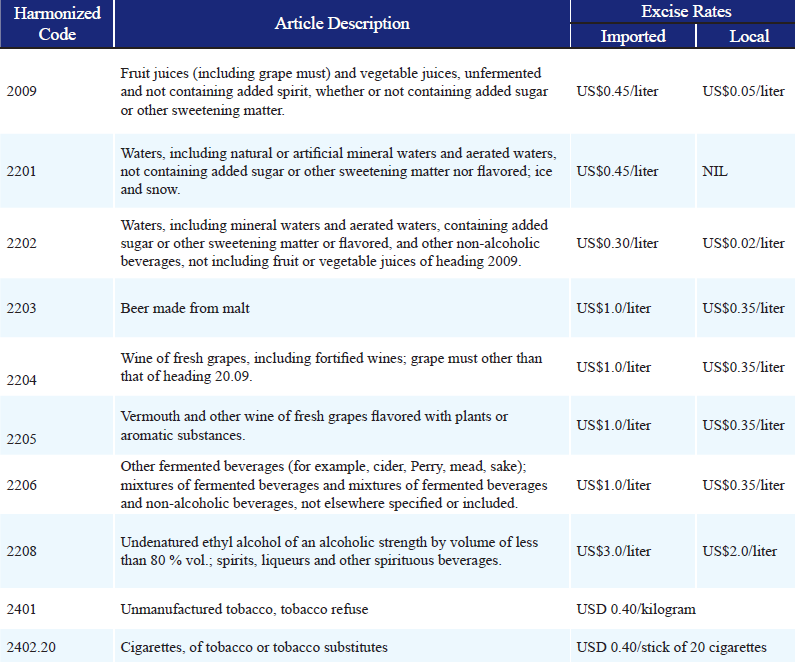
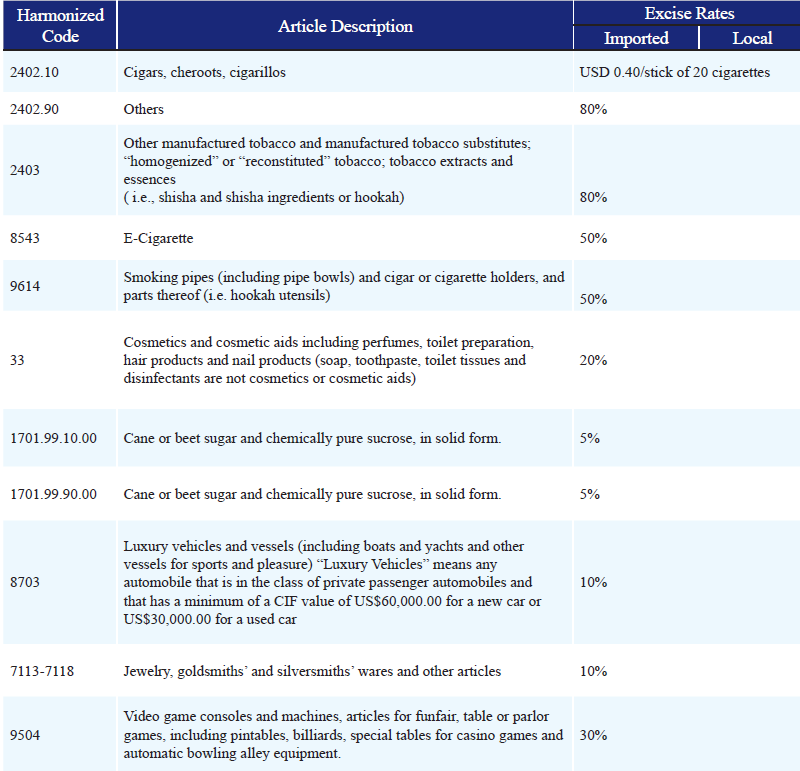
PART V. CUSTOMS REVENUE CODE
Chapter 12. GENERAL PROVISIONS
Sub-Chapter A. General
Section 1200. Customs Law of the Republic of Liberia
The Customs Law of the Republic of Liberia shall consist of Parts I and V of this title, which shall be cited as the Customs Revenue Code of 2000 and sometimes referred to as “the Customs Code” and “this Code”, the Customs Tariff; international agreements containing customs provisions insofar as they are applicable in Liberia; and the customs regulations hereto be and issued.
Section 1201. Definitions
In this Code, except in so far as the context otherwise requires, words describing the singular shall include the plural, and vice versa, the use of the masculine pronoun shall include the feminine, and the following expressions have the following meanings respectively:
(a) “Aircraft” means civil aircraft not used exclusively in the service of the Government of the Republic of Liberia or a foreign country; and includes any government-owned aircraft engaged in carrying passengers or goods for commercial purposes, and all balloons, gliders, kites, airships and flying machines.
(b) “Appraiser” means a person appointed as an appraiser of goods and includes any person authorized by law or regulation of the Commissioner General to perform such duties.
(c) “Approved” means approved by the Commissioner General or his delegate.
(d) “Approved Route” means a route designated under the provisions of Section 1401(c) or Section
1576(c) of this Code for the movement of vehicles and vessels into, out of and in transit through Liberia by land, or inland waterway.
(e) “Bearer Negotiable Instruments” includes monetary instruments in bearer form such as travellers checks; negotiable instruments, including checks, promissory notes and money orders, that are either in bearer form, endorsed without restriction, made out to a fictitious payee, or otherwise in such form that title thereto passes upon delivery; and incomplete instruments including checks, promissory notes and money orders, signed but with the payee’s name omitted.
(f) “Border” means the boundary between the Republic of Liberia and a contiguous country.
(g) “Commander” in relation to an aircraft, includes any person having or taking the charge or command of the aircraft.
(h) “Container” includes any bundle or package and any box, cask or other receptacle whatsoever.
(i) “Customs Airport” means an airport designated as a port of entry or exit under the provisions of Section 1213 of this Code.
(j) “Customs Area of Jurisdiction” means special surveillance zone along the land, sea, river and lake borders, as well as in the perimeter of ports, airports, railway stations and other points of embarkation or disembarkation for goods and persons in International travel.
(k) “Currency” means the coin and paper money of Liberia, or of a foreign country, that is designated as legal tender or is customarily used and accepted as a medium of exchange.
(l) “Customs Controls” means measures applied by the Customs to ensure compliance with customs
laws and other legislation of Liberia governing the entry, exit, transit, transfer, and storage of goods
moved between Liberia and other countries or territories, and the presence and movement within Liberia of imported goods.
(m) “Customs Liability” means the obligation of a person to pay the amount of import or export duties and taxes which apply to specific goods under the customs laws of the Republic of Liberia.
(n) “Customs Duties” means the import or export duties prescribed by the Customs tariff to which goods are liable on entering or leaving Liberia excluding other taxes and levies.
(o) “Customs Formalities” means all the operations which must be carried out by the persons concerned and by the Customs Department in order to comply with the customs laws.
(p) “Customs Port” means a place designated under the provisions of Section 1213 of this Code in
connection with the arrival and departure of vessels by sea.
(q) “Customs Station” means a place designated under the provisions of Section 1213 of this Code in connection with the arrival and departure of vehicles, vessels and persons by land and inland waterway.
(r) “Customs Status” means the status of goods as imported or domestic goods.
(s) “Customs Warehouse” means a secure place for the storage of goods placed under warehouse procedure.
(t) “Declarant” means the person who makes a goods declaration in his own name or the person in whose name such a declaration is made.
(u) “Domestic Goods” means goods which fall into any of the following categories:
(1) goods wholly obtained in Liberia and not incorporating goods imported from countries or territories outside of Liberia. Goods wholly obtained in Liberia shall not have the customs status of domestic goods if they are obtained from goods placed under the transit, the free zone, warehouse, temporary admission, or inward-processing procedure;
(2) goods brought into Liberia from countries or territories outside of Liberia and released for home use; or
(3) goods obtained or produced in Liberia either solely from the goods referred to in paragraph (2) or from goods referred to in paragraphs (1) and (2).
(v) “Drawback” means the amount of import duties and taxes repaid or remitted by the Government under the drawback procedure set out under Section 1657.
(w) “Established in Liberia” means (a) in the case of a natural person, any person who has his habitual residence in Liberia and (b) in the case of a legal person or an association of persons, any person who has his registered office, central headquarters or a permanent business establishment in Liberia.
(x) “Export Duties and Taxes” means customs duties and all other duties, taxes or charges which are collected on or in connection with the exportation of goods but not including any fees for services
prescribed by Section 1822 or collected by the Liberia Revenue Authority on behalf of another national authority.
(y) “Exporter” in relation to goods for exportation or for use as stores, includes the shipper of the goods and any person performing in relation to an aircraft or vehicle functions corresponding to those of a shipper.
(z) “Goods” means articles of all kinds and includes vessels, aircraft, vehicles, animals, stores, baggage, and currency and bearer negotiable instruments.
(aa) “Goods Declaration” means a statement made in the manner prescribed by the Commissioner
General through regulation by which the persons concerned indicate the customs procedure to be applied to the goods and furnished the particulars which the Customs Department requires for its application.
(bb) “Government” means the Government of the Republic of Liberia.
(cc) “Holder of the Goods” means the person who is the owner of the goods or who has a similar right to dispose of them or who has physical control of them.
(dd) “Import Duties and Taxes” means Customs duties and all other duties, taxes or charges which
are payable on or in connection with the importation of goods but not including any fees for services prescribed by Section 1822 or collected by the Liberia Revenue Authority on behalf of another national authority.
(ee) “Imported goods” means goods other than domestic goods.
(ff) “Importer”, in relation to any imported goods, means the person to whom or to whose order the goods is consigned, and includes any owner or other person being possessed of or beneficially interested in the goods at any time between their importation and the time when they are delivered out of customs custody.
(gg) “Inland Waterway” means any passage for a vessel into, out of, or through Liberia other than by sea.
(hh) “Land And Landing”, in relation to aircraft, include alighting on water.
(ii) “Master”, in relation to a vessel, includes any person having or taking charge of the vessel.
(jj) “Means of transport for private use” means road vehicles and trailers, boats and aircraft, together with their spare parts and normal accessories and equipment, imported or exported exclusively for personal use by the person concerned and not for the transport of persons for remuneration or the industrial or commercial transport of goods, whether or not for remuneration.
(kk) “Non-resident” means any person who does not normally reside in Liberian and temporarily enters Liberia.
(ll) “Office of Departure” means any port of entry or exit at which a customs transit operation commences.
(mm) “Office of Destination” means any port of entry or exit at which a customs transit operation is terminated.
(nn) “Officer” means an official of the Liberia Revenue Authority assigned to the Customs Department and includes commissioned and warrant and petty officers.
(oo) “Official Hours” means the time from eight o’clock antemeridian to four o’clock postmeridian Monday through Friday and from eight o’clock antemeridian to noon on Saturday, exclusive of official holidays, when customs offices shall be open and officers shall be in attendance.
(pp) “Owner”, in relation to an aircraft, includes the operator of the aircraft.
(qq) “Port Of Entry or Exit” means a place or area designated under Section 1213 of this Code.
(rr) “Refund” means the amount of import or export duty and taxes repaid by the Government to importer or exporter under the procedures set out under Section 1655 or Section 1656 of this Code.
(ss) “Release of goods” means the act whereby the Customs Department makes goods available for the purposes specified for the customs procedure under which they are placed.
(tt) “Remission” means the waiving of the obligation to pay import or export duties which have not been paid under the procedures set out under Section 1655 or Section 1656 of this Code.
(uu) “Returning resident” means any person who normally resides in Liberia and is returning from abroad;
(vv) “Shipment” includes loading into an aircraft.
(ww) “Stores” means goods for use in a vessel or aircraft and includes fuel and spare parts and other articles of equipment, whether or not for immediate fitting, and goods carried in vessels and aircraft for retail sale to passengers on board.
(xx) “Trade Defense Measures” means any quotas, quantitative restrictions, special charges or duties, or other measures imposed under authority of law providing for the protection of Liberian industries or producers against injurious imports.
(yy) “Vehicle” includes every description of carriage or other contrivance used or capable of being used as a means of transportation on land, but does not include aircraft.
(zz) “Vessel” includes every description of watercraft or other contrivance used or capable of being used as a means of transportation by water, but does not include aircraft.
(aaa) “Warehouse Proprietor” means the occupier of an authorized customs warehouse.
Section 1202. Currency Exchange
For customs purposes the rates of exchange between the Liberian dollar and other currencies shall be the market rate published by the Central Bank of Liberia and applicable on the date on which the customs liability is incurred.
Section 1203. Appointment of Agents
(a) Without prejudice to Section 1310, anything required by this Code to be done by any person may be done on his behalf by an agent.
(b) In relation to the requirements for the report and clearance of a vessel by the master thereof, it shall be lawful for those functions to be performed on his behalf by a licensed deck officer or the purser of such vessel or by a responsible member, accepted by the Commissioner for Customs as such, of the firm of agents for the vessel in Liberia; provided that nothing contained in this Section shall thereby relieve a master of any liability or penalty provided under the customs law in connection with the report and clearance of vessels.
(c) In relation to the requirements for the report and clearance of an aircraft by the commander thereof, it shall be lawful for those functions to be performed by another member of the crew of the aircraft or by a person authorized to act for the owner or operator of the aircraft, provided that nothing contained herein shall relieve the commander or the owner or operator of the aircraft of any liability or penalty in connection with the report and clearance of aircraft.
(d) If required, authority for a person to act as an agent for another person shall be given in writing by that other person in such form and manner as the Commissioner General may prescribe.
Section 1204. Rules and Forms Prescribed by the Commissioner General
(a) In addition to the specific powers conferred by this Code, the Commissioner General is authorized to prescribe forms of declarations, security, and other documents, and rules and regulations not inconsistent with law, to be used in carrying out the provisions of this Code, and shall give such directions to customs officers and prescribe such rules and forms to be observed by them as may be necessary for the proper execution of the law.
(b) Before the promulgation of any rule or regulation implementing the provisions of this Code, the
Commissioner General shall ensure that interested persons are notified and provided a reasonable
opportunity to comment on the proposed rule or regulation unless he determines that such notification and comment is impracticable, unnecessary or contrary to the public interest.
(c) The Commissioner General shall ensure that any rule or regulation issued under this Code shall be
published not less than 30 days prior to its entry into force, unless he finds that such prior publication is precluded due to urgent circumstances or other good cause, which reasons shall be published with the rule or regulation.
Section 1205. Military Aircraft and Vessels
Military aircraft or vessels belonging to a foreign government which are not engaged in any civilian or commercial activity and which enter Liberia by permission of the Government shall not be subject to the customs laws.
Sections 1206-1209. Reserved
Sub-Chapter B. Customs Administration
Section 1210. Power of Commissioner General to Secure Uniform Assessment of Duties
For the purpose of obtaining uniformity, the following powers and directives shall be applicable to the revenue laws relating to customs:
(a) Powers of the Commissioner General. The Commissioner General shall establish and promulgate
such rules and regulations not inconsistent with law and may disseminate such information as may be necessary to secure a just, impartial and uniform account and valuation of imported and exported goods, and the classification and assessment of duties thereon at the various ports of entry.
(b) Procedure for Reversal of Commissioner General’s Ruling. No ruling or decision, once made by the Commissioner General, giving construction to any law imposing customs duties shall be reversed or modified adversely to the Republic of Liberia by the same or a succeeding Commissioner General, except in concurrence with an opinion of the Minister of Justice recommending the same or a final decision of the Tax Court.
(c) Commissioner General’s Rulings to be Binding on Customs Officers. It shall be the duty of all officers of the Customs Department to execute and carry into effect all instructions of the Commissioner General relative to the execution of the revenue laws relating to customs and in case any difficulty arises as to the true construction or meaning of any part of the revenue laws, the decision of the Commissioner General shall be binding upon all officers of the Customs Department.
Section 1211. Customs Seal
The Customs Seal of the Republic of Liberia, or its electronic equivalent pursuant to Section 105 of this Act, shall be impressed upon all official documents requiring the impress of the seal. The original counterpart of a goods declaration and supporting documents which are delivered to the declarant for the purpose of obtaining release from customs custody of imported goods shall bear the impress of the customs seal.
Section 1212.Customs Flag
(a) Design. The Liberia Revenue Authority shall use and display at customhouses, other customs
buildings, business offices, and stations, and on boats employed by the Customs Department a customs flag which shall have the following described form and design. It shall be the same shape and proportion as the national flag with five vertical red stripes and six vertical white stripes, and in the upper field there shall be a square of white with a single blue star therein.
(b) Authorized Display. The customs flag shall be displayed only as herein authorized:
(1) All boarding boats of the Customs Department shall fly the customs flag in the bow and the national flag in the stern.
(2) All customhouses, customs buildings, business offices, and stations shall fly the customs flag on the same staff beneath the national flag.
Section 1213.Ports Of Entry or Exit
(a) Port of Entry or Exit, which may be referred to as “Customs Port”, Customs Airport” or “Customs
Station”, as appropriate, shall refer to any place or area in Liberia designated by or under any act of
the National Legislature or by an Executive Order of the President at which the Customs Department
is assigned to receive declaration of imported or exported goods, to authorize and control the clearance thereof, to collect customs duties and taxes thereon , to administer the various provisions of the customs law and Liberia Revenue Authority Act; and such designation shall specify the name, location and exact limits of each port of entry or exit.
(b) Any such port of entry or exit existing on the effective date of the commencement of the provisions of this Code shall be deemed to be so designated under the provisions of the Code, provided that the Commissioner General, Legislature by its act or the President by executive order may revoke or vary the designation made, or deemed to have been made, in accordance with this Section and may designate additional places and areas to be ports of entry as the public interest may require.
(c) Without prejudice to any other provisions of this Code relating to the provision of accommodation of customs officers, any person responsible for the administration of any port of entry or exit shall provide for the use of officers appointed to that port of entry or exit, to the satisfaction of the Commissioner General, suitable living accommodation (where required by the Commissioner General) and modern office accommodation together with the necessary furniture, toilet facilities, cleaning, general maintenance, electricity, air condition, Internet, WAN AND LAN connectivity, computers, servers and related equipment, required software licenses, communication equipment CCTV and all other equipment, tools, vehicles and all other facilities including warehouses and examination sheds, security gate(s) and offices that enable customs officers to carry out their function to the satisfaction of the Commissioner General free of expense to the Government.
Section 1214.Customs Control; Prohibitions and Restrictions
(a) Goods brought into Liberia shall, from the time of their arrival to Liberia, be subject to customs
controls.
They shall remain under such control for as long as necessary to determine their customs status. Imported goods shall remain under customs control until they are released for home use, exported, destroyed or abandoned.
(b) Domestic goods declared for export shall be subject to customs controls, from the time of acceptance of the declaration placing them under such procedure.
Such goods shall remain under customs control until the time of their exportation or until they are abandoned or destroyed or the customs declaration is invalidated.
(c) The Customs Department may, in accordance with laws of Liberia, apply such prohibitions and
restrictions to goods under its control as are justified on grounds of, inter alia, public morality, public
policy or public security, the protection of the health and life of humans, animals or plants, the protection of the environment, the protection of national treasures possessing artistic, historic or archaeological value and the protection of industrial or commercial property, including controls on drug precursors, goods infringing certain intellectual property rights, and currency or bearer negotiable instruments entering or leaving Liberia, as well as to the implementation of fishery conservation and management measures and of commercial policy measures.
The competent authority, in consultation with the Commissioner General, may by regulation adopt
such measures as required for the Customs Department’s implementation and enforcement of such
prohibitions and restrictions. The Customs Department shall collaborate and make regular report on
the execution of the prohibitions and restrictions to the competent authority and shall include such
information and statistics in its national reporting.
Section 1215.Third-Party Shipment Inspection
(a) Definitions. In this Section-
(1) “Shipment inspection” means the verification of the quality, the quantity, the volume, the price,
including the currency exchange rate and financial terms, and/or the tariff classification of goods.
(2) “Shipment inspection entity” means any entity contracted or mandated by the Commissioner
General to carry out shipment inspection.
(b) Appointment. Without prejudice to Section 1520, the Commissioner General may, subject to such
conditions and terms as he deems appropriate,-
(1) subject to legal provisions concerning public procurement of goods, works or services by the
government of Liberia or its ministries, departments and agencies, appoint a shipment inspection
entity to carry out shipment inspection;
(2) require shipment inspection of goods prior to their export to, and/or after their arrival in, Liberia;
and
(3) require shipment inspection of goods prior to their export from Liberia.
(c) Regulations. The Commissioner General shall by regulation adopt measures to implement any
shipment inspection instituted under subsection (b) of this Section. To the extent that the third party
inspection covers quality and standards of goods, the regulations and procedures establishing the quality standards will be promulgated by the Ministry of Commerce or the competent authority in consultation with the Commissioner General and for the enforcement by the Customs Department at the ports of entry.
(d) Administrative Fine. The Minister in consultation with the Commissioner General shall by regulation define administrative fines for violations of regulations issued pursuant to subsection (c) of this Section, provided that:
(1) the amount of any such administrative fine shall not exceed the customs value of the goods concerned, as that value is determined by the Customs Department; and
(2) for purpose of the assessment, collection and administrative protest, any such administrative fine shall be treated as a customs levy.
Section 1216.Immunity from Liability
The Commissioner General, Deputy Commissioners General, the Commissioner of Customs or the officers involved, shall not be in any way liable to any person for or on account of any rulings or decisions as to the classification of any imported or exported goods or the duties charged thereon, or the collection of any duties, taxes or other customs charges on or on account of said goods, or any other matter or things as to which such person might under this Code be entitled to protest or appeal from the decision thereon of the Commissioner General, Deputy Commissioners General, the Commissioner for Customs, or the other officers involved.
Section 1217.Delegation of Authority
(a) Without prejudice to the laws of Liberia concerning functions and authorities of the Liberia Revenue Authority, the Commissioner General or Commissioner for Customs, as the case may be, may delegate in whole or in part any function or action he/she is authorized to perform under this Code to any subordinate officer or employee of Liberia Revenue Authority, provided that any delegation made by the Commissioner of Customs shall be made in consultation with the Commissioner General.
(b) A delegation under this Section shall be in writing, shall be published, shall be subject to such terms, conditions, and limitations as the delegating official may deem advisable, and shall be revocable at any time by such official in whole or in part.
Sections 1218-1219. Reserved
Sub-Chapter C. Provision of Information
Section 1220.Exchange of Additional Information between Customs and Economic Operators
(a) The Liberia Revenue Authority and persons whose activities are covered by the customs laws may
exchange any information not specifically required under such laws, in particular for the purpose of
mutual cooperation in the identification and counteraction of risks. That exchange may take place under a written agreement and may include access to the computer systems of such persons by the Liberia Revenue Authority.
(b) Any information provided by one party to the other in the course of the cooperation referred to in
subsection (a) shall be confidential unless both parties agree otherwise.
Section 1221.Provision of Information by the Liberia Revenue Authority
(a) At the request of an interested person, the Liberia Revenue Authority shall provide free of charge
information concerning the application of the customs laws.
(b) The Liberia Revenue Authority shall issue and publish such forms, notices, and explanations as may be necessary for persons to comply with the provisions of the customs laws.
(c) Wherever feasible, the Liberia Revenue Authority shall make promptly and freely available via the
Internet any regulations issued under this Code, general administrative rulings, and any other decisions, notifications, explanations, forms or other information that is required or authorized to be published under the customs laws.
Section 1222.Consultations
The Liberia Revenue Authority shall maintain a regular dialogue with persons whose activities are covered by the customs law and other authorities involved in international trade in goods.
Section 1223.Provision of Information to the Liberia Revenue Authority
(a) Any person directly or indirectly involved in the accomplishment of customs formalities or in customs controls shall, at the request of the Liberia Revenue Authority and within any time limit specified, provide those authorities with all the requisite documents and information, in an appropriate form, and all the assistance necessary for the completion of those formalities or controls.
(b) The lodging of any declaration or the submission of an application for a license or other decision,
shall render the person concerned responsible for the following:
(1) the accuracy and completeness of the information given in the declaration or application;
(2) the authenticity of any documents lodged or made available;
(3) where applicable, compliance with all of the obligations relating to the placing of the goods in
question under the customs procedure concerned, or to the conduct of the authorized operations.
Paragraph (1) of this subsection shall apply also to the provision of any information in any other form
required by or given to the Liberia Revenue Authority.
Where the declaration is lodged, the application is submitted or information is provided by an agent of the person concerned, the agent shall also be bound by the obligations set out in paragraph (1) of this subsection.
(c) The provisions of Section 54 of this Code shall apply mutatis mutandis to information which is
acquired by the Customs Department or its officers, agents or employees in the course of performing
their duties, and which is by its nature confidential or which is provided on a confidential basis.
Sections 1224-1234. Reserved
Sub-Chapter D. Customs Decisions
Section 1235.General Provisions
(a) Where a person makes a request under the customs laws for a decision by the Liberia Revenue
Authority or a department or officer thereof, that person shall supply all the information required by the Liberia Revenue Authority in order to be able to take that decision.
A decision may also be requested by, and taken with regard to, several persons, in accordance with the conditions prescribed by the customs laws.
(b) Except where otherwise provided for in the customs laws, a decision as referred to in subsection (a) shall be taken, and the applicant notified, without delay, and at the latest within four months of the date on which the Liberia Revenue Authority receives all the information required in order to be able to take that decision.
However, where the Liberia Revenue Authority is unable to comply with those time limits, the applicant shall be informed of that fact before the expiration of those time limits, given the reasons for the delay, and provided an indication of the further period of time which is considered necessary to make a decision on the request.
(c) Except where otherwise specified in the decision or in the customs laws, the decision shall take effect from the date on which the applicant receives the decision, or is deemed to have received it, and shall be enforceable by the Liberia Revenue Authority from that date.
(d) Before taking a decision which would adversely affect the person or persons to whom it is addressed, the Liberia Revenue Authority shall communicate the grounds, including the applicable provisions of the customs laws on which the Liberia Revenue Authority intends to base the decision, to the person or persons concerned who shall be given the opportunity to express their point of view within a period prescribed from the date on which the communication was made.
Following the expiration of that period, the person concerned shall be notified, in writing, of the decision, which shall set out the grounds, including the applicable provisions of the customs laws, on which it is based. The decision shall refer to the person’s rights of appeal under this Code.
(e) The Commissioner General shall by regulation adopt measures to implement this Section, including the following:
(1) the cases in which and conditions under which the first paragraph of subsection (d) shall not apply; and
(2) the period referred to in the first paragraph of subsection (d).
(f) The Commissioner General may at any time annul, amend or revoke a previously-issued decision where it does not conform to the customs laws.
(g) Subsections (c), (d), and (e) of this Section, Section 1236 and Section 1237 shall also apply to the assessment of administrative fines and civil penalties under this Code and other decisions taken by the Liberia Revenue Authority without prior request from the person concerned.
Section 1236.Annulment of Favorable Decisions
(a) A decision favorable to the person to whom it is addressed shall be annulled if all the following
conditions are satisfied:
(1) the decision was issued on the basis of incorrect or incomplete information;
(2) the applicant knew or ought reasonably to have known that the information was incorrect or incomplete;
(3) if the information had been correct and complete, the decision would have been different.
(b) The person to whom the decision was addressed shall be notified of its annulment.
(c) Annulment shall take effect from the date on which the initial decision took effect, unless otherwise specified in the decision in accordance with the customs laws.
Section 1237.Revocation and Amendment of Decisions
(a) A favorable decision shall be revoked or amended where, in cases other than those referred to in
Section 1236, one or more of the conditions required for its issue were not or are no longer fulfilled.
(b) Except where otherwise specified in the customs laws, a favorable decision addressed to several
persons may be revoked only in respect of a person who fails to fulfill an obligation imposed under that decision.
(c) The person to whom the decision was addressed shall be notified of its revocation or amendment.
(d) Section 1235(c) shall apply to the revocation or amendment of the decision. However, in exceptional cases where the legitimate interests of the person to whom the decision was addressed so require, the Liberia Revenue Authority may defer the date on which revocation or amendment takes effect.
Section 1238.Binding Decisions
(a) The Customs Department shall, on request of an importer, exporter or other person with a justifiable cause, issue a binding decision on the tariff classification of goods, the origin of goods, or such other matters as the Commissioner General may prescribe by regulation.
(b) No binding decision shall be issued where the request-
(1) concerns a current or completed customs transaction;
(2) presents questions or transactions that are hypothetical in nature; or
(3) presents a question that is pending before a court of Liberia in which the Government of Liberia or any of its officers is a party.
(c) A decision shall be binding on the Liberia Revenue Authority, as against the recipient of the decision, only in respect of goods for which customs formalities are completed after the date on which the decision takes effect. The decision shall be binding on the recipient of the decision, as against the Liberia Revenue Authority, only with effect from the date on which he receives, or is deemed to have received, notification of such decision.
(d) The Commissioner General shall prescribe by regulation the validity periods of binding decisions;
provided, however, an origin decision shall be valid for a period of not less than three years from the
date on which the decision takes effect.
(e) The application of a binding decision to the transaction to which it is purported to relate is subject
to verification by the Liberia Revenue Authority of the facts incorporated in the decision letter, a
comparison of the transaction described therein to the actual transaction, and the satisfaction of any
conditions on which the decision was based.
(f) Notwithstanding anything contained in this Code, a binding decision shall be annulled where it is
based on inaccurate or incomplete information from the applicant.
(g) The Commissioner General shall by regulation prescribe the form, content and manner of submission of requests for binding decisions and any further measures for the implementation of this Section.
Section 1239.Administrative Protest
(a) Decisions Subject to Protest. This section applies to the following decisions of officers of the Liberia Revenue Authority—
(1) the assessment of customs duties, taxes or fees, including all underlying findings and determinations as to:
(A) the customs value of the goods
(B) the tariff classification of the goods
(C) the country of origin of the goods
(D) the rate and amount of import or export duties and taxes or fees assessed; or
(E) the person liable to pay the amount charged or the amount of his liability;
(2) the refusal to pay a claim for drawback;
(3) the refusal to refund customs duty under Section 1655 or Section 1656 of this Code; and
(4) a binding decision issued under Section 1238 of this Code.
(b) Right of Protest. Any -
(1) person whose liability to pay any customs duties, taxes, or fees is determined by, results from, or is or will be affected by a decision under this section, or
(2) person in relation to whom, or on whose application, a decision under this section has been made may submit a protest to the Liberia Revenue Authority to require its review of that decision.
(c) Time of Filing. A protest of a decision shall be filed with the Liberia Revenue Authority no later than 30 days after -
(1) the date the assessment notice, or amended assessment notice, under Section 1637 is served on
the person with respect to decisions described in paragraph (1) of subsection (a) of this Section, or
(2) the date the decision as to which protest is made is served on the person, in all other circumstances.
(d) Review. On receipt of a protest, the Liberia Revenue Authority shall review the protested decision and may either—
(1) confirm the decision; or
(2) modify or reverse the decision and take such further steps, if any, in consequence of the modification or reversal as it deems appropriate.
Review of a protest shall be undertaken by one or more officers or other persons as the Commissioner General shall designate who shall be independent of the officer who made the decision under protest.
(e) Deemed Confirmation. Where the Liberia Revenue Authority does not notify the protestant of their determination on the review within a period of 60 days from the date the protest was submitted, the Liberia Revenue Authority shall be assumed for the purposes of this section to have confirmed the decision that is being protested.
(f) Rights of Further Appeal. The protestant may appeal a decision of the Liberia Revenue Authority
under subsection (d), or a deemed confirmation under subsection (e), by notifying an appeal within 30 days of the date of such decision or deemed decision to either-
(1) the Board of Tax Appeals pursuant to Section 61 of this Act, and for such purposes the decision or deemed decision of the Liberia Revenue Authority shall be considered a determination of the
Commissioner General, or
(2) a court of competent jurisdiction.
(g) Obligation to Pay. The obligation to pay any customs duty, tax, or fee under this Code shall not be suspended by a protest made under this Section.
(h) Refund and Credit. If the protested decision is modified or reversed, the Liberia Revenue Authority shall
- if so requested in writing by the protesting taxpayer, credit the amount of any customs duty, taxes or fees found to have been collected in excess against the liability of the protesting taxpayer for future payment of such amounts, or
- recommend to the Minister that he remit or refund immediately any such amounts found to have
been collected in excess, or pay any drawback or refund found due.
(i) Finality of Decisions. Decisions under subsection (a) shall be final and conclusive upon all persons (including the government and any officer thereof) unless a protest is filed in accordance with this section, or unless an appeal against the Liberia Revenue Authority’s confirmation (or deemed confirmation) of the decision is taken pursuant to subsection (f) within the time prescribed by that subsection. When the decision on further appeal under subsection (f) becomes final, a copy of that decision shall be transmitted to the Liberia Revenue Authority which shall take action accordingly.
(j) Regulations. The Commissioner General shall by regulation adopt measures as necessary to implement this Sub-Chapter, including:
(1) the required form and content of a protest;
(2) the place or persons to whom a protest shall be addressed; and
(3) the conditions under which a protest may be amended.
Sections 1240-1299. Reserved
Chapter 13. LICENSED ACTIVITIES AND AUTHORIZED PLACES
Sub-Chapter A. General
Section 1300. Definitions
As used in this Chapter:
(a) The term “customs broker” means any person granted a customs brokers license by the Liberia Revenue Authority under Section 1311.
(b) The term “bonded carrier” means any person granted a bonded carrier license by the Liberia Revenue Authority under Section 1321.
(c) The term “customs business” means those activities involving transactions with the Customs
Department concerning the declaration and release of goods, the tariff classification and valuation
of goods, and the payment of customs duties, taxes, or other charges assessed or collected by the
Customs Department upon goods by reason of their importation or exportation, or the refund,
remission, or drawback thereof. It also includes the preparation of documents or forms in any format and the electronic transmission of documents, invoices, bills, or parts thereof, intended to be filed with the Customs Department in furtherance of such activities, whether or not signed or filed by the preparer, or activities relating to such preparation, but does not include the mere electronic transmission of data received for transmission to the Customs Department.
(d) The term “customs controlled area” means any location or facility that is described by Section 1325 of this Code.
Section 1301.Revocation or Suspension of Licenses; Hearings and Appeal
(a) Where the Liberia Revenue Authority intends to revoke or suspend a license issued under this Chapter, the licensee shall be notified and provided an opportunity to respond.
(b) If a response is filed, or the Liberia Revenue Authority determines that the revocation or suspension is still warranted, the Liberia Revenue Authority shall notify the licensee in writing of a hearing to be held within 5 business days, or at a later date if the licensee requests an extension and shows good cause therefore, before a qualified panel of the Liberia Revenue Authority as the Commissioner General may appoint for the hearing. If the licensee waives the hearing, or the licensee or his designated representative fails to appear at the appointed time and place, the appointed panel shall make findings and recommendations based on the record before the panel.
At the hearing, the licensee may be represented by counsel, and the hearing shall be conducted in
accordance with the Administrative Procedure Act.
(c) Except when a hearing is conducted directly by the Commissioner General under the provisions of subsection (b), in which event his determination therein shall be the final administrative determination, a licensee aggrieved by a determination made by a hearing officer pursuant to the provisions of subsection (b) may appeal to the Commissioner General for a final administrative determination by filing in the office of the Commissioner General within 10 days after receipt of notice of such determination a request for such final administrative determination.
An appeal to the Board of Tax Appeals may be taken by any licensee from any determination of the Commissioner General suspending or revoking a license in accordance with the provisions of Section 59.
Sections 1303-1309. Reserved
Sub-Chapter B. Customs Brokers
Section 1310. Requirement of a License
No person may conduct customs business (other than solely on behalf of that person) unless that person holds a valid customs broker license issued by the Liberia Revenue Authority under Section 1311.
Section 1311.Issuance of a Customs Broker License
(a) The Liberia Revenue Authority may grant an individual a customs broker license only if that
individual is a citizen of Liberia. Before granting the license, the Liberia Revenue Authority may require an applicant to show any facts deemed necessary to establish that the applicant is of good moral character and qualified to render valuable service to others in the conduct of customs business. In assessing the qualifications of an applicant, the Liberia Revenue Authority shall conduct an examination to determine the applicant’s knowledge of customs and related laws, regulations and procedures, bookkeeping, accounting, and all other appropriate matters. The licensee must adhere to the rules, standards and code of conduct set by the Liberia Revenue Authority in order to maintain his license.
(b) The Liberia Revenue Authority may grant a customs broker license to any corporation, association, or partnership that is organized or existing under the laws of Liberia if at least one officer of the corporation or association, or one member of the partnership, holds a valid non-transferable customs broker license granted under subsection (a) of this Section at all times.
(c) A customs broker shall exercise responsible supervision and control over the customs business that it conducts and shall adhere at all time to the standards, rules and code of conduct established by the Liberia Revenue Authority.
Section 1312. Grounds for Revocation by Liberia Revenue Authority
Without prejudice to the application of the provisions on Customs decisions prescribed by Sub-Chapter D of this Code, the Liberia Revenue Authority shall revoke or suspend a license of any customs broker, if it is shown that the broker-
(a) has made or caused to be made in any report filed with the Liberia Revenue Authority, any statement which was, at the time and in light of the circumstances under which it was made, false or misleading with respect to any material fact, or has omitted to state in any such report any material fact which was required to be stated therein or failed to adhere to the standards, rules, and code conduct set by the Liberia Revenue Authority;
(b) has been convicted at any time after the filing of an application for the customs broker license of any felony or misdemeanor which the Liberia Revenue Authority finds—
(1) involved the importation or exportation of goods;
(2) arose out of the conduct of its customs business; or
(3) involved larceny, theft, robbery, extortion, forgery, counterfeiting, fraudulent concealment, embezzlement, fraudulent conversion, or misappropriation of funds;
(c) has violated any provision of the Liberia Revenue Code;
(d) has counselled, commanded, induced, procured, or knowingly aided or abetted a violation by any
other person of any provision of any of the customs laws;
(e) has knowingly employed, or continues to employ, any person who has been convicted of a felony,
without written approval of such employment from the Liberia Revenue Authority; or
(f) has, in the course of its customs business, with intent to defraud, in any manner willfully and knowingly deceived, misled or threatened any client or prospective client.
Section 1313. Revocation by Operation of Law
The failure of a customs broker that is licensed as a corporation, association, or partnership under Section 1311 to have, for any continuous period of 120 days, at least one officer of the corporation or association, or at least one member of the partnership, validly licensed under subsection (a) of that Section shall, in addition to causing the broker to be subject to any other sanction under this Code, result in the revocation by operation of law of its license.
Section 1314. Regulations
The Commissioner General shall set minimum standards and prescribe regulations relating to the customs business of customs brokers as the Commissioner General considers necessary to protect importers and the revenue of Liberia and to carry out the provisions of this Section, including rules and regulations governing the licensing of customs brokers, the keeping of books, accounts and records by customs brokers, and documents and correspondence, and the furnishing by customs brokers of any other information relating to their customs business to the Liberia Revenue Authority .
Sections 1315-1319. Reserved
Sub-Chapter C. Bonded Carriers
Section 1320. Requirement of a License
No person may transport imported goods from one point to another within Liberia unless that person holds a valid bonded carrier license issued by the Liberia Revenue Authority under Section 1321; provided, however, that in places where no bonded carrier is reasonably available such goods may be transported other than by a bonded carrier under such regulations as the Commissioner General shall prescribe.
Section 1321. Issuance of a Bonded Carrier License
Under such regulations and subject to such terms and conditions as the Commissioner General shall prescribe—
(a) any common carrier of goods owning or operating a railroad, steamship, or other transportation line or route for the transportation of merchandise in Liberia,
(b) any contract carrier authorized to operate as such by any agency of Liberia, and
(c) any freight forwarder authorized to operate as such by any agency of Liberia, upon application and provision of a security, may be issued a license as a bonded carrier by the Liberia Revenue Authority.
A private carrier, upon application, may be licensed as a bonded carrier by the Liberia Revenue Authority, subject to regulations and, in the case of each applicant, to such special terms and conditions as the Commissioner General may prescribe to safeguard the revenue of Liberia with respect to the transportation of goods by such applicant.
Sections 1322-1324. Reserved
Sub-Chapter D. Customs-Controlled Areas
Section 1325.Customs Controlled Areas
Subject to such exemptions as the Customs Department may allow under Section 1328(d) of this Code, no area shall be used for the following purposes unless authorized by the Liberia Revenue Authority as a customs controlled area:
(a) the processing of any vessel or aircraft arriving in or departing from Liberia or the loading or unloading of goods onto or from such vessels or aircraft;
(b) the temporary storage of goods imported at a port of entry or exit and not yet released by the Customs Department, including any goods not yet declared in accordance with this Code (including holding such goods while they are awaiting examination) and any goods seized as liable to forfeiture;
(c) the embarkation, disembarkation or processing of persons arriving in or departing from Liberia; or
(d) as a customs warehouse.
Section 1326. Application for Authorization
An application for an area to be authorized as a customs controlled area may be made by the owner or occupier of, or person operating in, the area and shall be made in such form and shall contain such particulars as the Commissioner General may by regulation prescribe.
Section 1327. Provision of Security
An applicant for an authorization to operate a customs controlled area shall be required to provide a guarantee to secure the Government against any loss or expense connected with or arising from the deposit, storage, or manipulation of goods in such area.
Section 1328. Authorization Decisions
(a) Subject to the provisions on customs decisions set out in Sub-Chapter D of Chapter 12 of this Code, the Customs Department may grant or refuse an application for an authorization made under Section 1326, or revoke, amend or annul an issued authorization.
(b) Section 1301 of this Code shall apply, mutatis mutandis, to a decision of the Customs Department to revoke, amend or annul such authorizations.
(c) The grant of an authorization shall be subject to such terms, conditions, or restrictions as the Commissioner General shall prescribe by regulation and the payment by the applicant of the prescribed fee, if any.
(d) The authorization shall—
(1) specify the area in respect of which it is granted;
(2) specify the applicant as the authorized person; and
(3) specify the purpose or purposes described in subsections (a) to (d) of Section 1325 of this Code for which the area is authorized.
(e) Where, on an application for an area to be authorized as a customs controlled area, the Liberia Revenue Authority is of the opinion that it is not in the public interest or it is impracticable or unnecessary that the area should be authorized as a customs controlled area, the Liberia Revenue Authority may, in its discretion, consistent with regulation promulgated by the Commissioner General and under such conditions as it thinks fit, direct that the area need not be authorized as a customs controlled area.
(f) The Customs Department may authorize a customs warehouse for use by any person for the
warehousing of goods (public customs warehouse) or for the storage of goods by the authorized person only (private customs warehouse).
(g) A direction given under subsection (d) of this Section may be given in respect of the whole or any
specified part of the business carried on in the area, and shall exempt the area from such provisions of this Code as may be specified in the direction.
Section 1329.Surrender of Authorization
An authorization to operate a customs controlled area may be surrendered at any time by the authorized person by the giving of one month’s notice in writing to the Customs Department.
Section 1330. Closing of Customs Controlled Area
Where any authorization issued under Section 1328 of this Code is annulled, revoked, or surrendered, duty shall thereupon become due and payable on all goods within that area that are or were subject to the control of the Customs Department immediately prior to the annulment, revocation, or surrender, unless the Customs Department permits the goods to be removed to another customs controlled area or placed under a customs procedure.
Section 1331. Liabilities Not Affected by Ceasing to Act as Authorized Person
The obligations and liabilities under this Code of an authorized person in respect of anything done or omitted to be done by the authorized person while authorized shall not be affected by the fact that the authorized person ceases to act as such nor by the fact that the authorization is annulled, revoked, or surrendered.
Section 1332. Customs Facilities in Customs Controlled Areas
(a) The person authorized to operate of any customs controlled area authorized under this Code shall
provide and maintain without charge to the Government such operating areas, living accommodation
(where applicable) and office accommodation together with the necessary furniture, toilet facilities,
cleaning, general maintenance, electricity, air condition, Internet, equipment, tools and all other
facilities including warehouses and examination sheds that enable the Customs Department to carry out its function to the satisfaction of the Commissioner General.
(b) The person authorized to operate every customs controlled area shall store goods subject to the
control of the Customs Department in such manner and in such location as prescribed by regulation.
Section 1333. Storage charges
In such circumstances and for such period of time as may be prescribed, no charges shall be made by the person authorized to operate a customs controlled area for the reception or storage in that area of any imported goods at no cost to the Liberia Revenue Authority.
Section 1334. Officers Not to Own or Lease Customs Controlled Areas
No officer, employee, agent, contractor or persons otherwise affiliated with the Liberia Revenue Authority shall own, in whole or in part, any place used as a customs warehouse or other customs controlled area or enter into any contract or agreement for the lease or use of any such place with a view to its subsequent use as a customs warehouse or other customs controlled area.
Section 1335. Records
The person authorized to operate any customs controlled area shall keep records and submit such reports in the form and manner prescribed by regulation. The records must enable the Customs Department to supervise the customs controlled area in all respects and particularly with regards to the identification of goods placed therein, their customs status and their movements and the customs duties and taxes thereon and required domestic taxes.
Section 1336. Regulations
The Commissioner General shall by regulation prescribe such measures as may be necessary for the establishment of customs controlled areas, to protect the revenue and interests of the Government in the conduct, management and operation of such areas, and in the withdrawal of and accounting for goods deposited therein.
Sections 1337-1399. Reserved
Chapter 14. ARRIVAL AND DEPARTURE OF GOODS, PERSONS AND CONVEYANCES
Sub-Chapter A. Arrival of Vessels, Vehicles, and Aircraft
Section 1400.Advance Conveyance and Cargo Declarations
(a) Except as may be provided by regulation, the person in charge of a vessel, aircraft or vehicle that
is due to arrive to Liberia from a place outside Liberia shall provide an advance declaration of the
following matters—
(1) the impending arrival of the vessel, aircraft or vehicle;
(2) its voyage;
(3) its crew;
(4) its passengers;
(5) a cargo declaration of all goods to be brought into Liberia, whether or not intended for discharge
within Liberia; and
(6) the port of entry or exit or other place at which the aircraft, vessel or vehicle will arrive.
(b) The owner or operator of the vessel, aircraft or vehicle referred to in subsection (a) of this Section,
or an agent of the owner or operator, may provide the information referred to in subsection (a) on behalf of the person in charge of the vessel, vehicle or aircraft.
(c) The Commissioner General shall by regulation adopt measures necessary for the implementation of this Section, which shall include-
(1) the form, content, and manner of submission of the declarations required by this Section;
(2) the time limits for submission of such declarations, and any exceptions or variations therefrom; and,
(3) the cases in which the requirement for the notifications set out in subsection (a) of this Section may be waived or adapted, and the conditions under which such notifications may be waived or adapted.
In adopting such measures, the Commissioner General may allow for variation to take into account different types of goods traffic, modes of transport, or economic operators, or international agreements which provide for special security arrangements.
Section 1401. Place of Arrival
(a) The person in charge of a vessel or an aircraft –
(1) that arrives to Liberia from a point outside Liberia; or
(2) that is carrying passengers or goods brought from a place outside Liberia and not yet cleared on
importation shall not cause or permit the vessel or aircraft to call or land at any place in Liberia other than a port of entry or exit which, in the case of vessels or aircraft to which Section 1400 applies, shall be the port of entry or exit declared by that person in accordance with that Section.
(b) Any person importing or concerned with importing any goods in a vessel or aircraft shall not bring the goods into Liberia at any place other than a port of entry or exit.
(c) The person in charge of any vehicle or vessel entering Liberia by land or inland waterway shall
proceed at once with his vehicle or vessel to the customs station nearest to the point at which he shall have crossed the border into Liberia by such approved routes as may be designated by the Liberia Revenue Authority.
(d) On application by the person in charge of a vessel, aircraft, or vehicle, the Customs Department may permit that person to bring the vessel or aircraft to a place other than a port of entry or exit, subject to such conditions (if any) as the Customs Department may specify.
(e) A vessel, aircraft or vehicle after arriving in Liberia shall not-
(1) depart from the port, place, or airport of arrival; or
(2) discharge any passenger until a declaration of arrival in accordance with Section 1403 of this Code has been made, unless authorized to do so by the Customs Department.
Section 1402. Unforeseeable Circumstances and Force Majeure
(a) Where, by reason of unforeseeable circumstances or force majeure, the obligations set out in Section 1401 cannot be met, the person bound by that obligation or any other person acting on that persons’ behalf shall inform the Customs Department of the situation without delay. Where the unforeseeable circumstances or force majeure do not result in total loss of the goods, the Customs Department shall also be informed of their precise location.
(b) The Customs Department shall determine the measures to be taken in order to permit customs controls of the vessel or aircraft and any goods thereon in the circumstances specified in subsection (a) and to ensure, where appropriate, that they are subsequently conveyed to a customs airport or customs port or other place designated or approved by the Liberia Revenue Authority.
(c) In the case of the circumstances described in subsection (a) of this Section, the person in charge of
the vessel or aircraft involved shall reimburse the Government at rates prescribed by regulation for the cost of providing the necessary attendance by the Customs Department and other relevant Government agencies including the cost of the compensation due to, and any expense incurred by, those authorities.
Section 1403.Declaration of Arrival
(a) Arrival by Sea or Air. Declaration of arrival of every vessel or aircraft entering Liberia from a place
outside Liberia shall be made by the person in charge of such vessel or aircraft, or his authorized agent, in the form and manner prescribed by regulation, to the Customs Department-
(1) at the customs port or airport of first arrival in Liberia; and
(2) at each subsequent customs port of call or airport at any time whilst it is carrying passengers or
goods brought from a place outside Liberia and not yet cleared on importation.
(b) Sea and Air Arrival: Time Limit. The declaration specified in subsection (a) shall be made-
(1) in the case of a ship, before
- the end of 24 hours (excluding any period that occurs on a Sunday or official holiday) after the ship’s arrival; or
- the issue of a Certificate of Clearance in respect of the ship and the port; whichever first happens; or
(2) in the case of an aircraft, before
- the end of 3 hours after the aircraft’s arrival; or
- the issue of a Certificate of Clearance in respect of the aircraft and the airport; whichever first happens.
(c) Arrival by Land or Inland Waterway. The person in charge of any vehicle or vessel entering Liberia
by land or inland waterway shall, immediately upon arrival to the customs station nearest to his point
of entry into Liberia-
(1) declare the arrival and
(2) present the vehicle or vessel, and all persons and goods (including baggage) on board, for inspection to the Customs Department.
(d) Obligations on Arrival. The master of a vessel, person in charge of a vehicle, or commander of an aircraft shall –
(1) present or submit to the Customs Department such information, data, documents, papers or manifests as prescribed by regulation;
(2) answer all questions relating to the vessel, aircraft or vehicle, the goods carried therein, or the crew and the voyage as may be put to him by the Customs Department; and
(3) comply with any direction of the Customs Department as to the movement of such conveyance within the port of entry or exit, and as to the unloading of goods or the disembarkation of crew or passengers.
Section 1404.Vessels Not Required to Report
Declaration of arrival under Section 1403 and advance declarations under Section 1400 shall not be required in case of the following vessels-
(a) vessels of war and public vessels not permitted by the law of the nations to which they belong to be employed in the transportation of passengers and goods by way of trade;
(b) vessels arriving in distress or for the purpose of taking on bunkers or other stores or of embarking
or disembarking seagoing laborers of Liberian citizenship for or from work abroad and which shall
depart within 24 hours of their arrival without having taken on board any passengers or goods other
than bunkers and stores; provided that the master shall report under oath to the Customs Department at the custom house the date and hour of arrival and intended departure, the quantity of bunkers and stores taken on board, and the number of Liberian citizens so embarked or disembarked; and
(c) tugs in the foreign trade when towing vessels which are required to report.
Section 1405.Unloading and Removal of Imported Goods
(a) No goods or baggage may be unloaded or landed from any vessel or aircraft required to declare
arrival under Section 1403 of this Code -
(1) prior to such declaration of arrival;
(2) other than at a customs controlled area authorized for that purpose;
(3) outside the official hours;
(4) without the permission of the Customs Department;
(5) other than for immediate deposit in a customs controlled area for temporary storage in the port
of arrival.
(b) The Customs Department, upon good cause being shown and subject to such conditions and restrictions as it sees fit to impose, may permit-
(1) goods to be unloaded elsewhere than at a port of entry or exit at any place designated by it;
(2) goods to be unloaded within a customs port into another vessel or at any mooring or place other than an authorized customs controlled area;
(3) unloading outside official hours; or,
(4) goods to be removed to, or deposited in, any place designated by it in that port.
(c) Subject to such conditions or restrictions as may be prescribed by regulation, the Customs
Department, upon application of the person in charge of the vessel or aircraft or an authorized agent
thereof, may permit goods or baggage to be unloaded from such vessel or aircraft before submission of the declaration of arrival.
(d) Goods unloaded from a vessel or aircraft shall remain at the place of unloading, or at any place to
which they have been allowed by the Commissioner for Customs to be removed after unloading, until a release or permit for their delivery has been issued by the Customs Department in accordance with the provisions of this Code.
(e) Except as otherwise allowed by the Commissioner for Customs, goods unloaded from an importing vessel into another vessel in a customs port shall forthwith be removed to and landed at a customs controlled area authorized for that purpose or other permitted place.
Section 1406.Outturn Reports
(a) The person in charge of a vessel or aircraft, or such person’s authorized agent, shall deliver to the
Customs Department an outturn report of all goods landed at a customs port of entry or exit from such vessel or aircraft.
(b) An outturn report shall-
(1) specify any goods included in a cargo declaration that have not been unloaded or, if there are no such goods, a statement to that effect; and
(2) specify any goods not included in a cargo declaration that have been unloaded or, if there are no such goods, contain a statement to that effect.
(c) Except as otherwise prescribed by regulation, an outturn report shall be submitted-
(1) in the case of goods unloaded from a vessel at customs port, not later than five days from the date of completion of discharge of a vessel in the customs port, and
(2) in the case of goods unloaded from an aircraft at a customs port of entry or exit, within 24 hours
after the time of the arrival of the aircraft to the port.
(d) If so requested by a customs officer, the person submitting the outturn report shall produce for
inspection copies of the relevant tallies taken at the time of landing.
(e) The Commissioner General shall by regulation adopt measures necessary for the implementation of this Section, which shall include-
(1) the form, content, and manner of submission of the outturn reports;
(2) any exceptions or variations from time limits for submission of such outturn reports; and,
(3) the cases in which the requirement for the outturn report may be waived or adapted and the
conditions for such waivers or adaptations.
Section 1407.Amendment of Advance Cargo Declaration
The person who submits an advance cargo declaration shall be permitted on request to correct one or more of the particulars of that report after it has been submitted. However, no such correction shall be possible after any of the following events-
(a) the person has been informed by a customs officer that the goods will be examined;
(b) the Customs Department has established that the particulars in question are incorrect;
(c) the Customs Department has allowed the removal of the goods from the place of arrival; or
(d) the period for submission of an outturn report under Section 1406(c) has expired.
Section 1408.Temporary Storage
(a) Until such time that goods are placed under a customs procedure for which a goods declaration has been accepted, imported goods shall have the status of goods in temporary storage from the moment of arrival to Liberia. Such goods shall hereinafter be described as “goods in temporary storage.”
(b) The advance cargo declaration shall constitute the declaration for temporary storage.
(c) Goods in temporary storage shall be stored only in customs-controlled areas authorized for that
purpose.
(d) Goods in temporary storage shall be subject only to such forms of handling as are designed to ensure their preservation in an unaltered state without modifying their appearance or technical characteristics, provided, however, with the permission of the Customs Department, such goods may be examined or samples may be taken, in order that they may be assigned a customs procedure. Such permission shall be granted, on request, to the person authorized to place the goods under such procedure.
Section 1409. Goods Remaining on Board
Subject to such conditions or restrictions as may be prescribed by regulation, any vessel or aircraft having on board goods duly reported to be destined for another Liberian port or a foreign port or place may, after the arrival of such vessel or aircraft under the provisions of this Sub-Chapter, proceed to such port or place of destination with the cargo so destined therefor, without unloading the same and without the payment of duty thereon.
Sections 1410-1414. Reserved
Sub-Chapter B. Departure of Vessels, Vehicles and Aircraft
Section 1415.Pre-Departure Declaration
(a) All goods destined for departure from Liberia shall be covered by a pre-departure declaration lodged or made available to the Customs Department at the customs office competent for the place where the goods leave Liberia before the goods are to be brought out of Liberia.
(b) The pre-departure declaration shall take the form of one of the following-
(1) where goods leaving Liberia are placed under a customs procedure for the purpose of which a goods declaration is required, the appropriate goods declaration; or
(2) an exit declaration as prescribed by regulation in other cases. The provisions of Chapter 15A of this Act shall apply to such exit declaration mutatis mutandis.
(c) The Commissioner General shall by regulation specify-
(1) the cases in which, and the conditions under which, goods leaving Liberia are not subject to a pre-departure declaration;
(2) the conditions under which the requirement for a pre-departure declaration may be waived or adapted;
(3) the deadline by which the pre-departure declaration is to be lodged or made available before the goods are brought out of Liberia, and any variation or exceptions to such deadlines;
(4) the competent customs office at which the pre-departure declaration is to be lodged or made
available and where customs controls are to be carried out.
Section 1416. Exit Formalities
(a) Goods leaving Liberia shall be subject to exit formalities which shall, as appropriate, include the
following-
(1) the repayment or remission of import duties or the payment of export refunds;
(2) the collection of export duties and taxes;
(3) the collection of other charges or fees, as provided for under relevant laws relating to the collection of those charges;
(4) the application of prohibitions and restrictions applicable to export of goods as well as any nontariff legal measures in force governing international trade.
(b) If required by the Customs Department, the exporter shall give security to the satisfaction of the
Customs Department that the goods will be duly shipped and exported and discharged at the declared destination within such time as the Customs Department may prescribe or, in the case of goods for use as stores, will be so used, or that they will be otherwise accounted for to the satisfaction of the Customs Department.
Section 1417.Clearance Required
Except as otherwise allowed under the customs laws, no vessel or aircraft shall depart from any custom port or customs airport at which it commences, or at which it touches during a voyage to an eventual destination outside Liberia, until clearance of the vessel or aircraft for that departure has been obtained from the Customs Department at that port.
Section 1418.Certificate of Clearance
Except as otherwise authorized by the Customs Department, before any certificate of clearance is granted to the person in charge of a vessel or aircraft to which Section 1417 applies, that person, or his authorized agent, must-
(a) make entry outwards by delivering to the Customs Department, at the customhouse at or nearest
to the place of departure, a notice of intended departure in such form and manner and containing such particulars as prescribed by regulation;
(b) answer all such questions relating to the vessel or aircraft, the goods carried therein, the crew, the
passengers and the voyage or flight and any other relevant matter as may be put to him by the Customs Department;
(c) produce any other documents required by a proper customs officer relating to the conveyance or its passengers, crew, cargo, stores or intended voyage or journey; and
(d) comply with all requirements in this or any other law of Liberia concerning the conveyance and its
passengers, crew, cargo, stores and intended voyage or flight.
Section 1419.Time and Place of Loading Goods for Departure
(a) Except as otherwise allowed under the customs laws, no goods may be taken aboard an aircraft, or loaded or made waterborne for loading into a vessel, for exportation or use as stores for use on a voyage or flight to a place outside Liberia-
(1) other than at a customs controlled area authorized for that purpose;
(2) before the vessel has been entered outwards;
(3) until a pre-departure declaration has been made for the goods;
(4) outside official hours; or
(5) without the permission of an officer.
(b) The Customs Department, upon good cause being shown and subject to such conditions and
restrictions as they see fit to impose, may permit goods and stores of the kind referred to in subsection (a) of this Section to be loaded, or made waterborne for loading, in a customs port other than at an authorized customs controlled area at a place designated by them.
Section 1420.Notification of Goods Not Loaded
The Customs Department shall be immediately notified by the exporter if any goods released by the Customs Department for exit under a pre-departure declaration were not duly loaded on the designated vessel or aircraft.
Section 1421.Permission to Re-land Goods
Except as otherwise allowed under the customs laws, no goods which have been placed on board an aircraft or vessel for exportation or use as stores on a flight or voyage to a place outside Liberia shall be unloaded therefrom without the permission of the Customs Department.
Section 1422.Place of Departure
(a) Save as permitted under the customs laws-
(1) no person shall depart on a voyage or flight to a place outside Liberia from any place in Liberia
other than a customs port or customs airport;
(2) no passengers or goods shall be taken on board a vessel or aircraft for such a voyage or flight
from any place other than a customs port or customs airport; and
(3) the person in charge of the vessel or aircraft engaged in a voyage or flight from a customs port or customs airport to a place outside Liberia shall not cause or permit the vessel or aircraft to call or land at any place in Liberia other than a customs port or airport specified in the application for the clearance.
(b) The Customs Department, upon good cause being shown and subject to such conditions and
restrictions as they see fit to impose, may permit a vessel to load goods for exportation or as stores
for use on a voyage to an eventual destination outside Liberia other than in a customs port at a place
designated by them.
(c) The Minister in charge of the agency responsible for the direction of civil aviation in Liberia may,
after consultation with the Commissioner General or Commissioner General‘s designate, who shall be the Commissioner for Customs, and the other Government agencies concerned with the arrival and departure of aircraft, permit an aircraft to arrive from, or depart to, a place outside Liberia other than a customs airport at a place designated by him.
(d) In such cases, the operator or commander of the aircraft shall reimburse the Government at rates
prescribed by regulation for the cost of providing such facilities, including the compensation due to, and the expenses incurred by, the Customs Department and other Government agencies concerned.
Section 1423.Refusal or Revocation of Clearance
(a) For the purpose of securing compliance with any provisions of the customs laws or any other
enactment relating to the importation or exportation of goods, the Customs Department, may, on good cause being shown, at any time, refuse clearance of any vessel or aircraft and, where clearance has been granted, at any time whilst the vessel is within the limits of a customs port the aircraft is on the ground at the place of departure demand that the clearance be returned to it.
(b) Any such demand may be made orally or in writing to the person in charge of the vessel or aircraft and if made in writing may be served by-
(1) delivering it to him personally;
(2) leaving it on board the vessel or aircraft with the person appearing to be in charge thereof; or,
(3) delivering it to the agent of the vessel or aircraft at the port of clearance.
(c) Where a demand for the return of a clearance is made as aforesaid, the clearance shall forthwith
become void.
Section 1424.Outward Manifest
Not later than five working days from the date of clearance of a vessel from a customs port or other place approved by the Commissioner General for a voyage to an eventual destination outside Liberia, the master or his authorized agent shall deliver to the Customs Department , at the customhouse at or nearest to the port or place of departure, a declaration and a manifest in such form and manner and containing such particulars as prescribed by regulation of all goods loaded into vessel for exportation at that port or place.
Section 1425.Simplified Procedures for Transport by Air
Subject to such conditions and restrictions as the Commissioner General sees fit to impose, an aircraft may-
(a) be cleared outwards and embark passengers and load goods and stores at a customs airport for a flight via another customs airport in Liberia to an eventual destination outside Liberia;
(b) be cleared outwards and embark passengers and load goods for exportation or as stores for use thereon for a flight to an eventual destination outside Liberia, notwithstanding that the aircraft is continuing its inward flight to another customs airport in Liberia and is carrying passengers and goods brought from a place outside Liberia and not yet cleared on importation; or,
(c) take aboard passengers and goods at a customs airport for carriage to another customs airport in Liberia notwithstanding that the aircraft-
(1) is carrying passengers and goods brought in that aircraft from a place outside Liberia and not yet cleared on importation; or
(2) has been cleared outwards and is carrying passengers and goods on a flight to an eventual destination outside Liberia;
provided that such internal carriage of passengers and goods shall not contravene any restriction on such carriage under any provision of the law relating to civil aviation.
Sections 1426-1429. Reserved
Sub-Chapter C. Coastwise Traffic
Section 1430.Coasting trade
(a) Subject to Section 1431, any ship that is engaged in the trade of carrying goods coastwise between places in Liberia shall for the purposes of this Code be a coasting ship.
(b) Subject to Section 1431, no goods not yet declared on importation and no goods for exportation shall be carried in a ship engaged in the trade of carrying goods coastwise.
(c) The Commissioner General may by regulation specify what trade by water between places in Liberia is or is not to be deemed to be carrying goods coastwise.
Section 1431.Coasting Trade – Exceptional Provisions
The Customs Department, subject to such conditions and restrictions as they see fit to impose, may-
(a) permit goods brought by an importing vessel to some place in Liberia but consigned to and intended to be delivered at some other place in Liberia to be transshipped before due declaration of the goods has been made to another ship for carriage coastwise to that other place.
(b) where any ship has begun to load goods at any place in Liberia for exportation or as stores for use on a voyage to an eventual destination outside Liberia and is to go to any other place to complete loading, permit that ship to carry other goods coastwise until she has completed the loading.
(c) permit a ship to carry goods coastwise notwithstanding that the ship is carrying goods brought
therein from some place outside Liberia and not yet declared on importation; provided however such
ship shall not be considered a coasting ship under this Sub-Chapter but shall be subject to the reporting obligations of Sub-Chapter A of Chapter 14 (which relates to arrival of vessels to the customs territory).
Section 1432.Clearance of Coasting Ship
(a) Subject to the provisions of this Section and except as the Commissioner General by regulation may permit, before any coasting ship departs from any port the master thereof shall deliver to the Customs Department an account in such form and manner and containing such particulars as the Commissioner General shall by regulation direct. Such account, when signed by the Customs Department, shall be the clearance of the ship from that port and the pass for any goods to which the account relates.
(b) The Customs Department, subject to such conditions as it deems fit to impose, may grant a general authorization for clearance in respect of any coasting ship and any goods carried therein.
(c) Any such general authorization for clearance may be revoked by the Customs Department by notice in writing delivered to the master or the owner of the ship or to any member of the crew on board the ship.
Section 1433.Deviations from Authorized Operations
If in the case of any vessel which is carrying goods coastwise-
(a) any goods are taken on board or removed therefrom at sea or any place outside Liberia; or
(b) except for some unavoidable cause, the vessel touches at any place outside Liberia or deviates from its voyage; or
(c) the vessel touches at any place outside Liberia the master or other person in charge shall report the fact to the Customs Department at the first place in Liberia at which the vessel arrives thereafter.
Section 1434.Regulations
The Commissioner General may make regulations as to the carriage of goods coastwise -
(a) regulating the loading and unloading of the goods; and
(b) requiring the keeping and production by the master of a coasting ship of such record of the cargo
carried on that ship as may be prescribed in the regulations.
Sections 1435-1439. Reserved
Sub-Chapter D. Arrival and Departure of Persons
Section 1440. Reporting Arrival to Liberia
(a) Persons Arriving other than by Conveyance. Except as otherwise provided by law or by such
regulations as the Commissioner General may prescribe, persons arriving in Liberia other than by
vessel, vehicle, or aircraft shall—
(1) enter Liberia only at a port of entry or exit designated by the Commissioner General; and
(2) immediately—
(A) report the arrival, and
(B) present themselves, and all articles accompanying them for inspection; to the Customs Department at the appropriate customs controlled area designated for that port of entry or exit.
(b) Persons Arriving by Reported Conveyance. Except as otherwise authorized by the Commissioner
General, passengers and crew members aboard a conveyance the arrival in Liberia of which was made
or reported in accordance Section 1403 of this Code, or in accordance with applicable regulations, shall remain aboard the conveyance until authorized to depart the conveyance by the appropriate officer of the Customs Department. Upon departing the conveyance, the passengers and crew members shall immediately report to the designated customs controlled area with all articles accompanying them.
(c) Persons Arriving by Unreported Conveyance. Except as otherwise authorized by the Commissioner
General, persons aboard a conveyance the arrival in Liberia of which was not made or reported in
accordance with the law or regulations referred to in subsection (b) of this Section shall immediately
notify an officer of the Customs Department of and report their arrival, together with appropriate
information concerning the conveyance on or in which they arrived, and present their property for
customs examination and inspection.
(d) Departure from Customs Controlled Area. Except as otherwise authorized by the Commissioner
General, any person required to report to a customs controlled area under subsection (a), (b), or (c) of
this Section may not depart that area until authorized to do so by the Customs Department.
Section 1441.Declaration and Presentation of Baggage
(a) Except as otherwise allowed under the customs laws, any person entering Liberia shall, at such place and in such manner as prescribed by regulation, declare anything contained in his baggage or carried with him which—
(1) he has obtained outside the Liberia; or
(2) being imported goods, he has obtained in Liberia without payment of duty or tax, and in respect of which he is not entitled to exemption from duty under the customs laws.
(b) Any person entering or leaving Liberia shall answer such questions as the Customs Department may put to him with respect to his baggage and anything contained therein or carried with him, including any currency or bearer negotiable instruments, and shall, if required by the Customs Department, produce that baggage and any such thing for examination at such place as the Commissioner General by regulation may direct, and shall not depart from that place or remove any baggage or article therefrom without the permission of the Customs Department .
(c) Where the journey of a person arriving by air in Liberia is continued or resumed by air to a destination in Liberia which is not the place where he is regarded for the purposes of this Section as entering the Liberia, subsections (a) and (b) of this Section shall apply in relation to that person on his arrival at that destination as they apply in relation to a person entering the Liberia.
Section 1442.Transportation of Currency and Bearer Negotiable Instruments
(a) Any person who enters or leaves Liberia with currency or bearer negotiable instruments contained
in his baggage or carried with him in an amount equal to or above 500,000 dollars shall declare such
currency or bearer negotiable instruments.
(b) A declaration under this section shall be made at the time and place the Commissioner General shall by regulation prescribe, and shall contain the following information to the extent the Commissioner General so prescribes-
(1) the legal capacity in which the person filing the report is acting;
(2) the origin, destination, and route of the monetary instruments;
(3) when the monetary instruments are not legally and beneficially owned by the person transporting
the instruments, or if the person transporting the instruments personally is not going to use them, the identity of the person that gave the instruments to the person transporting them, the identity of the person who is to receive them, or both;
(4) the amount and kind of monetary instruments transported;
(5) additional information.
Sections 1443-1444. Reserved
Sub-Chapter E. Goods Imported and Exported By Pipeline
Section 1445.Approved Pipelines
(a) No goods may be imported into or exported from Liberia by means of a pipeline other than through a pipeline approved for that purpose by a written decision of the Commissioner General and any such pipeline shall be referred to as an “approved pipeline”.
(b) Any approval made under this Section may be revoked or amended by decision of the Commissioner General.
(c) The Regulation(s) shall prescribe the conditions under which goods may be imported or exported by an approved pipeline.
(d) Section 1235 to 1237 shall apply to decisions made by the Commissioner General under this Section.
Sections 1446-1499. Reserved
Chapter 15-A. GOODS DECLARATION
Sub-Chapter A. Goods Declaration
Section 1500.Obligation to Declare Goods
(a) Imported goods arriving to Liberia shall be placed under a customs procedure for-
(1) Home use;
(2) Temporary Admission;
(3) Customs Warehouse;
(4) Free Zone;
(5) Transit;
(6) Transshipment;
(7) Inward Processing; or
(8) Stores.
(b) Domestic goods destined for departure from Liberia shall be placed under a customs procedure for exportation or stores.
(c) All goods intended to be placed under a customs procedure shall be covered by a goods declaration prescribed for the particular procedure.
(d) Except as otherwise provided, the declarant shall be free to choose the customs procedure under
which he wishes to place the goods, under the conditions for that procedure, irrespective of their nature or quantity, or their country of origin, consignment or destination.
Section 1501.The Declarant
(a) Any person having the right to dispose of the goods shall be entitled to act as declarant.
However, where acceptance of a goods declaration imposes particular obligations on a specific person, the declaration must be made by that person or by his customs broker.
(b) When a customs broker acts on behalf of a person, the broker shall so indicate in the declaration, and that represented person shall be taken as the declarant.
A person who fails to state that he is acting as a customs broker or who states that he is acting as a
customs broker without being empowered to do so shall be deemed to be acting in his own name and on his own behalf.
(c) The declarant shall be established in Liberia. However, the following declarants shall not be required to be established within Liberia:
(1) persons who lodge a declaration for transit or temporary admission;
(2) persons who declare goods occasionally, provided that the Customs Department deems this to be justified.
(d) The Commissioner General may by regulation specify cases and conditions under which the requirement of establishment in Liberia set out in subsection (c) may be waived.
Section 1502.Form and Content of Goods Declarations
(a) Goods declarations shall contain all the particulars necessary for application of the provisions
governing the customs procedure for which the goods are declared and shall be signed.
(b) The Commissioner General shall by regulation adopt measures for implementation of this Section.
Section 1503.Documents Supporting the Goods Declaration
(a) The supporting documents required for application of the provisions governing the customs procedure for which the goods are declared shall be made available to the Customs Department at the time when the declaration is lodged.
However, upon request by the declarant, the Customs Department may allow those documents to be
made available after release of the goods.
(b) When a goods declaration is lodged by means of an electronic record, the Customs Department may accept, instead of the lodging of those documents, access to the relevant data in the economic operator’s computer system.
(c) The Commissioner General shall by regulation adopt measures for the implementation of this Section.
Section 1504. Provisional or Incomplete Declarations
(a) The Customs Department shall, subject to regulations prescribed under subsection (b), allow any
person to have goods placed under a customs procedure on the basis of a provisional or incomplete
declaration which may omit certain of the particulars and supporting documents referred to in Section 1502 and Section 1503, respectively.
(b) The Commissioner General shall by regulation prescribe the conditions under which a provisional
or incomplete declaration referred to in subsection (a) of this Section will be allowed, the specifications to which such declarations must correspond, and any other measures necessary for the implementation of this Section.
Section 1505.Supplementary Declaration
(a) Except as the Commissioner General may otherwise prescribe by regulation, in the case of a provisional or incomplete declaration pursuant to Section 1504, the declarant shall furnish a supplementary declaration containing the further particulars necessary to complete the goods declaration for the customs procedure concerned.
(b) The supplementary declaration may be of a general, periodic or recapitulative nature.
(c) The supplementary declaration and the provisional or incomplete declaration referred to in Section 1504 shall be deemed to constitute a single, indivisible instrument taking effect on the date on which the provisional or incomplete declaration is accepted in accordance with Section 1511.
Sections 1506-1509. Reserved
Sub-Chapter B. Lodgment and Acceptance of the Declaration
Section 1510.Time and Place of Lodgement
(a) All goods imported into Liberia must be placed under a customs procedure within 14 days from the date of arrival.
Where circumstances so warrant, the Customs Department may set a shorter period or authorize an
extension of the period referred to in this subsection.
(b) A declaration shall be lodged during official hours with the Customs Department at the port of entry serving the customs controlled area where the goods are to be released for home use or other customs procedure.
The Customs Department on justified request may allow for submission of the goods declaration outside official hours.
(c) A declaration covering goods to be imported into Liberia may be lodged before the arrival of the
goods to Liberia provided that the goods have already been loaded on board the vessel, aircraft, or
vehicle transporting those goods to Liberia.
Section 1511.Acceptance of a Declaration
(a) Declarations which comply with the conditions set out in this Chapter and regulations issued by
the Commissioner General pursuant to subsection (c) shall be accepted by the Customs Department
immediately.
(b) The date of acceptance of the goods declaration by the Customs Department shall, except where
otherwise provided, be the date to be used for the application of the provisions governing the customs procedure for which the goods are declared and for all other import or export formalities.
(c) The Commissioner General shall by regulation specify detailed rules for the implementation of this
Section.
Section 1512.Amendment of a Declaration
(a) The declarant shall, at his request, be permitted to amend one or more of the particulars of the
declaration after the declaration has been accepted by the Customs Department. The amendment shall not render the declaration applicable to goods other than those which it originally covered.
(b) No such amendment shall be permitted where it is requested after any of the following events-
(1) the Customs Department has informed the declarant that they intend to examine the goods;
(2) the Customs Department has established that the particulars in question are incorrect; or
(3) except as may be otherwise provided by regulation, the Customs Department has released the
goods.
Section 1513.Invalidation of a Declaration
(a) The Customs Department shall, at the request of the declarant, invalidate a declaration already
accepted in the following cases-
(1) where it is satisfied that the goods are immediately to be placed under another customs procedure;
(2) where it is satisfied that, as a result of special circumstances, the placing of the goods under the
customs procedure for which they were declared is no longer justified.
However, where the Customs Department has informed the declarant of their intention to examine
the goods, a request for invalidation of the declaration shall not be accepted before the examination
has taken place.
(b) The declaration shall not be invalidated after the goods have been released.
Section 1514.Modified Declaration Requirements in Particular Cases
(a) With the objective of simplifying and expediting the release thereof, the Commissioner General
may by regulation vary the requirements in this Code for the declaration, verification and release of the following goods but is not authorized to vary the amount of customs duty payable -
(1) Goods, where -
(A). the aggregate value of the shipment does not exceed an amount specified by the Commissioner General by regulation, but not more than 2,500 dollars; or
(B). different commercial facilitation and risk considerations that may vary for different classes or kinds of goods or different classes of transactions may dictate;
(2) Goods damaged during the voyage by fire or through marine casualty or any other cause, without
fault on the part of the shipper;
(3) Goods recovered from a wrecked or stranded vessel;
(4) Personal and household effects not imported in pursuance of a purchase and not intended for sale;
(5) Goods sent by person abroad as gift to persons in Liberia;
(6) Articles carried on the person or contained in the baggage of a person arriving in Liberia;
(7) Tools of trade of a person arriving in Liberia;
(8) Personal effects of citizens of the Republic of Liberia who have died abroad;
(9) Commercial means of transport eligible for temporary admission or re-importation in the same state;
(10) Live animals and perishable goods; and
(11) Goods transported by express consignment operators.
(b) Such modified declaration, verification and release processes may include, without limitation, use of verbal declarations, reduced data requirements and simplified forms, or use of a commercial document in place of the customs declaration.
Section 1515.Simplified Procedures for Authorized Persons
(a) The Customs Department shall allow authorized persons use of simplified customs formalities and controls, which may include-
(1) release of the goods on the provision of the minimum information necessary to identify the goods and permit the subsequent completion of the final goods declaration;
(2) conducting customs formalities at the declarant’s premises or another place authorized by the
Commissioner General;
(3) allowing a single goods declaration for all imports or exports in a given period where goods are
imported or exported frequently by the same person;
(4) use of the authorized person’s commercial records to self-assess their duty and tax liability and, where appropriate, to ensure compliance with other customs laws; or
(5) allowing the lodgement of the goods declaration by means of an entry in the records of the
authorized person to be supported subsequently by a supplementary declaration.
(b) The Commissioner General shall by regulation adopt measures necessary for implementation of this Section, including rules in respect of the following:
(1) the granting of any authorizations referred to in subsection (a);
(2) the cases in which review of the authorizations is to be carried out and the conditions under
which their use is to be monitored by the Liberia Revenue Authority ;
(3) the conditions under which the authorizations are granted;
(4) the conditions under which a person may be authorized to carry out certain customs formalities
which should in principle be carried out by the Customs Department, including the self-assessment
of import and export duties, and to perform certain controls under supervision by the Customs
Department;
(5) the conditions under which the authorizations may be suspended or revoked;
(6) the specific roles and responsibilities of the competent customs officers involved, particularly in
respect of the controls to be applied; and
(7) the form of, and any time limit for, the completion of formalities.
(c) Where an international treaty or agreement to which Liberia is a party allows simplified customs
formalities and controls provided under this Section to be provided to persons established in a country or territory other than Liberia, the Liberia Revenue Authority, shall grant such benefits to such persons if the Commissioner General determines that such persons have the status of an authorized person under the relevant legislation of that foreign country or territory.
Sections 1516-1519. Reserved
Sub-Chapter C. Examination of Goods
Section 1520.Verification of a Declaration
The Customs Department may, for the purpose of verifying the accuracy of the particulars contained in a goods declaration which it has accepted,-
(a) examine the declaration and all of the supporting documents;
(b) require the declarant to present other documents;
(c) examine the goods;
(d) take samples for analysis or for detailed examination of the goods.
Section 1521.Examination and Sampling of Goods
(a) Transport of the goods to the places where they are to be examined and where samples are to be taken, and all the handling necessitated by such examination or taking of samples, shall be carried out by or under the responsibility of the declarant. The costs incurred shall be borne by the declarant.
(b) The declarant shall have the right to be present or represented when the goods are examined and when samples are taken. Where the Customs Department has reasonable grounds for so doing, it may require the declarant to be present or represented when the goods are examined or samples are taken or to provide them with the assistance necessary to facilitate such examination or taking of samples.
(c) Samples shall be taken only where deemed necessary by the Customs Department to establish the tariff description or value of goods or to ensure the application of other provisions of laws of Liberia.
Samples drawn shall be as small as necessary to conduct the examination or analysis.
(d) Provided that samples are taken in accordance with the customs laws, the Liberia Revenue Authority shall not be liable for payment of any compensation in respect thereof but shall bear the costs of its analysis or examination.
(e) Where the results of the test or examination of the sample are adverse to the declarant, the Liberia Revenue Authority , may, on request of the declarant, conduct a second test or examination of the goods and, if appropriate, may accept the results of such test for purposes of verification of the customs declaration: provided that such second test or examination shall be permitted only if the goods have not been released or that, if they have been released, the declarant proves that they have not been altered in any way.
(f) The Commissioner General may authorize any laboratory to conduct tests or examinations of
imported goods for any purposes under this Code. Designation of such laboratories shall be subject to prior accreditation and supervision by the Customs Department in accordance with such regulations and procedures as the Commissioner General may prescribe. The Liberia Revenue Authority shall ensure the publication of the name and address of any such authorized laboratory.
Section 1522.Cooperation between Authorities
Where, in respect of the same goods, controls other than customs controls are to be performed by Government authorities other than the Customs Department, the Customs Department shall, in close cooperation with those other authorities, endeavor to have those controls performed wherever possible at the same time and place as customs controls, with the Customs Department having the coordinating role in achieving this.
Section 1523.Partial Examination and Sampling of Goods
(a) Where only part of the goods covered by a goods declaration is examined, or samples are taken, the results of the partial examination, or of the analysis or examination of the samples, shall be taken to apply to all the goods covered by the same declaration.
(b) However, the declarant may request a further examination or sampling of the goods if he considers that the results of the partial examination, or of the analysis or examination of the samples taken, are not valid as regards the remainder of the goods declared. The request shall be granted, provided that the goods have not been released or that, if they have been released, the declarant proves that they have not been altered in any way.
(c) For the purposes of subsection (a), where a goods declaration covers two or more items, the particulars relating to each item shall be deemed to constitute a separate declaration.
(d) The Commissioner General shall, by regulation, adopt measures specifying he procedure to be
followed in the event of divergent results of examinations pursuant to subsection (a) of this Section.
Section 1524.Assessment of Commingled Goods
Whenever goods liable to different rates of duty are so packed or commingled that the quantity or value of each class or description of goods cannot readily be ascertained on examination thereof by an officer, then the whole of the contents of the container or lot in which the goods are so packed or commingled shall be subject to the highest rate of duty applicable to any part thereof:
provided that the declarant may at his own risk and expense segregate the goods in such a manner that the classification, quantity and value of each class or description of goods may be properly ascertained.
Section 1525.Results of Verification
(a) The results of verifying the goods declaration shall be used for the application of the provisions
governing the customs procedure under which the goods are placed.
(b) Where the goods declaration is not verified, subsection (a) shall apply on the basis of the particulars contained in the declaration.
Section 1526.Identification Measures
(a) The Customs Department or, where appropriate, persons authorized to do so by the Customs
Department, shall take the measures necessary to identify the goods where identification is required in order to ensure compliance with the provisions governing the customs procedure for which those goods have been declared.
(b) Means of identification affixed to the goods or means of transport shall be removed or destroyed
only by the Customs Department or, where they are authorized to do so by the Customs Department, by persons, unless, as a result of unforeseeable circumstances or force majeure, their removal or destruction is essential to ensure the protection of the goods or the means of transport.
Sections 1527-1529. Reserved
Sub-Chapter D. Release of Goods
Section 1530.Release of Goods
(a) Without prejudice to Section 1531, goods declared shall be released as soon as the Customs
Department has examined them or decided not to examine them in accordance with regulation, provided that-
(1) the due amount of import or export duties and taxes, fees and penalties, if applicable, have been
fully paid;
(2) no offence has been found;
(3) the import or export license or any other documents required have been acquired; and
(4) all permits and clearances have been acquired.
(b) If the Customs Department is satisfied that in accordance with regulations, the declarant will
subsequently accomplish all the formalities in respect of clearance it shall release the goods, provided
that the declarant submits a provisional or incomplete declaration pursuant to Section 1504 of this Act, and that a guarantee issued to the satisfaction of the Commissioner General as defined in regulation has been furnished to ensure collection of any applicable duties and taxes.
(c) When the Customs Department decides that it requires laboratory analysis of samples, detailed
technical documents or expert advice, it shall release the goods before the results of such examination are known, provided that any security required in accordance with regulation has been furnished and provided it is satisfied that the goods are not subject to prohibitions or restrictions.
Section 1531.Release Dependent on Payment or Provision of Guarantee
(a) Where the placing of goods under a customs procedure gives rise to a customs liability, the release of the goods shall be conditional upon the payment of the amount of import or export duties and taxes corresponding to the customs liability or the provision of a guarantee as defined by regulation to cover that liability.
(b) Where, pursuant to the provisions governing the customs procedure for which the goods are declared, the provision of a guarantee is required, those goods shall not be released for the customs procedure in question until such guarantee is provided.
Sections 1532-1534. Reserved
Sub-Chapter E. Abandonment; Disposal by the Liberia Revenue Authority
Section 1535.Abandonment or Destruction of Imported Goods
(a) Imported goods may, with the prior permission of the Liberia Revenue Authority and provided that no offense has been detected, be abandoned to the Government by the declarant or by the owner or person who has custody of the goods, or destroyed or rendered commercially valueless under control of the Liberia Revenue Authority. Any costs involved shall be borne by the person concerned.
(b) Imported goods shall be considered abandoned to the Government where the customs formalities necessary to place the goods under a customs procedure are not initiated within 30 days after date of arrival to Liberia.
Section 1536. Disposal of Goods by the Liberia Revenue Authority
(a) Subject to such regulations as the Commissioner General shall prescribe, the Liberia Revenue
Authority shall take any necessary measures, including seizure and forfeiture, sale at public auction or destruction, to dispose of goods in the following cases-
(1) where the customs formalities necessary to place the goods under a customs procedure are not
initiated within the period prescribed by this Code.
(2) where the goods cannot be released for any of the following reasons:
(A). it has not been possible, for reasons attributable to the declarant, to undertake or continue
examination of the goods within the period prescribed by the Liberia Revenue Authority;
(B) the documents which must be produced before the goods can be placed under, or released for, the customs procedure requested have not been made available;
(C) payments or a guarantee which should have been made or provided in respect of import or
export duties and taxes, as the case may be, have not been made or provided within the period
prescribed;
(D) they are subject to prohibitions or restrictions;
(3) where the goods have not been removed within 5 days after their release;
(4) where, after their release, the goods are found not to have fulfilled the conditions for that release;
(5) where goods are abandoned to the Government in accordance with Section 1535.
(b) The Customs Department, at the risk and expense of the declarant or, where applicable, the owner or person who has custody of the goods, shall transfer the goods in question to a customs controlled area or such other place under supervision of the Customs Department as it may designate.
(c) The surplus of the proceeds of a sale held under this Section, after the payment of storage charges, expenses, import or export duties and taxes, fees, penalties and other charges, and the satisfaction of any lien for freight, charges or contribution in general average, shall be deposited in the consolidated fund and available for appropriation by the Legislature for general purposes of the Government if claim therefore is not filed within ten days from the date of sale. The sale of such goods shall exonerate the master of any vessel, the commander of any aircraft or the person in charge of any vehicle in which the goods were imported from all claims of the owner thereof, who, nevertheless, on due proof of his interest as owner, shall be entitled to receive the amount of any surplus of the proceeds of sale less a ten percent charge for Customs handling.
(d) The computation of import or export duties and taxes, fees or other charges for the purposes of sale at auction under this Section shall be at the rate or rates applicable at the time the goods became subject to such sale.
Sections 1537-1539. Reserved
Chapter 15-B. CUSTOMS PROCEDURES
Sub-Chapter A. Home Use
Section 1540. Definition
(a) Imported goods intended to be put on the Liberian market or intended for private use or consumption within Liberia shall be placed under the customs procedure for home use.
(b) Release for home use shall entail the following-
(1) payment of any import duties and taxes due;
(2) payment, as appropriate, of other charges or fees, as provided for under relevant laws relating to
the collection of those charges or fees;
(3) compliance with any trade defense measures and any prohibitions and restrictions, insofar as they do not have to be applied at an earlier stage; and
(4) completion of the other formalities specified for the importation of the goods.
(c) Goods released for home use may be disposed of without Customs restriction, and shall confer on
imported goods the customs status of domestic goods.
Section 1541. Re-Importation in the Same State
(a) Whenever goods, whether originating in Liberia or not, of a kind chargeable with customs duties
are re-imported into Liberia after exportation therefrom and declared for home use, such goods shall
be exempted from such duty and taxes on such re-importation if it is shown to the satisfaction of the
Customs Department -
(1) that such goods had not been imported prior to their exportation; or
(2) that such goods had been imported prior to their exportation and were not at the time of such
importation liable to customs duties; or
(3) that such goods had been imported prior to their exportation and that all customs duties with
which they were chargeable on such importation had been duly paid and either no drawback of
duties has been paid on such exportation or all drawbacks so paid has been repaid to the Liberia
Revenue Authority; and
(4) that such goods remain in the same state in which they were exported.
(b) This Section shall not apply to goods in the manufacture or production of which there has been used any imported component which, if it had been imported at the date of reimportation of the goods, would be chargeable with a duty of customs, unless it is shown to the satisfaction of the Customs Department that-
(1) no duty was chargeable on such component at the time of its original importation, or that any such duty then chargeable had been paid; and
(2) no drawback of any such duty was paid on exportation of the goods or that any such drawback has been repaid to the Liberia Revenue Authority.
(c) Goods which have been imported and exported by way of transit or transshipment or temporarily
imported without payment of duty with a view of their re-exportation only shall not be deemed to have been imported or exported for the purpose of subsections (a) and (b) of this Section.
Section 1542. Re-Importation after Processing Abroad
(a) Whenever goods which are of a kind chargeable on importation into Liberia with customs duties are exported and are subsequently re-imported after having been subjected to any process (whether of repair or further manufacture) outside Liberia and would, if they had not been subjected to such process, be exempted from duty on such re-importation then in every such case-
(1) if the form or character of such goods has, in the opinion of the Customs Department, been
substantially changed by such process, duty shall be charged on the full value of such goods on
importation;
(2) if the form or character of such goods has, in the opinion of the Customs Department not been
substantially changed by such process duty shall be charged only on the amount by which in the
opinion of the Customs Department the value of the goods at the time of exportation was increased
by subjection to process;
(3) when computing the amount by which the value of the goods has been increased by subjection to
process, the Customs Department, if it thinks fit, may fix the amount by reference to the sum which is shown to its satisfaction to have been paid for the processing of such goods.
(b) Photographic and cinematographic film exposed in Liberia and developed or printed abroad shall be exempt from duty on importation.
(c) Nothing in this Section shall operate to effect in any way a legal exemption from specified customs duties conferred by law on the importation into Liberia of goods which have been exported therefrom for the purpose of being subjected to and have been so subjected to, any process, outside Liberia for which such exemption is allowed.
Sections 1543-1544. Reserved
Sub-Chapter B. Temporary Admission
Section 1545. Definition
(a) Under the temporary admission procedure, goods may be imported into Liberia conditionally
relieved totally or partially from payment of import duties, taxes and trade defense levies; such goods
must be imported for specific purpose and must be intended for re-export within a specified period and without having undergone any change except normal depreciation due to the use made of them. Such goods shall be subject to Customs User Fee consistent with regulation.
(b) The temporary admission procedure may only be used if the following conditions are met-
(1) the goods are not intended to undergo any change, except normal depreciation due to the use
made of them;
(2) it is possible to ensure that the goods placed under the procedure can be identified, except where,
in view of the nature of the goods or of the intended use, the absence of identification measures is not liable to give rise to any abuse of the procedure;
(3) unless otherwise provided for in the customs laws, provision of a guarantee in order to ensure
payment of the amount of any import duty and taxes which may be incurred in respect of the goods; and
(4) the requirements for total duty relief specified by the customs laws are met.
Section 1546.Situations Covered by Temporary Admission Procedure
The Commissioner General shall by regulation specify the cases in which, and the conditions under which, the temporary admission procedure may be used.
In adopting those measures, account shall be taken of international agreements and of the nature and the use of the goods.
Section 1547. Discharge of the Temporary Admission Procedure
The temporary admission procedure shall be discharged when the goods are re-exported or placed under a subsequent customs procedure.
Section 1548. Transfer of Temporary Admission
On request, the Customs Department may, in writing, authorize the transfer of the benefits of the temporary admission procedure to another person provided that such person
- satisfies the conditions specified in the customs laws regarding the procedure, and
- accepts the obligations of the person who declared the good for temporary admission.
Section 1549. Period of Time Allowed for Temporary Admission
(a) The Commissioner General shall by regulation prescribe the period within which goods placed
under the temporary admission procedure must be discharged. Such period must be long enough for the objective of authorized use to be achieved.
The maximum period during which goods may remain under the temporary admission procedure shall be 12 months even where the procedure was discharged by placing the goods under the customs warehouse or free zone procedure and subsequently placing them under the temporary admission procedure again.
(b) Where, in exceptional circumstances, the authorized use cannot be achieved within the periods
referred to in subsection (a), the Liberia Revenue Authority may, at the duly justified request of the
declarant or an authorized transferee, extend those periods for a reasonable duration.
Sections 1550-1554. Reserved
Sub-Chapter C. Customs Warehouse
Section 1555. Definition
(a) Under the customs warehousing procedure imported goods may be stored in Liberia in a customs-controlled area authorized for that purpose without being subject to-
(1) import duties and taxes; or
(2) trade defense measures, insofar as they do not prohibit the entry or exit of goods into or from
Liberia.
(b) In accordance with Section 1657, domestic goods may be placed under the customs warehousing
procedure in order to benefit from drawback of import duties on condition that they will be subsequently exported.
(c) The Customs Department may where an economic need exists and customs controls will not be
adversely affected, authorize the following to take place in a customs warehouse:
(1) storage of domestic goods, or
(2) processing of goods under the inward processing procedure, subject to the conditions specified
for that procedure;
provided, however, that such goods shall not be regarded as being under the customs warehousing
procedure.
Section 1556. Authorized Operations
Subject to such conditions and restrictions as the Customs Department sees fit to impose consistent with regulation, and without prejudice to any reasonable conditions imposed by the customs warehouse proprietor, any person entitled to dispose of the warehoused goods shall be allowed to-
(a) inspect the goods
(b) take samples, against payment of import duties and taxes wherever applicable;
(c) carry out operations necessary for preservation of the goods; and
(d) carry out such other normal handling operations as are necessary to improve the packaging or
marketable quality of the goods or to prepare them for shipment, such as breaking bulk, grouping of
packages, sorting and grading, and repacking.
Section 1557. Transfer of Ownership
Subject to such conditions and restrictions as the Commissioner General by regulation may prescribe, transfer of the ownership of goods under the customs warehouse procedure shall be allowed.
Section 1558. Duration of Customs Warehouse Procedure
(a) No goods shall remain in customs warehouse for longer than two years from the date first placed
under the customs warehouse procedure; provided that the Customs Department may grant an extension of time but that any such extension shall not exceed four years from the date the goods are first placed under the Customs warehouse procedure.
(b) If any goods which have not been duly cleared for withdrawal remain in warehouse beyond the time allowed in subsection (a) above, the Customs Department shall cause the goods and waste (where the goods have been destroyed) to be removed to a customs controlled area authorized for temporary storage of goods at the risk and expense of the warehouse proprietor or importer or owner of the goods.
Section 1559. Inter-Warehouse Transfers
Subject to such conditions and restrictions as the Customs Department shall impose, a person entitled to dispose of the goods may move all or a part of them from one customs warehouse to another.
Section 1560. Responsibility
(a) The customs warehouse licensee and the declarant or subsequent owner of the goods shall be
responsible for the following-
(1) ensuring that goods are not removed from customs control;
(2) fulfilling the obligations arising from the storage of goods covered by the customs warehousing
procedures;
(3) complying with the particular conditions specified in the license for the operation of a customs
warehouse; and
(4) complying with regulations issued thereunder.
(b) By way of derogation from subsection (a), where the license concerns a public customs warehouse, it may provide that the responsibilities referred to in points (1) or (2) of subsection (a) devolve exclusively upon the declarant or subsequent owner of the goods.
(c) The declarant or subsequent owner of the goods shall be responsible for -
(1) fulfilling the obligations arising from the placing of the goods under the customs warehousing
procedure.
(2) unless otherwise provided for in the customs laws, provision of a guarantee in order to ensure
payment of the amount of any import duty and taxes which may be incurred in respect of the goods.
Section 1561. Discharge of the Procedure
The customs warehouse procedure shall be discharged when the goods placed under the procedure are placed under a subsequent customs procedure, have left Liberia, have been destroyed with no waste remaining, or are abandoned to the Government in accordance with Section 1535.
Sections 1562-1564. Reserved
Sub-Chapter D. Free Zone
Section 1565. Definition
(a) Under the free zone procedure imported goods may be placed in an area designated under the laws of Liberia as a free zone without being subject to-
(1) import duties and taxes; or
(2) any trade defense measures, insofar as they do not prohibit the entry or exit of goods into or from Liberia.
(b) In accordance with Section 1657, and subject to such conditions and restrictions as the Liberia
Revenue Authority shall prescribe by regulation, domestic goods may be placed under the free-zone
procedure in order to benefit from drawback of import duties.
Section 1566. Domestic Goods in Free Zones
(a) Domestic goods may be entered, stored, moved, used, processed or consumed in a free zone. In such cases the goods shall not be regarded as being under the free-zone procedure.
(b) At the request of the person concerned, the Customs Department shall certify the customs status as domestic goods of the following goods:
(1) domestic goods which enter a free zone;
(2) domestic goods which have undergone processing operations within a free zone;
(3) goods released for home use within a free zone.
Section 1567. Presentation of Goods and their Placement under the Procedure
(a) Goods brought into a free zone shall be presented to the Customs Department and undergo the
prescribed customs formalities in the following cases:
(1) where they are brought into the free zone directly from outside of Liberia;
(2) where they have been placed under a customs procedure which is ended or discharged when they are placed under the free-zone procedure;
(3) where they are placed under the free-zone procedure in order to benefit from drawback of import
duties and taxes;
(4) where legislation establishing the free zone or other legislation provides for such formalities.
(b) Goods brought into a free zone in circumstances other than those covered by paragraph 1 of
subsection (a) need not be presented to customs physically prior to entry into free zone except where
requested to do so by Customs. Without prejudice to the foregoing, such goods must go through other Customs formalities.
(c) Without prejudice to Section 1566, goods brought into a free zone are deemed to be placed under the free-zone procedure at the moment of their entry into a free zone, unless they have already been placed under another customs procedure, and are subject to Customs User Fee.
Section 1568. Authorized Operations
Goods placed under the free zone procedure may undergo-
(a) the usual forms of handling intended to preserve them, improve their appearance or marketable
quality or prepare them for distribution or resale, subject to such conditions and restrictions as the
Liberia Revenue Authority sees fit to impose; and
(b) such other operations or processing as may be provided under the legislation establishing the free zone or other legislation.
Section 1569. Imported goods in Free Zones
Imported goods may, while they remain in a free zone, be released for home use or be placed under the inward processing or temporary admission procedure, under the conditions laid down for those procedures.
In such cases the goods shall not be regarded as being under the free-zone procedure.
Section 1570. Bringing Goods out of Free Zones
Without prejudice to legislation establishing the free zone or other legislation, goods in a free zone may be exported from Liberia, or brought into another part of Liberia from the free zone.
Where not otherwise declared for a prior specific customs procedure, imported goods brought from a free zone into another part of Liberia shall be considered goods in temporary storage pending lodgment of the goods declaration.
Section 1571. Customs Status
Where goods are brought out of a free zone into another part of Liberia or placed under a customs procedure, they shall be regarded as imported goods unless their customs status as domestic goods has been proven by the certificate referred to in Section 1566(b) or by any other status document provided for in the customs laws.
However, for the purposes of applying export duties and export licenses or export control measures prescribed by law, such goods shall be regarded as domestic goods, unless it is established that they do not have the customs status of domestic goods.
Section 1572. Transfer of Ownership
Subject to such conditions and restrictions as the Commissioner General by regulation may prescribe, transfer of the ownership of goods under the free zone procedure shall be allowed.
Section 1573. Discharge of the Procedure
The free zone procedure shall be discharged when the goods placed under the procedure, or the processed products, are placed under a subsequent customs procedure, have left Liberia, or have been destroyed with no waste remaining, or are abandoned to the Government in accordance with Section 1535.
Section 1574. Reserved
Sub-Chapter E. Transit
Section 1575. Definition
(a) Under the transit procedure, any imported goods other than explosives and goods the importation of which is prohibited may be moved from one port of entry or exit to another within Liberia by a bonded carrier without being subject to-
(1) import duties and taxes; or
(2) any trade defense measures, insofar as they do not prohibit the entry or exit of goods into or from Liberia.
(b) A movement referred to in subsection (a) shall take place in one of the following ways:
(1) under the transit procedure under the customs laws;
(2) in accordance with the TIR Convention (Customs Convention on the International Transport of Goods under Cover of TIR Carnets), provided that such movement:
(A) began or is to end outside Liberia; or
(B) is effected between two points in Liberia through the territory of a country or territory outside Liberia;
(3) in accordance with the ATA Convention/Istanbul Convention (Customs Convention on the A.T.A. Carnet for the Temporary Admission of Goods/Convention on Temporary Admission), where a transit movement takes place;
(4) under the postal system in accordance with the acts of the Universal Postal Union, when the goods are carried by or for holders of rights and obligations under such acts.
(c) The Commissioner General shall prescribe in regulations setting out the cases and conditions under which goods may be transported under the transit procedure otherwise than by a bonded carrier and such other measures as necessary for the operation of the transit procedure.
Section 1576. Transit Obligations of Declarant and Carrier
(a) A declarant who places goods under the transit procedure shall be responsible for-
(1) presentation of the goods intact and the required information at the customs office of destination
within the prescribed time limit, by means of any prescribed itinerary, and in compliance with the
measures taken by the Customs Department to ensure their identification;
(2) observance of the customs laws relating to the procedure; and
(3) provision of a guarantee in order to ensure payment of the amount of any import duty and taxes
which may be incurred in respect of the goods unless otherwise provided for in the customs laws.
(b) The obligation of the declarant shall be met and the transit procedure shall end when the goods placed under the procedure and the required information are available at the Customs office of destination in accordance with the customs laws.
(c) A carrier or person responsible for the transiting of goods who accepts goods knowing that they
are moving under the transit procedure shall also be responsible for presentation of the goods intact at the customs office of destination within the prescribed time limit, by means of any approved routes as may be specified by the Liberia Revenue Authority, and in compliance with the measures taken by the Customs Department to ensure their identification.
Section 1577. Discharge of the Transit Procedure
The transit procedure shall be discharged by the Customs Department when it is in a position to establish, on the basis of a comparison of the data available to the customs office of departure and those available to the customs office of destination, that the procedure has ended correctly.
Section 1578. Status of Goods at Customs Office of Destination
Where not otherwise declared for a customs procedure, imported goods for which the transit procedure is ended shall have the status of goods in temporary storage.
The transit document shall constitute the declaration for temporary storage.
Section 1579. Reserved
Sub-Chapter F. Transshipment
Section 1580. Definition
(a) Under the transshipment procedure, any imported goods may be transferred from an importing vessel or aircraft to an exporting vessel or aircraft within the same port of entry or exit without being subject to-
(1) import duties and taxes; or
(2) any trade defense measures, other than those provisions which prohibit the entry of goods into, or exit of goods from, Liberia.
(b) The Commissioner General shall by regulation-
(1) designate the ports of entry where goods may be transshipped;
(2) specify the maximum time period allowed after arrival for the export of goods that are placed under the transshipment procedure; and
(3) adopt such other measures as may be deemed necessary for implementation of this Sub-Chapter.
Section 1581. Admission to Transshipment
(a) Notwithstanding Section 1510 of this Code, a declaration to place goods under the transshipment
procedure may be lodged prior to the arrival of the goods to Liberia.
(b) Subject to such restrictions and conditions as the Commissioner General may prescribe by regulation, an advance cargo declaration submitted under Section 1400 in respect of goods transshipped may serve as a declaration for transshipment.
(c) Notwithstanding the provisions of Section 1415 of this Code, goods placed under the transshipment procedure may be exported from Liberia without submission of a pre-departure declaration but must comply with subsection (b) of this section.
Section 1582. Transshipment Obligations
(a) A declarant who places goods under the transshipment procedure shall be responsible for-
(1) securing the goods off-loaded from the importing vessel or aircraft in a customs controlled area
duly authorized for that purpose;
(2) compliance with any measures taken by Customs Department to ensure the identification of the goods;
(3) loading the goods on the exporting carrier within the prescribed time limit;
(4) observance of the customs laws relating to the procedure; and
(5) compliance with regulation issued thereunder.
(b) The obligation of the declarant shall be met and the transshipment procedure shall end when the
goods are loaded on board the vessel or aircraft that will export the goods from Liberia.
(c) Transshipment goods may be moved from one customs-controlled area to another at the same port of entry or exit where the goods were offloaded subject to prior authorization of the Customs Department.
Section 1583. Reserved
Sub-Chapter G. Inward Processing
Section 1584. Definitions
In this Sub-Chapter-
(a) “processing operations” means any of the following-
(1) the working of goods, including erecting or assembling them or fitting them to other goods;
(2) the processing of goods;
(3) the destruction of goods;
(4) the repair of goods, including restoring them and putting them in order;
(5) the use of goods which are not to be found in the processed products, but which allow or facilitate the production of those products, even if they are entirely or partially used up in the process (production accessories).
(b) “rate of yield” means the quantity or percentage of processed products obtained from the processing of a given quantity of goods placed under a processing procedure.
(c) “processed products” means goods placed under the inward processing procedure which have
undergone processing operations.
(d) “equivalent goods” means goods described in Section 1587.
Section 1585. Inward Processing
(a) Without prejudice to use of equivalent goods, imported goods may be used in Liberia under the
inward-processing procedure in one or more processing operations without such goods being subject to any of the following-
(1) import duties and taxes;
(2) any trade defense measures, insofar as they do not prohibit the entry of goods into, or exit of goods from, Liberia.
(b) The inward-processing procedure may be used in cases other than repair and destruction only where, without prejudice to the use of production accessories, the goods placed under the procedure can be identified in the processed products.
(c) In the case of equivalent goods, the inward processing procedure may be used where compliance with the conditions prescribed in respect of use of equivalent goods can be verified.
(d) In addition to subsections (a) and (b), the inward-processing procedure may also be used for goods intended to undergo operations to ensure their compliance with technical requirements for their release for free circulation.
Section 1586. Authorization
(a) An authorization from the Liberia Revenue Authority shall be required for the use of the inward
processing procedure.
The conditions under which the use of the inward processing procedure is permitted shall be set out in the authorization.
(b) The Commissioner General shall by regulation adopt measures for-
(1) the granting of the authorization referred to in subsection (a);
(2) the cases in which review of the authorization is to be carried out;
(3) the conditions under which the authorization is granted;
(4) the conditions under which the authorization may be suspended or revoked; and
(5) the form of, and any time limit for, the completion of formalities.
(c) Except where otherwise provided for in the customs laws, the authorization referred to in subsection (a) shall be granted only to the following persons-
(1) persons who are established in Liberia;
(2) persons who provide the necessary assurance of the proper conduct of the operations and provide a guarantee; and
(3) the person who carries out processing operations on the goods or arranges for them to be carried out.
(d) Except where otherwise provided for and in addition to subsection (c), the authorization referred to in subsection (a) shall be granted only where the following conditions are fulfilled-
(1) where the Customs Department is able to exercise customs controls without having to introduce administrative arrangements disproportionate to the economic needs involved;
(2) where the essential interests of Liberian producers would not be adversely affected by an
authorization (economic conditions).
The essential interests of Liberian producers shall be deemed not to be adversely affected except
where evidence to the contrary exists or the Commissioner General has by regulation provided that
such interests are deemed adversely affected in the circumstances presented by the authorization.
(e) Where evidence exists that the essential interests of Liberian producers are likely to be adversely
affected by the grant of an authorization under this Section, an examination of the economic conditions by the Commissioner General shall take place.
(f) The Commissioner General shall by regulation adopt measures governing the following:
(1) examination of the economic conditions;
(2) the determination of cases in which the essential interests of Liberian producers are likely to be
adversely affected;
(3) the determination of cases in which the essential interests of Liberian producers shall be deemed to be adversely affected.
(g) The holder of the authorization shall notify the Liberia Revenue Authority of all factors arising after the authorization was granted which may influence its continuation or content.
Section 1587. Equivalent Goods
(a) Equivalent goods shall consist in domestic goods which are processed instead of the goods placed under the inward processing procedure. Except as the Commissioner General may provide by regulation, equivalent goods shall have the same tariff classification, the same commercial quality, and the same technical characteristics as the goods which they are replacing.
(b) The Liberia Revenue Authority shall authorize the following, provided that the proper conduct of the procedure, in particular as regards customs controls, is ensured-
(1) the use of equivalent goods under the inward processing procedure;
(2) the exportation of processed products obtained from equivalent goods before the importation of
the goods they are replacing (“prior exportation”);
(c) The use of equivalent goods shall not be permitted where it would lead to an unjustified import duty advantage.
(d) In the case of prior exportation referred to in paragraph (2) of subsection (b) of this Section, and
where the processed products would be liable to export duties if they were not being exported in the
context of the inward processing procedure, the holder of the authorization shall provide a guarantee
to ensure payment of the duties should the goods which the equivalent goods replaced not be imported within the period referred to in Section 1593.
Section 1588. Records
Except as otherwise provided under the customs laws, the person authorized under Section 1586 and all persons carrying on an activity involving the storage, working or processing of goods placed under the inward processing procedure or the processed products shall keep records in a form approved by the Liberia Revenue Authority.
The records must enable the Customs Department to supervise the inward processing procedure in particular with regard to identification of the goods placed under that procedure, their customs status, and their movements.
Section 1589. Transfer of Rights and Obligations
The rights and obligations of the holder of an authorization with regard to goods which have been placed under the inward processing procedure may, under the conditions prescribed by the Liberia Revenue Authority, be fully or partially transferred to other persons who comply with the conditions prescribed for the procedure.
Section 1590. Movement of Goods
Goods placed under the inward processing procedure may be moved between different places in Liberia insofar as this is provided for in the authorization or under the customs laws.
Section 1591. Standard Rates of Yield
Except where a rate of yield has been specified by other law the Liberia Revenue Authority shall set either the rate of yield or average rate of yield of the processing operation or, where appropriate, the method of determining such rate.
The rate of yield or average rate of yield shall be determined on the basis of the actual circumstances in which processing operations are, or are to be, carried out. That rate may be adjusted, where appropriate, in accordance with Section 1236 and Section 1237.
Section 1592. Discharge of the Procedure
The inward processing procedure shall be discharged when the goods placed under the procedure or the processed products are placed under a subsequent customs procedure, have left Liberia, or have been destroyed with no waste remaining, or are abandoned to the Government in accordance with Section 1535.
Section 1593. Period for Discharge of the Procedure
(a) The Liberia Revenue Authority shall specify the period within which the inward-processing procedure is to be discharged, in accordance with Section 1592.
That period shall run from the date on which the imported goods are placed under the procedure and shall take account of the time required to carry out the processing operations and to discharge the procedure.
(b) The Liberia Revenue Authority may grant an extension, of reasonable duration, of the period specified pursuant to subsection (a) on submission of a duly justified request by the holder of the authorization.
The authorization may specify that a period which commences in the course of a calendar month,
quarter, or semester shall end on the last day of a subsequent calendar month, quarter, or semester
respectively.
(c) In cases of prior exportation in accordance with Section 1587(b)(2), the Liberia Revenue Authority
shall specify the period within which the imported goods must be declared for the procedure. That
period shall run from the date of acceptance of the export declaration relating to the processed products obtained from the corresponding equivalent goods.
Section 1594. Reserved
Sub-Chapter H. Export
Section 1595. Definition
(a) Domestic goods destined to leave Liberia shall be placed under the export procedure.
(b) The provisions of Section 1416 concerning exit formalities shall apply to goods placed under the
export procedure.
Sub-Chapter I. Stores
Section 1596. Stores on Board Arriving Vessels and Aircraft
(a) Subject to such conditions and restrictions as the Commissioner General may by regulation impose, and except as otherwise provided under this Sub-Chapter, goods carried as stores on aircraft or vessels arriving from a place outside Liberia and duly reported on arrival shall be exempt from import duties and taxes, provided that such stores-
(1) shall not be used before the departure of the ship or aircraft from its last port of departure in
Liberia otherwise than for the use of the passengers or crew or for the service of the ship or aircraft;
and
(2) shall not be unshipped or unloaded.
(b) The Customs Department may require the person in charge of the vessel or aircraft to take appropriate measures to prevent any unauthorized use of the stores including sealing of the stores, when necessary.
Section 1597. Other Disposal of Stores
(a) Notwithstanding Section 1596, goods carried as stores on aircraft or vessels arriving from a place
outside Liberia and duly reported on arrival may, with the permission the Customs Department, and
subject to such conditions and restrictions as the Commissioner General may by regulation impose, be-
(1) landed for temporary custody in a secure place approved by the Customs Department, and
reshipment on the same aircraft or vessel for use on a flight or voyage to an eventual destination
outside Liberia;
(2) landed for immediate transfer at the same place to another vessel or aircraft of the same line for
use on a voyage or flight to an eventual destination outside Liberia; or
(3) landed for placement under the customs warehouse procedure, without the payment of duty.
(b) Provided they contain no articles prohibited to be imported into Liberia, stores referenced in
subsection (a) of this Section may, with the permission the Customs Department, be entered for home use on payment of the duties, taxes and service fees due.
Section 1598. Supply of Stores Exempted from Customs Duties
(a) Under such regulations as the Commissioner General may prescribe, imported or domestic goods
intended for use as stores on vessels or aircraft engaged in the foreign trade may be withdrawn free
of any customs duties and taxes from any customs warehouse or from continuous customs custody
elsewhere or from a free zone.
(b) Under such regulations as the Commissioner General may prescribe, fuel oil, replacement parts,
accessories, equipment, and consumable stores, other than clothing, tobacco and alcoholic beverages, may be shipped free of Customs duties and taxes from any warehouse or from continuous customs custody elsewhere or from a free zone, on any vessel registered in Liberia and engaged in domestic trade.
Section 1599. Reserved
Sub-Chapter A. The Customs Tariff
Section 1600. Definitions
For purposes of this Sub-Chapter-
(a) “Harmonized System Convention” means the International Convention on the Harmonized Commodity Description and Coding System, done at Brussels on June 14, 1983.
(b) “Harmonized System” means the Harmonized Commodity Description and Coding System established by and appended to the Harmonized System Convention, as amended.
(c) “Technical Rectifications” means corrections of an editorial character or minor technical or clerical
changes which do not affect the substance or meaning of the text, such as—
(1) errors in spelling, numbering, or punctuation;
(2) errors in indentation;
(3) errors (including inadvertent omissions) in cross-references to headings or subheadings or notes; and
(4) other clerical or typographical errors.
Section 1601. Customs Tariff
(a) Import and export duties shall be based on the Customs Tariff.
(b) Other measures prescribed by the customs law or other legislation of Liberia shall be applied in
accordance with the tariff classification of those goods where appropriate.
(c) The Customs Tariff shall comprise the following-
(1) the Harmonized System;
(2) subdivisions to the Harmonized System established by the Commissioner General in accordance
with the provisions of this Sub-Chapter;
(3) preliminary provisions, additional section or chapter notes and footnotes relating to such subdivisions;
(4) units of measure of goods as the Commissioner General may establish for statistical purposes; and
(5) the rates of customs duty, taxes and other levies applicable to goods falling under such subdivisions.
(d) The imposition of import and export duties may be subject to such requirements, conditions and
exclusions as may be determined in the Customs Tariff.
(e) The Customs Tariff may provide for the granting of exemptions, partial exemptions or relief in
respect of a duty on dutiable goods, including for –
(1) the circumstances in which exemption, partial exemption or relief may be granted in respect of
the relevant duty;
(2) the state entity, body or person authorized to grant such exemptions, partial exemptions or relief;
(3) the persons who may apply for such exemptions, partial exemptions or relief;
(4) the procedures to regulate the submission, processing and consideration of applications and the
granting of such exemptions, partial exemptions or relief;
(5) time and other limitations on the submission of applications and the granting of such exemptions,
partial exemptions or relief; and
(6) the conditions on which such exemptions, partial exemptions or relief may be granted.
Section 1602. Transitional Rule: Issue of Customs Tariff
(a) Subject to Section 1605, the Commissioner General shall, by notice in the Official Gazette, issue
and publish the Customs Tariff replacing the Tariff Schedules to the Customs Revenue Code of Liberia
2000 (December 15, 2000).
(b) The Customs Tariff issued under subsection (a) shall incorporate all duties and taxes, rates,
exemptions or reliefs to the extent possible provided for in the Customs Revenue Code of Liberia Act of 2000, including any amendment thereto as may be enacted to the date of issuance of the Customs Tariff.
(c) Until the Commissioner General shall issue a Customs Tariff in terms of subsection (a), Schedules I
to V to the Customs Revenue Code of Liberia 2000 as amended shall for all purposes be regarded as the Customs Tariff issued in terms of subsection (a).
Section 1603. Authority to Amend the Customs Tariff
Subject to Section 1605, the Commissioner General shall, by notice in the Official Gazette, issue amendments to the Customs Tariff as necessary or appropriate to-
(a) implement any international obligations on tariffs and trade, including obligations under regional
trade agreements, binding on Liberia;
(b) conform the Customs Tariff with amendments made to the Harmonized System;
(c) implement applicable provisions of national laws;
(d) effect any changes in –
(1) terminology used in international tariffs and trade instruments; or
(2) mechanisms or procedures applicable to international trade, or
(e) make such technical rectifications as required.
Section 1604. Validity Dates
Issuance of a Customs Tariff under Section 1602(a), or any amendment to the Customs Tariff under Section 1603, shall not take effect before the 30th day after the date of its publication in the Official Gazette.
Section 1605. Submission of Customs Tariff to Legislature
Where the issuance of a Customs Tariff under Section 1602(a), or any amendment thereto under Section 1603, will affect the rate of import duties or taxes on existing trade, the Minister shall, in consultation with the Commissioner General, submit a report setting forth the proposed Customs Tariff or proposed amendment and the reasons therefor, including economic analysis where necessary, to the President who, if in agreement, shall submit the proposed Customs Tariff or proposed amendment to the Legislature for enactment. In such cases, the Commissioner General shall issue and publish the Customs Tariff or amendments upon enactment into law.
Section 1606. Tariff Classification of Goods
(a) For the application of tariff or non-tariff measures, “tariff classification” of goods shall consist in
the determination of one of the subheadings of the Customs Tariff under which those goods are to be classified.
(b) The subheading determined in accordance with subsection (a) shall be used for the purpose of
applying the measures linked to that subheading.
Sections 1607-1609. Reserved
Chapter 16. CUSTOMS DUTIES AND TAXES
Sub-Chapter B. Customs Valuation of Goods
Section 1610. Value of Goods for Customs Purposes
For the purposes of applying the Customs Tariff and non-tariff measures prescribed by the customs laws, the customs value of imported goods shall be determined in accordance with Section 1611 through Section 1621, and the customs value of exported goods shall be determined in accordance with Section 1622.
Section 1611. Definitions
For purposes of this Sub-Chapter —
(a) “Identical goods” means goods which are produced in the same country and the same in all respects as the goods being valued, including physical characteristics, quality and reputation. Minor differences in appearance would not preclude goods otherwise conforming to the definition from being regarded as identical.
(b) “Similar goods” means goods which are produced in the same country as the goods being valued
and, although not alike in all respects, have like characteristics and like component materials which
enable them to perform the same functions and to be commercially interchangeable with such goods.
The quality of the goods, their reputation and the existence of a trademark are among the factors to be considered in determining whether goods are similar.
(c) “Goods of the same class or kind” means goods which fall within a group or range of goods produced by a particular industry or industry sector, and includes identical or similar goods.
(d) “Buying commissions” means fees paid by an importer to his agent for the service of representing
him in the purchase of the goods being valued.
(e) “Generally accepted accounting principles” refers to any generally recognized consensus or substantial authoritative support as defined in this Code regarding, inter alia,
(1) which economic resources and obligations should be recorded as assets and liabilities;
(2) which changes in assets and liabilities should be recorded;
(3) how the assets and liabilities and changes in them should be measured;
(4) what information should be disclosed and how it should be disclosed; and
(5) which financial statements should be prepared.
Section 1612. Special Rules
(a) For purposes of this Sub-Chapter, the following persons shall be treated as persons who are related-
(1) members of the same family, including brothers and sisters (whether by whole or half-blood),
spouse, ancestors, and lineal descendants;
(2) any officer or director of an organization and such organization;
(3) an officer or director of an organization and an officer or director of another organization, if each
such individual is also an officer or director in the other organization;
(4) partners;
(5) employer and employee;
(6) any person directly or indirectly owning, controlling, or holding with power to vote, five percent or more of the outstanding voting stock or shares of any organization and such organization; and
(7) two or more persons directly or indirectly controlling, controlled by, or under common control with, any person.
(b) For purposes of this Sub-Chapter, the terms “identical goods” and “similar goods” do not include,
as the case may be, goods which incorporate or reflect engineering, development, artwork, design work, and plans and sketches for which no adjustment has been made under Section 1620(a)(2)(iv) because such elements were undertaken in Liberia.
(c) For purposes of this Sub-Chapter, goods shall not be regarded as “identical goods” or “similar goods” unless they were produced in the same country as the goods being valued.
(d) For purposes of this Sub-Chapter, information that is submitted by a declarant, buyer, or producer
in regard to the valuation of goods may not be rejected by the Customs Department on the basis of the accounting method by which that information was prepared, if the preparation was in accordance with generally accepted accounting principles as defined in the Liberia Revenue Code of 2000 as amended.
The applicability of a particular set of generally accepted accounting principles will depend upon the
basis on which the value of the goods is sought to be established.
(e) Upon written request by the declarant, the Customs Department, shall provide the declarant with
a written explanation of how the customs value of his goods was determined under this Sub-Chapter.
Section 1613. Primary Method of Valuation of Imported Goods
(a) The primary basis for the customs value of imported goods shall be the transaction value, that is the price actually paid or payable for the goods when sold for export to Liberia, adjusted, where necessary, in accordance with Section 1620 and Section 1621, provided-
(1) there are no restrictions as to the disposal or use of the goods by the buyer, other than any of the following-
(A) restrictions imposed or required by a law or by the public authorities in Liberia;
(B) limitations of the geographical area in which the goods may be resold;
(C) restrictions which do not substantially affect the customs value of the goods;
(2) the sale or price is not subject to some conditions or considerations for which a value cannot be
determined with respect to the goods being valued;
(3) no part of the proceeds of any subsequent resale, disposal, or use of the goods by the buyer will accrue directly or indirectly to the seller, unless an appropriate adjustment can be made in accordance with Section 1620(a)(4);
(4) the buyer and seller are not related or, where the buyer and seller are related, that the transaction
value is acceptable for customs purposes under the provisions of Section 1614.
(b) The price actually paid or payable is the total payment made or to be made by the buyer to the
seller or by the buyer to a third party for the benefit of the seller for the imported goods and includes all payments made or to be made as a condition of sale of the imported goods.
Section 1614. Related Party Sales
(a) In determining whether the transaction value is acceptable for the purposes of Section 1613(a)(4),
the fact that the buyer and the seller are related shall not in itself be sufficient grounds for regarding the transaction value as unacceptable. Where necessary, the circumstances surrounding the sale shall be examined and the transaction value shall be accepted provided that the relationship did not influence the price. If, in the light of information provided by the declarant or otherwise, the Customs Department has grounds for considering that the relationship influenced the price, it shall communicate the reason to the declarant in writing and the declarant shall be given a reasonable opportunity to respond.
(b) In a sale between related persons, the transaction value shall be accepted and the goods valued in
accordance with Section 1613 wherever the declarant demonstrates that such value closely approximates to one of the following occurring at or about the same time-
(1) the transaction value in sales, between buyers and sellers who are not related in any particular case, of identical or similar goods for export to Liberia;
(2) the customs value of identical or similar goods, as determined under Section 1617;
(3) the customs value of identical or similar goods, as determined under Section 1618.
In applying the foregoing tests, due account shall be taken of demonstrated differences in commercial levels, quantity levels, the elements enumerated in Section 1620and costs incurred by the seller in sales in which he and the buyer are not related and where such costs are not incurred by the seller in sales in which he and the buyer are related.
(c) The tests set forth in subsection (b) of this Section are to be used at the initiative of the declarant
and only for comparison purposes. Substitute values may not be established under the said paragraph.
Section 1615. Secondary Valuation Methods of Imported Goods
(a) Where the customs value of imported goods cannot be determined under Section 1613, it shall be
determined on the basis, and in the sequence, of the following:
(1) the transaction value of identical goods provided under Section 1616;
(2) the transaction value of similar goods provided under Section 1616, if the transaction value of identical goods under that section cannot be determined;
(3) the deductive value provided under Section 1617, if the transaction value of similar goods under Section 1616 cannot be determined;
(4) the computed value provided under Section 1618, if the deductive value under Section 1617 cannot be determined.
(b) The order of application of subsection (a)(3) and subsection (a)(4) of this Section shall be reversed,
if the declarant so requests.
Section 1616. Transaction Value of Identical and Similar Goods
(a) The transaction value of identical goods, or of similar goods, is the transaction value of imported
goods that are —
(1) with respect to the goods being valued, either identical goods or similar goods, as the case may
be; and
(2) exported to Liberia at or about the time that the goods being valued are exported to Liberia.
(b) Customs value determined under this Section shall be based on sales of identical goods or similar
goods, as the case may be, at the same commercial level and in substantially the same quantity as the goods being valued. Where no such sale is found, sales at a different commercial level and/or in different quantities, adjusted to take account of differences attributable to commercial level and/or to quantity, shall be used, provided that such adjustments can be made on the basis of demonstrated evidence which clearly establishes the reasonableness and accuracy of the adjustment, whether the adjustment leads to an increase or a decrease in the value.
(c) In applying this Section, an adjustment shall be made to take account of significant differences in the costs and charges referred to Section 1620(a)(5) between the imported goods and the goods being valued arising from differences in distances and modes of transport.
(d) If, in applying this Section, more than one transaction value of identical goods, or transaction value of similar goods, is found, the lowest such value shall be used to determine the customs value of the imported goods.
Section 1617. Deductive Value
(a) The customs value determined under this Section shall be value based on the unit price at which the imported goods, or identical or similar imported goods, are sold within Liberia in the greatest aggregate quantity to persons not related to the sellers, subject to the following deductions-
(1) either the commissions usually paid or agreed to be paid or the additions usually made for profit
and general expenses in connection with sales in Liberia of imported goods of the same class or
kind;
(2) the usual costs of transport and insurance and associated costs incurred within Liberia; and
(3) the customs duties and other taxes payable in Liberia by reason of the importation or sale of the
goods.
(b) In applying subsection (a) of this Section, sales of the imported goods or identical or similar imported goods that take place at or about the time of the importation of the goods being valued shall be used.
If neither the imported goods nor identical nor similar imported goods are sold at or about the time of importation of the goods being valued, the customs value shall, subject otherwise to the provisions of subsection (a), be based on the unit price at which the imported goods or identical or similar imported goods are sold in Liberia in the condition as imported at the earliest date after the importation of the goods being valued but before the expiration of 90 days after such importation.
(c) If neither the imported goods nor identical nor similar imported goods are sold in Liberia in the
condition as imported, then, if the declarant so requests, the customs value shall be based on the unit
price at which the imported goods, after further processing, are sold in the greatest aggregate quantity to persons in Liberia who are not related to the persons from whom they buy such goods, due allowance being made for the value added by such processing and the deductions provided for in subsection (a) of this Section.
Section 1618. Computed Value
The customs value of imported goods determined under this Section shall be based on a computed value, which shall consist of the sum of-
(1) the cost or value of materials and fabrication or other processing employed in producing the imported goods;
(2) an amount for profit and general expenses equal to that usually reflected in sales of goods of the same class or kind as the goods being valued which are made by producers in the country of exportation for export to Liberia;
(3) costs and charges referred to in Section 1620(a)(5).
Section 1619. Residual Method of Valuation of Imported Goods
(a) Where the customs value cannot be determined under the primary method provided under Section 1615 or any of the secondary methods referenced under Section 1615, it shall be determined, on the basis of data available in Liberia, using reasonable means consistent with the principles and general provisions of the following-
(1) the Agreement on Implementation of Article VII of the General Agreement on Tariffs and Trade;
(2) Article VII of General Agreement on Tariffs and Trade;
(3) this Sub-Chapter.
(b) No customs value shall be determined under subsection (a) of this Section on the basis of-
(1) the selling price in Liberia of goods produced in Liberia;
(2) a system which provides for the acceptance for customs purposes of the higher of two alternative
values;
(3) the price of goods on the domestic market of the country of exportation;
(4) the cost of production, other than computed values which have been determined for identical or
similar goods in accordance with Section 1618;
(5) prices for export to a country other than Liberia;
(6) minimum customs values; or
(7) arbitrary or fictitious values or false invoices and receipts.
Section 1620. Additions to the Price Paid or Payable
(a) In determining the customs value under Section 1613, there shall be added to the price actually paid or payable for the imported goods-
(1) the following, to the extent that they are incurred by the buyer but are not included in the price
actually paid or payable for the goods-
(A) commissions and brokerage, except buying commissions;
(B) the cost of packaging containers which are treated as being one, for customs purposes, with the goods in question; and
(C) the cost of packing, whether for labor or materials;
(2) the value, apportioned as appropriate, of the following goods and services where supplied directly or indirectly by the buyer free of charge or at reduced cost for use in connection with the production and sale for export of the imported goods, to the extent that such value has not been included in the price actually paid or payable-
(A) materials, components, parts and similar items incorporated in the imported goods;
(B) tools, dies, molds and similar items used in the production of the imported goods;
(C) materials consumed in the production of the imported goods;
(D) engineering, development, artwork, design work, and plans and sketches undertaken elsewhere than in Liberia and necessary for the production of the imported goods;
(3) royalties and license fees related to the goods being valued that the buyer must pay, either directly or indirectly, as a condition of sale of the goods being valued, to the extent that such royalties and fees are not included in the price actually paid or payable;
(4) the value of any part of the proceeds of any subsequent resale, disposal or use of the imported goods that accrues directly or indirectly to the seller;
(5) the costs of transport and insurance of the imported goods, and (ii) loading, unloading, and handling charges associated with the transport of the imported goods, to the place of introduction into Liberia.
(b) Additions to the price actually paid or payable shall be made under this Section only on the basis of objective and quantifiable data.
(c) No additions shall be made to the price actually paid or payable in determining the customs value
except as provided in this Section.
Section 1621. Exclusions from Customs Value
(a) Provided that they are shown separately from the price actually paid or payable, the following shall not be included in the customs value-
(1) charges for the transport of goods after their arrival at the place of introduction into Liberia;
(2) charges for construction, erection, assembly, maintenance or technical assistance, undertaken after importation of imported goods such as industrial plant, machinery or equipment;
(3) charges for interest under a financing arrangement entered into by the buyer and relating to the
purchase of imported goods, irrespective of whether the finance is provided by the seller or another
person, provided that the financing arrangement has been made in writing and where required, the
buyer can demonstrate that:
(A) such goods are actually sold at the price declared as the price actually paid or payable, and
(B) The claimed rate of interest does not exceed the level for such transactions prevailing in the country where, and at the time when, the finance was provided;
(4) charges for the right to reproduce imported goods in Liberia;
(5) buying commissions;
(6) import duties or other charges payable in Liberia by reason of the importation or sale of the goods.
Section 1622. Valuation of Exported Goods
Where no specific rate is fixed by law for the purpose of levying export duties, an ad-valorem duty shall be assessed by taking the market value of such goods at the time of export. The market value shall be taken to be the price at which the exported goods are freely sold to a purchaser abroad or, in the absence of such sales, offered for sale in the ordinary course of trade at the place of export. The market value shall include the cost of packaging containers and coverings of whatever nature and all other costs, charges and expenses incurred at the place of export before the actual shipment of such goods (FOB).
Section 1623. Regulations
The Commissioner General shall adopt measures for implementation of this Sub-Chapter which shall include-
(a) the method of determination of the customs value in specific cases, and with regard to goods for
which a customs liability is incurred after the use of the inward processing or free zone procedures;
(b) any further conditions, provisions and rules necessary for the application of this Sub-Chapter.
Sub-Chapter C. Country of Origin of Goods
Section 1624. Scope
(a) For purposes of this Sub-Chapter-
(1) “preferential rules of origin” shall mean those rules used to determine the origin of goods for
purposes of applying preferential tariff or preferential non-tariff measures-
(A) contained in agreements which Liberia has concluded with certain countries or territories or groups of such countries or territories, or
(B) adopted unilaterally by Liberia in respect of certain countries or territories or groups of such countries or territories.
(2) ”non-preferential rules of origin” shall mean those rules used to determine the origin of goods for purposes of applying the Customs Tariff and non-tariff measures established under the customs
laws, in circumstances where preferential rules of origin do not apply.
(b) Section 1625 to Section 1627of this Sub-Chapter set out the non-preferential rules of origin. Section 1628 sets out preferential rules of origin.
Section 1625. Non-Preferential Rules of Origin: Definition
(a) Goods wholly obtained in a single country or territory shall be regarded as having their origin in that country or territory.
(b) Goods the production of which involved more than one country or territory shall be deemed to
originate in the country or territory where they underwent their last substantial transformation.
Section 1626. Non-Preferential Rules of Origin: Proof
(a) Where an origin has been indicated in the goods declaration pursuant to the customs laws, the
Customs Department may require the declarant to prove the origin of the goods.
(b) Where proof of origin of goods is provided pursuant to the customs laws or other laws of Liberia,
the Customs Department may, in the event of reasonable doubt, require any additional evidence needed in order to ensure that the indication of origin does comply with the rules prescribed by the relevant legislation.
(c) A document proving origin may be issued by the Customs Department where the exigencies of trade so require or where requested.
Section 1627. Non-Preferential Rules of Origin: Regulations
The Commissioner General shall by regulation adopt measures for the implementation of Section 1625 and Section 1626.
Section 1628. Preferential Origin of Goods
(a) In the case of goods benefiting from preferential measures contained in agreements which Liberia
has concluded with certain countries or territories or with groups of such countries or territories, the
rules on preferential origin shall be specified in those agreements.
(b) In the case of goods benefiting from preferential measures adopted unilaterally by Liberia in respect of certain countries or territories or groups of such countries or territories, the Commissioner General shall, by regulation, adopt measures specifying the rules on preferential origin.
(c) The Commissioner General shall by regulation adopt measures necessary for the implementation of rules referred to in this Section.
Section1629. Reserved
Sub-Chapter D. Assessment and Payment
Section 1630. Incurrence of Customs Liability
(a) A customs liability on importation shall be incurred when imported goods subject to import duties
and/or taxes are placed under the customs procedure for home use.
(b) A customs liability on exportation shall be incurred when goods subject to export duties are placed under the customs procedure for exportation.
(c) The customs liability shall be incurred at the time of acceptance of the goods declaration in question.
(d) The declarant shall be the person responsible for payment of the customs liability.
Section 1631. Incurrence of Customs Liability through Non-Compliance: Import
(a) A customs liability on importation of goods subject to import duties or taxes shall be incurred through-
(1) the unlawful introduction of imported goods into Liberia;
(2) the unlawful removal of imported goods from a customs-controlled area or a free zone to another
part of Liberia;
(3) the failure to-
(A) comply with conditions governing the use of a customs procedure under which the goods have been placed, the granting of a reduced or zero rate of import duty by virtue of the end use of the goods, or the granting of an exemption, partial exemption, waiver, privilege or relief in respect of import duties or taxes; or
(B) fulfill obligations arising, in respect of imported goods, from their temporary storage; or
(4) the consumption or use of imported goods in a free zone or customs controlled area except as
permitted under the customs laws.
(b) Where goods disappear from a free zone or customs controlled area, and their disappearance cannot be explained to the satisfaction of the Customs Department, the Liberia Revenue Authority , may regard the goods as having been consumed or used in the free zone or the customs controlled area.
(c) The customs liability on importation shall be incurred-
(1) at the time of unlawful introduction, in the circumstances described in paragraph (1) of subsection (a);
(2) at the time of the unlawful removal, in the circumstances described in paragraph (2) of subsection (a);
(3) at the time of acceptance of the goods declaration, in the circumstances described in point (i) of
paragraph (3) of subsection (a);
(4) at the time the obligation under the customs laws is not met, in the circumstances described in
point (ii) of paragraph (3) of subsection (a);
(5) at the moment when the goods are consumed or are first used, in the circumstances described in paragraph (4) of subsection (a).
(d) The person responsible for payment shall be-
(1) in the circumstances described in paragraph (1) of subsection (a)-
(A) the person who introduced the goods unlawfully,
(B) any persons who participated in the unlawful introduction and who were aware or should have been reasonably aware that such introduction was unlawful, and
(C) any persons who acquired or held the goods in question and who were aware or should
reasonably have been aware at the time of acquiring or receiving the goods that they had been
introduced unlawfully.
(2) In the circumstances described in paragraph (2) of subsection (a)-
(A) the person who removed the goods,
(B) any persons who participated in such removal and who were aware or should reasonably have been aware that the goods were being unlawfully removed,
(C) any persons who acquired or held the goods in question and who were aware or should reasonably have been aware at the time of acquiring or receiving the goods that they had been
unlawfully removed, and
(D) where appropriate, the person required to fulfill the obligations arising from temporary storage of the goods or from the use of the procedure under which those goods are placed.
(3) In the circumstances described in paragraph (3) of subsection (a), the person who is required,
according to the circumstances-
(A) to fulfill the obligations arising in respect of the goods from their temporary storage,
(B) to comply with conditions governing the use of the procedure under which the goods have been placed, or
(C) to comply with the conditions for the exemption, partial exemption, waiver, privilege or relief in respect of payment of import duties or taxes or the granting of a reduced or zero rate of duty.
(4) In the circumstances described in paragraph (4) of subsection (a), the person who consumed or used the goods and any persons who participated in such consumption or use and who were aware or should reasonably have been aware that the goods were being consumed or used under
conditions other than those permitted under the customs laws.
(5) Where the Liberia Revenue Authority regards goods which have disappeared as having been
consumed or used in the free zone or the customs controlled area and it is not possible to apply the preceding paragraph, the person liable for payment of the customs liability shall be the last person known to the Customs Department to have been in possession of the goods.
Section 1632. Incurrence of Customs Liability through Non-Compliance: Export
(a) A customs liability on exportation shall be incurred on removal of domestic goods subject to export duties without a customs declaration, and shall be incurred at the moment the goods actually leave Liberia without such a declaration.
(b) The person responsible for payment shall be-
(1) the person who removed the goods, and
(2) any persons who participated in such removal and who were aware or should reasonably have been aware that a customs declaration had not been but should have been lodged.
Section 1633. Joint and Several Liability for Duty and Tax
Where several persons are liable for payment of the amount of import or export duty corresponding to one customs liability, they shall be jointly and severally liable for the full amount of the liability.
Section 1634. General rules for Calculation of Customs Duties
(a) The amount of the import or export duty shall be determined on the basis of the rules for calculation of duty which were applicable to the goods concerned at the time at which the customs liability in respect of them was incurred.
(b) Where it is not possible to determine precisely the time at which the customs liability is incurred, the customs liability shall be deemed to have been incurred at the time Customs Department so determines on the basis of available information.
Section 1635. Special Rules for Calculation of Import Duties
(a) Costs of Regular Handling and Storage. Where costs for storage or usual forms of handling have
been incurred within Liberia in respect of goods placed under a customs procedure, such costs or the
increase in value shall not be taken into account for the calculation of the amount of import duty.
(b) However, the customs value, quantity, nature and origin of imported goods used in the operations shall be taken into account for the calculation of the amount of import duty.
(c) Inward Processing Products. Where a customs liability is incurred for processed products resulting
from the inward-processing procedure, the amount of import duty corresponding to such liability shall, at the request of the declarant, be determined on the basis of the tariff classification, customs value, quantity, nature and origin of the goods placed under the inward-processing procedure at the time of acceptance of the goods declaration relating to those goods.
(d) Application of Favorable Tariff Treatment and Reliefs. Where the customs laws provides for a
favorable tariff treatment of goods, or for relief or total or partial exemption from import or export
duties, such favorable tariff treatment, relief or exemption shall also apply in cases where a customs
liability is incurred pursuant to Section 1631 of this Code, on condition that the failure which led to the incurrence of a customs liability did not constitute an attempt at deception.
(e) Goods Removed from Free Zones. Where a customs liability is incurred for goods that are removed from a free zone, the amount of import duty corresponding to such liability shall be determined as follows-
(1) any duties and taxes chargeable on the goods shall be those in force with respect to goods of that
class or description at the time the liability is incurred; and
(2) any duties and taxes chargeable shall be based on the quantity of imported goods used in the
processing of the good removed from the free zone; and
(3) domestic goods, whether they have been combined or made part, while in the zone, of other
goods may be removed there from free of duty;
provided that where the Customs Department, is not satisfied as to the origin of the goods or any
part or ingredient thereof duty shall be charged on such goods or such part or ingredient thereof as
if they were goods being imported for the first time.
Section 1636. Determination of Customs Duties
(a) The amount of import or export duty and taxes payable shall be determined by the Customs
Department as soon as they have the necessary information.
(b) Without prejudice to the Customs Department’s powers to conduct post-clearance and other release controls under Section 1770, the Customs Department may accept the amount of import or export duty and taxes payable determined by the declarant as prescribed in regulation.
Section 1637. Assessment Notice
(a) Except as otherwise provided in the customs laws, the Customs Department shall notify the person responsible for payment of the customs liability in the form and manner as the Commissioner General shall by regulation prescribe.
(b) The customs liability shall be notified to the person responsible for payment no later than 14 days of the date on which the Customs Department is in a position to determine the amount of import or export duty payable. The Customs Department is in a position to determine the amount of import or export duty payable when the declarant has submitted all relevant and required information.
(c) The Customs Department, within the period stated in Section 1638, may amend an assessment
notice by making such alterations or additions to the assessment as the Commissioner General considers necessary.
Section 1638. Period of Assessment of Customs Liability
(a) No customs liability shall be notified to the person responsible for payment after the expiration of a period of seven years from the date on which the liability was incurred.
(b) Where the customs liability is incurred as the result of an act which, at the time it was committed, was liable to give rise to fraud or criminal court proceedings, the seven -year period specified in subsection (a) shall be extended to a period of 10 years.
(c) Where a protest is filed under Section 1239, the periods specified in subsections (a) and (b) of this
Section shall be suspended, for the duration of the protest proceeding and any appeal therefrom, from the date on which the protest is filed.
Section 1639. Extinguishment of Customs Liability
(a) Without prejudice to Section 75 or any other provision of this Act, and any laws relating to nonrecovery of the amount of customs liability in the event of the judicially-established insolvency of
the person responsible for payment, a customs liability on importation or exportation is considered
extinguished as follows-
(1) by payment of the amount of customs duties, taxes and fees;
(2) by remission of the amount of customs duties and taxes; provided that, where several persons
are liable for payment of the amount of import or export duty corresponding to the customs liability
and remission is granted, the liability shall be extinguished only in respect of the person or persons to whom the remission is granted;
(3) by the invalidation of the goods declaration which gave rise to the liability;
(4) by abandonment to the Government or destruction under supervision of the Customs Department of the goods liable to customs duties, taxes and fees;
(5) where the customs liability arises as a result of the disappearance of the goods or the failure to
fulfill an obligation under the customs laws, the total destruction or irrevocable loss of the goods liable to import or export duties and taxes by accident or force majeure, provided-
(A) that such destruction or loss is duly established to the satisfaction of the Customs Department; and
(B) if such goods are under the customs warehouse procedure, the period allowed for warehousing under this Code has not expired;
(6) where the customs liability was incurred pursuant to Section 1631 or Section 1632 of this Code and-
(A) the failure which led to the incurrence of a customs liability had no significant effect on the correct operation of the customs procedure concerned and did not constitute an attempt at deception; and
(B) all necessary customs formalities required to comply with customs laws were subsequently carried out;
(7) where the customs liability was incurred pursuant to Section 1631 of this Code and evidence is
provided to the satisfaction of the Liberia Revenue Authority that the goods have not been used or
consumed in Liberia and have been exported there from; provided, however, that the liability shall not be extinguished in such cases in respect of any person or persons who attempted deception; or
(8) where goods released for home use duty-free, or at a reduced rate of import duty by virtue of
their end-use, have been exported with the permission of the Liberia Revenue Authority.
Section 1640. Administrative Exemptions
(a) The Liberia Revenue Authority, in order to avoid expense and inconvenience to the Government
disproportionate to the amount of revenue that would otherwise be collected, is authorized, under such regulations as the Minister shall prescribe, to—
(1) disregard a difference of an amount specified by the Minister by regulation, but not more than 100 US Dollars or its Liberian dollar equivalent, between the total customs duties, taxes, and other charges entered in the goods declaration and the total amount of customs duties, taxes, other charges, and interest determined by Liberia Revenue Authority;
(2) admit free of duty goods when carried on the person or contained in the baggage of any person
arriving in Liberia, and intended solely for that person’s personal or household use or gifts and not as stock in trade; provided that-
(A) such allowances shall not apply in the case of a person under 17 years of age;
(B) the Commissioner General may restrict any allowance in respect of a person who makes frequent journeys into and out of Liberia; and
(C) the aggregate fair retail value in the country of shipment of goods imported by one person on one day and exempted from the payment of duty shall not exceed an amount specified by the Minister by regulation, but not more than—
i. 150 US Dollars or its Liberian dollar equivalent in the case of articles sent as bona fide gifts from persons in foreign countries to persons in Liberia, or
ii. 200 US Dollars or its Liberian dollar equivalent in the case of articles accompanying, and for the personal or household use of, persons arriving in Liberia who are not entitled to an exemption from duty under the Customs Tariff;
(3) admit free of duty and taxes the means of transport for private use that are re-imported by returning residents, whether or not accompanying the person, provided that such goods were in free
circulation in Liberia when the returning resident departed with them from Liberia; or
(4) admit free of duty the means of transport for private use of non-residents, whether or not accompanying the person; provided, however, that where the value of such means of transport for private use exceeds 1000 US Dollars or its Liberian equivalent, as determined by the Liberia Revenue Authority, such means of transport shall be placed under the procedure for temporary admission in accordance with such regulations as the Commissioner General shall prescribe;
(5) waive the collection of customs duties, taxes, other charges, and interest due on goods when such customs duties, taxes, other charges, and interest are less than 100 US Dollars or such greater amount as may be specified by the Minister by regulation.
Section 1641. Payment
(a) Payment of customs duties, taxes and fees shall be made in cash, manager’s check, electronically
or by any other means permitted for discharge of tax liabilities under this Act or specified by the
Commissioner General by regulation.
(b) Payment may be made by a third person instead of the person designated under this Code as
responsible for payment.
(c) The person responsible for payment may in any case pay all or part of the amount of import or export duty, taxes and fees without awaiting expiration of the period he has been granted for payment.
Section 1642. General Time Limits for Payment
(a) Amounts of import or export duty, taxes and fees, corresponding to a customs liability notified in
accordance with Section 1637, shall be paid by the person responsible for payment within a period of
time following the assessment notice as prescribed by the Commissioner General.
(b) Without prejudice to Section 50(d) of this Code, that period shall not exceed 10 days following the
assessment notice to the person responsible for payment of the amount of the customs liability.
(c) If the person responsible for payment is entitled to any of the payment facilities set out in Section
1643, payment shall be made within the period specified in relation to those facilities.
(d) The provisions on penalties for late payments and failure to pay taxes under Section 52 apply mutatis mutandis to the failure to pay a customs liability within the periods prescribed by subsections (a) and (c) of this Section.
(e) In addition to any penalty imposed under subsection (d), where a customs liability arises as a result of any of the events described in subsection (a) of Section 1631 (which relates to incurrence of customs liability through non-compliance), there shall be due a penalty for late payment under Section 52 calculated from the date the customs liability is incurred pursuant to subsection (c) of Section 1631.
Section 1643. Deferred and Periodic Payments
Notwithstanding Section 74 of this Act, the Commissioner General is authorized to prescribe regulations to allow a person, upon provision of a cash or bank guarantee and without payment of interest or penalties, but with payment of fees, to-
(a) in the case of a single import or export, defer the payment of import or export duties and taxes
payable with respect to goods released to the declarant, but not to exceed 30 days from date of such
release; or
(b) in the case of multiple imports or exports by the same declarant, defer the payment of import or
export duties and taxes payable with respect to all goods released to that declarant within a single month, but not beyond 20 days from the end of that month in which such declarations were made.
Section 1644. Reserved
Sub-Chapter E. Customs Security
Section 1645. Requirement of Security
In any case in which bond or other security is not specifically required by law, the Commissioner General may by regulation prescribe or specific written instruction require, or authorize the Customs Department to require, such security as the Commissioner General or the Customs Department may deem necessary for the protection of the revenue or to assure compliance with any law, regulation, or instruction which the Customs Department is authorized to enforce.
Section 1646. Forms of Security
(a) A security may be provided to the satisfaction of the Commissioner General as prescribed in regulation in one of the following forms-
(1) a cash or cash equivalent deposit; or any other means of payment recognized by the Commissioner General as being equivalent to a cash deposit;
(2) another form of guarantee as prescribed by regulation which provides equivalent assurance that
import or export duties and taxes will be paid and any other obligations arising under the customs
laws will be properly discharged.
(b) The person required to provide a security may choose the form of security. However, the Liberia
Revenue Authority, may refuse to accept the form of security chosen where it does not meet the satisfaction of the Commissioner General as prescribed in regulation.
(c) The Liberia Revenue Authority, may require that the form of security chosen be maintained for a
specific period.
Section 1647. Guarantor
(a) Except as may be otherwise provided under ratified international agreements, a guarantor must be a third person established in Liberia. The guarantor must be approved by the Commissioner for Customs in accordance with established regulations.
(b) The guarantor shall undertake in writing to be jointly and severally liable for discharge of the
obligations of the principal under the customs laws and to pay the secured amount of any undischarged obligation.
(c) The Commissioner for Customs may refuse to approve the guarantor or the type of guarantee
proposed where either the guarantor or type of guarantee does not appear certain to ensure payment within the prescribed period of the amount of import or export duty and other charges due to the Customs Department.
Section 1648. General Security
At the request of the person required to provide a security, the Liberia Revenue Authority, may authorize the provision of one general security as prescribed in regulation to assure compliance with obligations under the customs laws in respect of two or more operations, declarations or customs procedures.
Such authorization shall be granted only to persons who satisfy the following conditions-
(a) they are established in Liberia;
(b) they have a record of compliance with customs and tax requirements;
(c) they are regular users of the customs procedures involved or are known to the Liberia Revenue
Authority to have the capacity to fulfill their obligation in relation to those procedures.
Section 1649. Level of Security
(a) The Commissioner of Customs, in accordance with such regulations as the Commissioner General
may prescribe, shall determine the required level of security on the basis of risk assessment taking into account all relevant factors, including-
(1) the prior record of the principal in timely payment of duties, taxes, and charges with respect to the
transaction(s) involving such payments;
(2) the prior record of the principal in complying with obligations concerning the storage and movement of imported goods, and other requirements relating to enforcement and administration of the customs laws;
(3) the value and nature of the goods involved in the transaction(s) to be secured;
(4) the degree and type of supervision that the Customs Department will exercise over the transaction(s); and
(5) the prior record of the principal in honoring bond commitments, including the payment of secured amounts.
(b) The Commissioner General shall by regulation prescribe the conditions whereby the requirement of security may be waived in particular cases where justified by risk assessment.
Section 1650. Additional or Replacement Guarantee
Where the Liberia Revenue Authority establishes that the guarantee provided does not ensure or is no longer certain or sufficient to ensure compliance with the obligations of the principal under the customs laws, including payment within the prescribed period of import or export duty or other charges, the Liberia Revenue Authority shall require an additional guarantee or the replacement of the original guarantee with a new guarantee, according to the choice of the person required to provide the security.
Section 1651. Release and Cancellation of Security
(a) The Liberia Revenue Authority shall release the guarantee immediately when the customs liability
or liability for other charges is extinguished or can no longer arise.
(b) Where the customs liability or liability for other charges has been extinguished in part, or may arise only in respect of part, of the amount which has been secured, a corresponding part of the guarantee shall be released accordingly at the request of the person concerned, unless the amount involved does not justify such action.
(c) The Liberia Revenue Authority may authorize the cancellation of any bond provided for in this Sub-Chapter, or of any charge that may have been made against such bond, in the event of a breach of any condition of the bond, upon the payment of such lesser amount or penalty or upon such other terms and conditions as it may deem sufficient. In order to assure uniform, reasonable, and equitable decisions, the Liberia Revenue Authority shall publish guidelines establishing standards for setting the terms and conditions for cancellation of bonds or charges thereunder.
Section 1652. Regulations
The Commissioner General is authorized to adopt by regulation measures necessary for implementation of this Chapter, including measures prescribing-
(a) the conditions and form of bonds, and the manner in which such bonds shall be submitted;
(b) the amount of liquidated damages payable on breach of bond conditions;
(c) requirements under which a person may be approved as a guarantor; and
(d) the cases and conditions under which alternative forms of guarantee may be accepted under Section 1646.
Sections 1653-1654. Reserved
Sub-Chapter F. Refund and Drawback of Duty
Section 1655. Refund and Remission of Duty
(a) The Minister is authorized to remit or refund import or export duties or other receipts upon the
recommendation of the Liberia Revenue Authority in the following cases-
(1) Duties, Taxes and Fees. Whenever it is ascertained on the basis of a final decision under Section
1239 of this Code that duties, taxes or fees had been assessed or paid on imported or exported goods in excess of that which should have been paid under the law.
(2) Other Charges. Whenever it is determined in the manner required by law that any charges, other
than duties, taxes and fees, have been erroneously or excessively assessed or collected.
(3) Fines, Penalties, and Forfeitures. Whenever money has been deposited on account of a fine, penalty, or forfeiture which did not accrue, or which is finally determined to have accrued in an amount less than that so deposited, or which is mitigated to an amount less than that so deposited or is remitted.
(4) Goods Not In Accordance with Contract. Whenever the Liberia Revenue Authority confirms that the conditions for refund under Section 1656 are met.
(5) Drawback. Whenever the Commissioner certifies as correct a claim for drawback under Section 1657 of this Act.
(b) Notwithstanding subsection (a), the Liberia Revenue Authority may only grant credit to importers or exporters who may request same for future imports or exports.
Section 1656. Goods Not In Accordance With Contract
(a) A refund shall be allowed where-
(1) goods were imported in pursuance of a contract of sale and duty was paid thereon but the
description, quality, state or condition of the goods at the time of release from customs custody was
not in accordance with the contract, and
(2) the importer either —
(A) returns the goods to the supplier, or
(B) with the permission of the Commissioner General , abandons the goods to the Liberia Revenue Authority or destroys the goods under customs control, and
(3) the goods have not been subjected to use after release from customs custody other than to an
extent necessary to discover that the goods were not in accordance with the contract.
(b) A refund shall be allowed where the Commissioner General is satisfied that the goods were shipped without the consent of the consignee and duty has been paid thereon, provided that the goods are, without having been used, returned to the consignor or abandoned to the Customs Department or destroyed under its supervision.
(c) The provisions of this Section shall not apply if the claim for refund of duty is not made within ninety days of the date of release from customs custody.
(d) A claim for refund under this Section shall be subject to verification by the Customs Department and any other compliance department designated by the Commissioner General.
Section 1657. Drawback: General Provision
(a) Subject to the other provisions of this Section, drawback shall be allowed on goods released for
home use if exported, or deposited in a customs warehouse or free zone for exportation or for shipment as stores, in the form of processed products.
(b) The provisions governing the inward processing procedure set out in Section 1584 through Section 1593 of this Code shall apply mutatis mutandis to drawback under this Sub-Chapter.
(c) Drawback shall, except as otherwise provided, be equal to the duty and taxes paid on the imported goods incorporated in or used in the manufacture of the processed products, provided that, where there is no receipt of an application for an amount of drawbacks, the Customs Department may recommend to the Commissioner General an amount which (1) appears to be appropriate, and (2) on average does not result in the duty drawn back amounting to more than the duty paid, and (3) relates to the number or quantity of the goods exported or deposited.
(d) Drawback shall not be allowed if, since duty was paid, the processed products have been used
otherwise than in the course of authorized processing operations or for normal testing.
(e) Notwithstanding anything herein before contained, drawback shall not be allowed if the amount of the drawback claimed exceeds the value of the goods.
Section 1658. Claims for Drawback
(a) An authorization for drawback shall be obtained before any goods are exported or deposited in a
warehouse or free zone.
(b) Every claim for payment of drawback shall be made within a period of twelve calendar months from the date of exportation or from the date of deposit in a bonded warehouse or free zone.
(c) The person holding the authorization for drawback shall make a declaration in the prescribed form
to the Commissioner General that the conditions under which drawback is allowed have been fulfilled.
(d) A claim for payment of drawback under this Section shall be subject to verification by the Liberia
Revenue Authority.
Section 1659. Drawback Goods Destroyed or Damaged After Shipment
(a) Where it is proved to the satisfaction of the Liberia Revenue Authority (that any goods after having been duly placed on board a vessel, aircraft, or vehicle for exportation have been destroyed by accident on board such vessel, aircraft, or vehicle any drawback payable on the goods shall be payable in the same manner as if the goods had been actually exported.
(b) Where it is proved to the satisfaction of the Liberia Revenue Authority that any goods after having
duly been placed on board a vessel, aircraft, or vehicle, for exportation have been materially damaged by accident on board such vessel, aircraft, or vehicle any drawback payable in respect of the goods shall, if they are landed in Liberia with the consent of the Commissioner and are either abandoned to the Government or destroyed under customs control in accordance with Section 1535 be payable as if the goods had been actually exported.
Sections 1660-1699. Reserved
Chapter 17-A FINES, PENALTIES AND FORFEITURES
Sub-Chapter A. Administrative Fines
Section 1700. Definitions
For purposes of this Sub-Chapter, a “material error or omission” in a goods declaration is an error or omission with respect to any of the following fields of the declaration-
(a) the identity of the exporter, including the name and Tax Identification Number;
(b) the identity of the importer or consignee, including the name and Tax Identification Number;
(c) the identity of the person making the declaration, including the name and Tax Identification Number;
(d) the identification of the importing or exporting vessel, vehicle or aircraft or its voyage number;
(e) the bill of lading, air waybill, or container identification details;
(f) the supplier’s invoice number;
(g) any import or export permit or license number or code;
(h) the tariff subheading under which the goods are classified under the Customs Tariff;
(i) the statistical quantity of the goods;
(j) the currency code for the currency in which the goods are traded;
(k) the value for duty expressed in the currency in which the goods are traded;
(l) the value for duty expressed in Liberian currency;
(m) the country of origin of the goods;
(n) the country from which the goods have been exported;
(o) the country of destination of the goods;
(p) the amount paid or payable to transport the goods to Liberia from the country of exportation,
including any amount paid or payable for internal transportation of the goods in that country;
(q) the insurance costs associated with transporting the goods to Liberia, inclusive of any insurance costs in the country of exportation;
Section 1701. Liability for Administrative Fines
(a) Declaration Errors and Omissions. Any person who lodges a goods declaration required by this Code, other than a declaration made pursuant to Section 1514, that contains either-
(1) a material error or omission, or
(2) any error or omission, if the result of which is that the amount of customs duty or tax payable
under this Code has not been paid or declared for payment or would not have been paid or declared
for payment, shall be liable for an administrative fine and any other criminal sanction that may be applicable.
(b) Non-compliance with License Conditions. Any person who fails to comply with any term or condition of a license or authorization issued by the Liberia Revenue Authority or the Customs Department under authority of-
(1) Section 1328, which relates to authorized customs-controlled areas;
(2) Section 1311, which relates to licensed customs brokers; or
(3) Section 1321, which relates to licensed bonded carriers shall be liable for an administrative fine in Section 1702.
Section 1702. Amount of Administrative Fines
(a) Declaration Errors and Omissions. The amount of administrative fine under paragraphs (a) of Section 1701 for errors or omissions in a declaration shall be-
(1) if the error or omission affects the amount of duty or tax payable,
(A) 100% of the duty payable, if this is the first administrative fine imposed on the person under Section 1701(a);
(B) 200% of the duty payable, if this is the second administrative fine imposed on the person under Section 1701(a);
(C) 300% of the duty payable, if the third or subsequent administrative fine imposed on the person under Section 1701(a);
(2) otherwise, if the error or omission does not affect the amount of duty or tax payable,
(A) 150 US Dollars or its Liberian Dollar equivalent per declaration, if this is the first administrative fine imposed on the person under Section 1701(a);
(B) 200 US Dollars or its Liberian Dollar equivalent per declaration, if this is the second administrative fine imposed on the person under Section 1701(a);
(C) 300 US Dollars or its Liberian Dollar equivalent per declaration, if this is the third or subsequent administrative fine imposed on the person under Section 1701(a).
(b) Non-Compliance with Conditions. The amount of administrative fine under paragraph (b) of Section 1701 for failure to comply with conditions of a license or authorization relating to Customs shall be the following-
(1) 350 US Dollar or its Liberian Dollar equivalent if this is the first administrative fine imposed on the person under Section 1701(b);
(2) 500 US Dollars or its Liberian Dollar equivalent if this is the second administrative fine imposed on the person under Section 1701(b);
(3) 750 US Dollars or its Liberian Dollar equivalent if this is the third or subsequent administrative fine imposed on the person under Section 1701(b).
Section 1703. Assessment Procedure
(a) Notification. Subject to Section 1704, where the Liberia Revenue Authority determines that a person is liable for an administrative fine, the Liberia Revenue Authority shall issue a written notification with an assessment of possible administrative fine to the person concerned.
The person concerned shall be provided not more than 20 days from the date of notification given under subsection (a) to respond.
Based on the response of the person concerned or otherwise, if the Liberia Revenue Authority is
satisfied that the person is entitled to be exempted from the imposition of a fine under Section 1704, no administrative fine shall be imposed under this Sub-Chapter.
(b) Finality.
(1) Where a person given notice under paragraph (a) does not respond within the period referred to in that paragraph, the assessment referred to in paragraph (a) becomes final and shall be due and
payable in addition to any customs duty and taxes that may be payable.
(2) Where a person given notice under paragraph (a) responds within the period referred to in that paragraph but said response does not satisfy the Liberia Revenue Authority that the person is entitled to be exempted under Section 1704 from the imposition of a fine, the Liberia Revenue Authority shall issue a final notice of determination.
Section 1704. No Fine in Certain Cases
(a) Declaration Errors and Omissions. A person is not liable to the imposition of an administrative fine
under this Sub-Chapter for errors or omissions in a goods declaration, if—
(1) that person has voluntarily disclosed the error or omission to the Customs Department in writing
before the Customs Department has notified the person that—
(A) the goods to which the declaration relates have been selected for examination by the Customs Department;
(B) documentation is required to be presented to the Customs Department in relation to that
declaration; or
(C) the Customs Department intends to conduct an audit or investigation in relation to a selection of declarations that includes that declaration, or in relation to declarations made over a period of time that includes the time the declaration was made; or
(2) that person satisfies the Customs Department that the person formed an opinion based on a set of facts which would have been the opinion of any reasonable person based on the same set of facts; or
(3) that person satisfies the Customs Department that he acted in good faith on information provided
by the importer, exporter, or supplier of the goods to which the declaration relates, and reliance on
the accuracy or completeness of the information so provided was reasonable in the circumstances; or
(4) the total correct value for duty of the goods to which the error on the declaration relates is less than 100 US Dollar or its Liberian Dollar equivalent; or
(5) the period between the date the declaration was lodged and the date on which the error or omission was first identified exceeds 5 years; or
(6) the declaration was made in accordance with a valid binding decision issued by the Customs Department pursuant to Section 1238 of this Code.
(b) Non-Compliance with Conditions of License or Authorization. A licensee or authorized person is not liable to the imposition of an administrative fine under this Sub-Chapter for failure to comply with license or authorization terms or conditions, if—
(1) where the failure to comply with the terms or conditions concerns the storage, movement or declaration of goods, the total value for duty of such goods is less than 100 US Dollars or its Liberian Dollar equivalent; or
(2) the period between the date of occurrence of the breach of the term or condition and the date on
which the breach was first identified exceeds 5 years.
Section 1705. Due Date for Payment and Interest
(a) An administrative fine assessed against a person under this Sub-Chapter shall become payable on the day the notice of assessment of the fine under Section 1703 is served on the person.
(b) Except as provided in subsection (c), a person on whom a notice of assessment of a fine has been
served shall pay, in addition to the fine, interest at the prescribed rate for the period beginning on the day after the notice was served on the person and ending on the day the fine has been paid in full, calculated on the outstanding balance of the fine.
(c) Interest is not payable if the fine is paid in full by the person within thirty days after the date of the
notice of assessment.
Section 1706.Enforcement
Administrative fines, interest, penalties, Customs service Fees, and collection Service Fees that are due and payable under this Sub-Chapter shall be considered a tax debt to the Government of Liberia pursuant to Section 12 of this Code.
Section 1707.Cumulative Remedy
(a) The authority of the Liberia Revenue Authority to assess administrative fines is in addition to other
remedies available under law, except that-
(1) a person shall not be assessed administrative fines under more than one section of this Sub-Chapter in respect of the same contravention of this Code and
(2) the Government of Liberia shall not seek civil penalties under any provision of this Code or other law for the violations covered by the notification of administrative fine.
(b) The payment of a fine does not preclude seizure and forfeiture of goods under this Code or other law in connection with the violation for which the fine was assessed.
(c) Without prejudice to the foregoing, the material errors or omissions of Section 1700 (r) & (s) shall be subject to criminal prosecution under the Liberia Revenue Code and other relevant laws.
Sections 1708-1709 Reserved
Sub-Chapter B. Civil Penalties
Section 1710. Place of Introduction
(a) Every person who contravenes subsection(a) or subsection (b) of Section 1401 commits an offence.
Every person who commits an offence against this Section is liable to a civil penalty of 10,000 US Dollars.
Section 1711. Failure to Report or Answer Questions Concerning Vessels Entering Liberia
(a) Every person commits an offence who —
(1) fails to declare arrival of a vessel as required by Section 1403 or
(2) makes the declaration required by Section 1403 but refuses at the time of making it to answer questions put to him by the Customs Department as required by that Section.
(b) Every person who commits an offence against-
(1) paragraph (1) of subsection (a) of this Section is liable to a penalty of 10,000 US Dollars, or
(2) paragraph (2) of subsection (a) of this Section is liable to a civil penalty of 5,000 US Dollars.
Section 1712. Failure to Produce Required Documents on Arrival
(a) Every person commits an offence who, being in charge of a vessel, aircraft, or vehicle, fails to present or submit any required document to the officer demanding the same, in accordance with Section 1403 of this Code.
(b) Every person who commits an offence against this Section is liable to a civil penalty of 7,000 US
Dollars.
(c) No penalty shall be incurred under this Section if the Liberia Revenue Authority shall be satisfied
that the said document was lost or mislaid without intentional fraud as prescribed in regulation.
Section 1713. Failure to Manifest Goods
(a) If a manifest required under the provisions of this Code does not include or describe any goods,
including stores, that are found on board of any vessel, aircraft or vehicle or after having been unladen from such vessel, aircraft or vehicle, the master of such vessel or the commander of such aircraft or the person in charge of such vehicle or the owner of such vessel, aircraft or vehicle commits an offense.
(b) Every person who commits an offence against this Section is liable to a civil penalty equal to the
customs value of such goods as determined by the Customs Department.
(c) No penalty shall be incurred under this Section if the Liberia Revenue Authority shall be satisfied
that the said manifest was defaced by accident or is incorrect by reason of clerical error or other mistake.
Section 1714. Failure to Manifest Goods; Additional Penalty for Certain Narcotic Drugs
(a) If any of the goods found on board any vessel, aircraft or vehicle, or found among the goods unladen therefrom, consist of the narcotic drugs of a kind described in subsection (b) of this Section and are not included or described in a manifest required under the provisions of the Code, the master of the vessel, owner of such vessel, commander of such aircraft or person in charge in such vehicle or the owner of such vessel, aircraft or vehicle commits an offense.
(b) Every person who commits an offense against this Section shall be subject to the additional civil
penalties:
(1) if any such goods so found consist of heroin, morphine or cocaine, an additional civil penalty of
500 US Dollars for each ounce thereof so found;
(2) if any such goods so found consist of smoking opium or opium prepared for smoking or
marijuana, an additional civil penalty of 100 US Dollars for each ounce thereof so found; and
(3) if any such goods so found consist of crude opium, an additional civil penalty of 100US Dollars
for each ounce thereof so found.
(c) Penalties incurred under this Section shall, notwithstanding the provision in Section 1737 relating to the immunity of vessels, aircraft or vehicles used as common carrier, constitute a lien upon such vessel, aircraft or vehicle which may be enforced by a libel in rem, except that the master of such vessel or commander of such aircraft or person in charge of such vehicle or the owner of such vessel, aircraft or vehicle used by any person as a common carrier of such vehicle, aircraft or the owner of such vessel, aircraft or in the transaction of business as such common carrier shall not be liable to such penalties and neither the vessel nor the aircraft nor the vehicle shall be held subject to the lien, if it appears to the satisfaction of the court that neither the master nor any of the carrier officers of such vessel including licensed and unlicensed officers and petty officers, nor commander of any of the crew of such aircraft nor the person in charge of such vehicle, nor the owner of the vessel, aircraft or vehicle, knew and could not, by the exercise of the highest degree of care or diligence, have known, that such narcotic drugs were on board.
(d) Clearance of any such vessel, aircraft or vehicle may be withheld until such penalties are paid or until a bond, satisfactory to the Liberia Revenue Authority , is given for payment thereof. The provision of this subsection shall not prevent forfeiture of any such goods, vessel, aircraft or vehicle under any other provision of law.
Section 1715. Manifested Goods Not Found
(a) If goods, including stores, that are described in a manifest or list required under the provisions of this Code are not found on board the vessel, aircraft or vehicle or among the unladen goods, the master of such vessel or commander of such aircraft or the person in charge of such vehicle or the owner of such vessel, aircraft or vehicle commits an offense.
(b) Every person who commits an offence against this Section is liable to a civil penalty of
(1) 100% of the value of the goods on the first offense
(2) 200% of the value of the goods on the second offense
(3) 300% on the value of the goods on the third and subsequent offenses
(c) No penalty shall be incurred under this Section if the Liberia Revenue Authority shall be satisfied
that no part of the goods not found was unshipped or discharged except as specified in the report of the master or commander of the person in charge.
Section 1716. Unlawful Unlading or Transshipment
(a) Every person commits an offence who, being the master of any vessel from a foreign port of place:
(1) allows any goods, including stores, to be unladen from such vessel at any time after its arrival within the territorial waters of the Republic of Liberia and before such vessel has come to the proper
place for the discharge of such goods, and before he has received a permit to unlade, or
(2) allows any goods, including stores, the importation of which into Liberia is prohibited, to be
unladen from his vessel at any place upon the high seas adjacent to the territorial waters of the
Republic of Liberia to be transshipped to or placed in or received on any vessel of any description with knowledge, or under circumstances indicating the purpose to render it possible that such goods
or any part thereof may be introduced, or attempted to be introduced, into Liberia in violation of law.
(b) Every person who commits an offence against this Section is liable to a civil penalty equal to twice
the Customs Department’s appraised value of the goods, but not less than 10,000 US Dollars for the
offense described in subsection (a)(1) and not less than 1,000,000 US Dollars for the offense described in subsection (a)(2).
(c) No penalty shall be incurred under this Section if the Liberia Revenue Authority shall be satisfied, upon presentation of proof by the master of the vessel from which the cargo or stores have been transshipped or unloaded, and the master of the vessel to which any such cargo or stores were transshipped, that that the unlading or transshipment was in fact due to accident, stress of weather, or other necessity.
Section 1717. Offenses Related to Ships Stores
(a) Every person who contravenes Section 1596 commits an offence.
(b) Every person who commits an offence against this Section is liable to a civil penalty of 5,000 US
Dollars.
Section 1718. Prohibition on the Sale and Purchase of Goods from Vessels
(a) In relation to a vessel arriving at any place in Liberia from a place outside Liberia, whether direct or
via another place in Liberia, it shall be an offence-
(1) for any member of the crew of the vessel or any passenger carried therein to sell or offer to sell any goods belonging to them or in their possession; or
(2) for any person to purchase or to attempt to purchase any goods belonging to or in the possession of any member of the crew of the vessel or any passenger carried therein.
(b) Without prejudice to any other provisions of the customs law, any person who is guilty of an offence under this Section shall be liable to a penalty of 5,000 US Dollars.
Section 1719. Offenses Related to Departure and Loading of Vessels
(a) Every person who contravenes Section 1419 commits an offence.
(b) Every person who commits an offence against this Section is liable to a civil penalty not exceeding
700,000 dollars.
Section 1720. Failure to Comply With Demand for Return of Clearance
(a) Every person commits an offense who, being the master of a vessel or a commander of an aircraft, fails to comply with a demand for return of a clearance made under Section 1423.
(b) Every person who commits an offence against this Section is liable to a civil penalty of 50,000
dollars.
Section 1721.Coastwise Trade Deviations
If in the case of any vessel which is carrying goods coastwise —
(a) any goods are taken on board or removed therefrom at sea or any place outside Liberia; or
(b) except for some unavoidable cause the vessel touches at any place outside Liberia or deviates from its voyage; or
(c) the vessel touches at any place outside Liberia and the master or other person in charge does not report the fact to the Customs Department at the first place in Liberia at which the vessel arrives thereafter, then without prejudice to any other provisions of the customs laws the master of the vessel shall be liable to a penalty of 40,000 dollars.
Section 1722. Violation of Conditions for Approved Pipelines
(a) Every person who imports or exports goods by pipeline in contravention of any conditions or
restrictions imposed by any approval granted, or regulations prescribed, under Section 1445 commits
an offence.
(b) Every person who commits an offence against this Section is liable to a civil penalty of 500,000
dollars.
Section 1723. Unlawful Entry into Customs Control Area
(a) Every person commits an offense who, unless otherwise authorized by the Customs Department,
enters a customs controlled area for the embarkation, disembarkation or processing of persons arriving in or departing from Liberia at a customs airport or, having so entered, refuses to leave promptly when so requested by an officer or a police officer or an officer of any agency having responsibility for security within the area, other than —
(1) a person coming within such category of person as is specified in subsections (b) and (c) of Section 1440 of this Code;
(2) a person acting in the course of his duty which necessarily requires his presence in such area, provided he is carrying on his person evidence in such form as the Commissioner General shall prescribe of his authority to perform that duty in that place; or
(3) any person authorized by the Liberia Revenue Authority, in such form as the Commissioner General may prescribe, to accompany a sick person or a child under twelve years of age to or from an aircraft arriving from or departing to a place outside Liberia.
(b) Every person who commits an offence against this Section is liable to a civil penalty of 50,000 dollars.
Section 1724.Importation, Exportation or Transit Contrary to Law
(a) Every person commits an offence who directs, assists financially or otherwise, or is any way knowingly concerned in the importation, bringing in, unloading, landing, removal, concealing,
harboring, or subsequent transportation, of any goods which are being or have been introduced, or
attempted to be introduced, into Liberia contrary to law.
(b) Every person commits an offense who exports or sends goods from Liberia, or attempts to export or send goods from Liberia, contrary to law
(c) Every person who fails to present goods to the customs office of destination in contravention to
subsection (c) of Section 1576 commits an offence.
(d) Every person who commits an offence against this Section is liable to a civil penalty equal to the
Customs Department’s appraised value of such goods.
(e) Without prejudice to the foregoing, offenses mentioned in this section may be subject to criminal
prosecution under the Liberia Revenue Code and other relevant laws.
Section 1725.False Statements or Declarations
(a) Every person commits an offence who—
(1) makes or signs, or causes to be made or signed, or delivers or causes to be delivered to the Customs Department or an officer any entry, declaration, notice, certificate or other document whatsoever; or
(2) makes any statement or declaration in answer to a question put to him by an officer which he is required by or under the provisions of this Code to answer, being a document or statement or declaration produced or made under the provisions of this Code which is inconsistent with the facts as determined by the Customs Department.
(b) Every person who commits an offence against this Section is liable to a penalty-
(1) if the document or statement or declaration was made in relation to imported or exported or
transited goods, in an amount equal to fifty percent of the customs value of that portion of goods
to which the false statement or declaration applies as determined by the Customs Department, or
(2) if otherwise, US$500 or its Liberian Dollar equivalent.
(c) Where by reason of any such document or statement as aforesaid the full amount of any duty payable is not paid, said goods shall be seized and held by Customs Department until the full amount of duty and related taxes unpaid are paid to the General Revenue Account and, without prejudice to subsection (d) of this Section and to any other provisions of the laws of the Republic of Liberia, if any person who commits an offence under this Section does so either knowingly or recklessly the goods shall be liable to forfeiture.
(d) Without prejudice to the foregoing, offenses mentioned in sub-section (a) may be subject to criminal prosecution under the Liberia Revenue Code and other relevant laws including chapter 12 of the Penal Code.
Section 1726.Failure to Declare
(a) Every person commits an offense who fails to declare any article or to produce any baggage or article as required by Section 1441.
(b) Every person who commits an offense against this Section is liable to a penalty equal in amount to the customs value of the article not declared or of the baggage or thing not produced plus all applicable taxes and levies, as the case may be, as determined by the Customs Department.
Section 1727.Offenses Related to Arrival of Persons
(a) Every person commits an offense who fails to report his arrival or present himself and accompanying articles or departs a conveyance or a designated place without authorization in violation of Section 1440.
(b) Every person who commits an offense against this Section is liable to a civil penalty of 3500 dollars.
Section 1728.Offences Related to Customs Warehouses
(a) Every person commits an offense who, without the authority of the Customs Department, , or without just and sufficient cause, opens any of the doors or locks of a customs warehouse or makes or obtains access to any such warehouse or to any goods warehoused therein.
(b) Every person who commits an offense against this Section is liable to a civil penalty of 700,000
dollars.
Section 1729.Offenses Related to Customs Licensed Activities
(a) Any person who knowingly-
(1) transacts customs business without holding a valid customs broker’s license in violation of
Section 1310, or
(2) transports imported goods from one point in Liberia to another without holding a valid bonded
carrier’s license in violation of Section 1320, or
(3) owns or operates an area used as a temporary storage area or customs warehouse without holding a customs controlled area license in violation of Section 1325 commits an offense.
(b) Every person who commits an offense against this section is liable to a monetary penalty of 350,000 dollars.
Section 1730.Failure to Make Advance Conveyance and Cargo Declaration
(a) Every person commits an offence who, being in charge of a vessel, aircraft, or vehicle, fails to make
an advance declaration required by regulation issued pursuant to authority of Section 1400 of this Code.
(b) Every person who commits an offence against this Section is liable to a penalty of up to 350,000
dollars.
Section 1731.Failure to Declare Currency or Bearer Negotiable Instruments
(a) Every person commits an offense who fails to declare currency or bearer negotiable instruments as required by Section 1442.
(b) Every person who commits an offense against this Section is liable to a fine consistent with regulation, in addition to criminal or other sanctions. of 33% of the total value of the currency or bearer negotiable instruments.
Section 1732.Importation of Drugs
Any person who imports narcotic, hallucinogenic or other drugs in violation of the provisions of the
Public Health law commits an offense and shall be subject to such penalty or other sanctions as may be provided by the Penal Code, the Public Health law, and other laws of Liberia.
Section 1733. Unlawful Fishing in the Territorial Waters of Liberia
(a) Every person commits an offense who, without legal authority to do so, fishes in the territorial waters of Liberia.
(b) Every person who commits an offense against this Section is liable to 500,000 US Dollar penalty.
(c) Without prejudice to the foregoing, offenses mentioned in sub-section (a) may subject the offender to forfeiture of vessel, implement and catch in addition to criminal prosecution under the Liberia Revenue Code and other relevant laws including the Penal Code and Maritime Law.
Section 1734 Reserved
Sub-Chapter C. Seizure and Forfeiture
Section 1735. Goods Liable to Forfeiture
The following goods shall be liable to forfeiture:
(a) goods in respect to which an offense has been committed under:
(1) Section 1420 of this Code (which relates to failure to notify the Customs Department if export
goods are not loaded);
(2) Section 1421 of this Code (which relates to the re-landing of export goods or stores without
permission by the Customs Department);
(3) Section 1714 of this Code (which relates to goods not manifested), if such goods are in the
possession of, or belonging or consigned to the master or to any of the crew of the vessel or to the
commander or any of the crew of the aircraft or to the owner or person in charge of the vehicle;
(4) Section 1718 of this Code (which relates to the retention on board, transfer and landing of ships
stores);
(5) Section 1719 of this Code (which prohibits certain sales and purchases of goods from vessels);
(6) Section 1723 of this Code (which relates to violation of conditions of import or export of goods
by pipeline);
(7) Section 1726 of this Code (which relates to false statements made in documents or in response
to question by an officer);
(8) Section 1727 of this Code (which relates to a person’s failure to declare articles or produce baggage on arrival to Liberia);
(9) Section 1732 of this Code (which relates to a person’s failure to declare currency or bearer negotiable instruments when required); or
(10) Section 1732 of this Code (which relates to the importation of drugs contrary to the Public Health law);
(b) stolen goods that are imported into Liberia or exported from Liberia or attempted to be imported into Liberia or exported from Liberia, whether or not duties and taxes have been paid on such goods;
(c) goods that are smuggled or clandestinely introduced or attempted to be introduced into Liberia
contrary to law;
(d) except as provided in Section 1737, any vessel, aircraft, vehicle, animal, or other thing used in, to aid in, or to facilitate by obtaining information or in any other way, the importation, bringing in, unloading, landing, removal, concealing, harboring, or subsequent transportation of any goods which are being or have been introduced, or attempted to be introduced, into Liberia contrary to law, whether upon such vessel, aircraft, vehicle, animal, or other thing or otherwise, together with its tackle, apparel, furniture, harness or equipment;
(e) goods in respect to which a person has contravened or failed to comply with the provisions of an authorization issued under Section 1328 for operation of a customs warehouse; and
(f) goods which have been lawfully permitted to be withdrawn from a warehouse or other customs controlled area without payment of duty for any purpose and are not duly delivered at the destination to which they should have been taken in accordance with that permission.
Section 1736. Libel of Vessels, Aircraft and Vehicles
Whenever
- any vessel, vehicle, or aircraft; or
- the owner or operator, or the master, pilot, conductor, driver, or other person in charge of a vessel, vehicle, or aircraft;
is subject to a penalty for violation of the customs laws, the conveyance involved shall be held for the payment of such penalty and may be seized and forfeited and sold in accordance with the customs laws. The proceeds of sale, if any, in excess of the assessed penalty and expenses of seizing, maintaining and selling the property shall be held for the account of any interested party.
Section 1737. Common Carrier Exception
(a) No conveyance used by any person as a common carrier in the transaction of business as a common carrier is subject to seizure and forfeiture under the customs laws for violations relating to goods contained—
(1) on the person;
(2) in baggage belonging to and accompanying a passenger being lawfully transported on such
conveyance; or
(3) in the cargo of the conveyance if the cargo is listed on the manifest and marks, numbers, weights and quantities of the outer packages or containers agree with the manifest; unless the owner or operator, or the master, pilot, conductor, driver or other person in charge participated in, or had knowledge of, the violation, or was grossly negligent in preventing or discovering the violation.
(b) Except as provided in subsection (a) or (c) of this section, no vessel, vehicle, or aircraft is subject to forfeiture to the extent of an interest of an owner for a drug-related offense established by that owner to have been committed or omitted without the knowledge, consent, or willful blindness of the owner.
(c) If any goods the importation of which is prohibited is found to be, or to have been—
(1) on board a conveyance used as a common carrier in the transaction of business as a common
carrier in one or more packages or containers—
(A) that are not manifested (or not shown on bills of lading or airway bills); or
(B) Whose marks, numbers, weight or quantities disagree with the manifest (or with the bills of lading or airway bills); or
(2) concealed in or on such a conveyance, but not in the cargo;
(3) the conveyance may be seized and, after investigation, forfeited unless it is established that
neither the owner or operator, master, pilot, nor any other employee responsible for maintaining and insuring the accuracy of the cargo manifest knew, or by the exercise of the highest degree of care and diligence could have known, that such goods were on board.
(d) For purposes of this section—
(1) The term “owner or operator” includes—
(A) a lessee or person operating a conveyance under a rental agreement or charter party;
(B) the officers and directors of a corporation;
(C) station managers and similar supervisory ground personnel employed by airlines;
(D) one or more partners of a partnership;
(E) representatives of the owner or operator in charge of the passenger or cargo operations at a particular location; and
(F) and other persons with similar responsibilities.
(2) The term “master” and similar terms relating to the person in charge of a conveyance includes
the purser or other person on the conveyance who is responsible for maintaining records relating to the cargo transported in the conveyance.
(e) When a common carrier has been seized in accordance with the provisions of subsection (c) of this section and it is subsequently determined that a violation of such subsection occurred but that the vessel will be released, the conveyance is liable for the costs and expenses of the seizure and detention.
Section 1738. Seizure Authority
If upon the examination of any vessel, aircraft or vehicle it shall appear that a breach of the customs laws of the Republic of Liberia is being or has been committed so as to render such vessel, aircraft or vehicle, or the goods or any part thereof on board of or brought into Liberia by such vessel, aircraft or vehicle liable to forfeiture, the same shall be seized by the Customs Department and held in accordance with law.
Section 1739. Application of Customs laws to Other Seizures by Customs Officers
The procedures set forth in Section 1740 through Section 1753 of this Code shall apply to seizures of any property effected by customs officers under any law enforced or administered by the Liberia Revenue Authority unless such law specifies different procedures.
Section 1740. Custody of Seized or Detained Goods
(a) Except as otherwise allowed in this Sub-Chapter, all vessels, vehicles, aircraft, goods or baggage
seized or detained as liable to forfeiture shall forthwith be placed and remain in the custody of the
Customs Department at the port of entry or exit at which, or at the discretion of Customs to the nearest place at which, such items were seized or detained to await disposition according to law; and pending such disposition the seized items shall be stored in such place as in the Customs Department’s opinion is most convenient and appropriate with due regard to security and the expense involved, whether or not the place of storage is at the port of entry or exit or place in which the items were seized or detained and storage of any items outside the port or place in which they were seized or detained shall in no way affect the jurisdiction of the court which would otherwise have jurisdiction over such items.
(b) Notwithstanding the provisions of subsection (a) of this Section, where the person seizing any vessels, vehicles, aircraft, goods or baggage as liable to forfeiture under the customs laws is a police or other law enforcement officer and those items may be required for use in connection with any proceedings otherwise than under the provisions of this Code, they may be retained in the custody of the police until either those proceedings have been completed or it is decided that no such proceedings shall be brought:
provided that-
(1) notice in writing of the seizure or detention and of the intention to retain the items in question
in the custody of police or other law enforcement officers, together with full particulars as to those
items, shall be given forthwith in writing to the Customs Department at the nearest convenient customs office;
(2) the Liberia Revenue Authority shall be permitted to examine those items and take account thereof at any time while they remain in the custody of the police or other law enforcement officers; and
(3) the seized items shall be delivered to the Customs Department where such proceedings are
completed or no longer required in connection with those proceedings or it is decided that no such proceedings shall be brought.
(c) If any person other than a Government officer by whom any items were seized or detained or who has custody thereof after their seizure or detention, fails to comply with any requirement of this Section or with any direction of the Liberia Revenue Authority given hereunder, he shall be liable to penalty of 1,000 United States Dollars or its Liberian Dollar equivalent.
(d) Subsections (b) and (c) of this Section shall apply in relation to any dutiable goods seized or detained by any person other than either a police or customs officer notwithstanding that the goods seized were not liable to forfeiture under the customs Laws.
Section 1741. Appraisement of Seized Goods
The Customs Department shall determine the domestic value, at the time and place of appraisement, of any vessels, vehicles, aircraft, baggage or other goods seized under the customs laws.
Section 1741. Appraisement of Seized Goods
The Customs Department shall determine the domestic value, at the time and place of appraisement, of any vessels, vehicles, aircraft, baggage or other goods seized under the customs laws.
Section 1742. Administrative Forfeiture: Notice of Seizure
If —
(a) the value of a seized vessel, vehicle, aircraft, baggage or other goods does not exceed 5,000 United States Dollars or its Liberian Dollars equivalent; or
(b) such seized goods are prohibited from importation; then the Commissioner General or Commissioner of Customs shall cause a notice of the seizure of such goods and the intention to forfeit and sell or otherwise dispose of the same according to law to be published for at least three successive weeks in such manner as the Commissioner General or Commissioner of Customs directs. Written notice of seizure together with information on the applicable procedures shall be sent to each party who appears to have an interest in the seized goods.
Section 1743. Notice of Claim; Condemnation Proceedings; Goods Deemed To Be
Condemned As Forfeited
(a) Notice of Claim. Any person claiming that any goods seized as liable to forfeiture are not so liable
shall, within thirty days of the first notice of seizure having been given in accordance with the provisions of Section 1742, file with the Liberia Revenue Authority a claim stating his interest therein.
(b) Forfeiture Proceedings. Upon the filing of a claim and giving provision of a bond to the Government in the amount of 150% of the value of goods liable for forfeiture along with sureties to be approved by the Commissioner General, conditioned provided that in the case of condemnation of the goods so claimed, the obligor shall pay all costs and expenses of the proceedings to obtain such condemnation, the Liberia Revenue Authority shall transmit such claim and bond, with duplicate list and description of the goods seized and the names of available witnesses, to the Minister of Justice in case of criminal condemnation, or to the Tax Court in case of civil condemnation, for the institution of proper proceedings for the forfeiture of the goods seized
(c) Goods Deemed to have been condemned as Forfeited. Where no claim is filed within the time
prescribed in Subsection (a) of this Section in respect of any goods of which notice of seizure has been given in accordance with the provisions of Section 1742 those goods shall be deemed to be forfeited.
(d) Effect of Forfeiture. Forfeiture under this Section shall have the same force and effect as a final
decree and order of forfeiture in a judicial forfeiture proceeding in a court of Liberia. Title shall be
deemed to vest in Liberia free and clear of any liens or encumbrances from the date of the act for which the forfeiture was incurred.
Section 1744.Seizure: Judicial Forfeiture Proceedings
If any vessel, vehicle, aircraft, goods, or baggage is not subject to Section 1742 of this Sub-Chapter, the Liberia Revenue Authority shall transmit a report of the case, with the names of available witnesses, to the Minister of Justice for the institution of the proper proceedings for the condemnation of such property.
Section 1745. Disposal of Seized and Detained Goods
Subject to the provisions of Section 1740(b) of this Code, any goods seized or detained under the provisions of this Code shall, pending the determination of their forfeiture or disposal, be dealt with and, if condemned or deemed to be condemned as forfeited, be disposed of in such manner as prescribed in regulation; provided that where goods are directed to be sold the proceeds of the sale shall be disposed of in accordance with the priorities set out in Section 1747.
Section 1746. Perishable Goods Subject To Summary Sale or Disposal
Whenever it appears to the Liberia Revenue Authority that any goods seized under the customs law are liable to perish or waste or to be greatly reduced in value by keeping them in the regular course, or that the expense of so keeping them is disproportionate to the value thereof-
(a) if such goods are subject to Section 1742 of this Sub-Chapter and have not been delivered under bond, the Customs Department in twenty-four hours after the receipt of the appraiser’s report shall proceed forthwith to advertise and sell or otherwise dispose of the goods under regulations to be prescribed by the Commissioner General; or
(b) if such goods are not subject to Section 1742, the Commissioner General shall forthwith transmit a
report of the seizure to the Minister of Justice, who shall petition the court to order an immediate sale of such goods and, if the ends of justice require it, the court shall order such immediate sale, the proceeds thereof to be deposited with the court to await the final determination of the forfeiture proceedings.
Whether such sale be made by the Customs Department or by order of the court, the proceeds thereof shall be held subject to claims of parties in interest to the same extent as the goods so sold would have been subject to such claim.
Section 1747. Disposal of Proceeds of Sale of Forfeited Property
Where any goods which have been condemned or deemed as forfeited under the provisions of this Sub-Chapter are sold the proceeds shall be disposed of in accordance with the following priorities-
First — for the payment of all proper expenses of the proceedings of forfeiture and sale, including expenses of seizure, maintaining the custody of the property, advertising and sale, and if forfeited by a decree of court and a bond for such court costs was not given, the cost as determined by the court;
Second —for the satisfaction of fines and penalties;
Third — for the payment of duty and related taxes;
Fourth --- liens for freight, charges, and contribution in general average, notice of which has been filed with the Commissioner General, according to law; and,
Fifth — the balance shall be deposited in the General Revenue Account of the Republic of Liberia as other costs and associated expenses incurred by Customs.
Section 1748. Release of Seized Property In Lieu of Condemnation Proceedings
If any person claiming an interest in any vessel, aircraft, vehicle, animal, merchandise or baggage seized under the provisions of this Code offers to pay the value of such vessel, aircraft, vehicle, animal, goods or baggage as determined under Section 1741 and it appears that such person has in fact a substantial interest therein, the Liberia Revenue Authority may accept such offer and release the vessel, aircraft, vehicle, animal, goods or baggage seized upon the payment of such value thereof which shall be distributed in the order provided in Section 1747.
Section 1749.Burden of Proof in Forfeiture Proceedings
In all suits or actions brought for the forfeiture of any vessel, aircraft, vehicle, animal, goods or baggage seized under the provisions of this Code where the property is claimed by any person, the burden of proof shall lie upon the claimant; and in all suits or actions brought for the recovery of the value of any vessel, aircraft, vehicle, animal, merchandise or baggage because of violation of any such laws, the burden of proof shall be upon the claimant, provided the probable cause shall be first shown for the institution of such suit or action, to be judged of by the courts subject to the following rules of proof:
(a) The testimony or deposition of the officer who has boarded, or required to come to a stop, or seized a vessel, aircraft, vehicle, animal, or has arrested a person, shall be prima facie evidence of the place where the act in question occurred.
(b) Marks, labels, brands or stamps indicative of foreign origin, upon or accompanying goods or containers of goods, shall be prima facie evidence of the foreign origin of such goods.
(c) The fact that a vessel of any description is found, or discovered to have been, in the vicinity of any vessel within the territorial water of the Republic of Liberia and under any circumstances indicating
contact or communication therewith, whether by proceeding to or from such vessel, or by coming to in the vicinity of such vessel, or by delivering to or receiving from such vessel any goods, person, or
communication, or by any other means affecting contact or communication therewith, shall be prima
facie evidence that the vessel in question had visited such vessel within the territorial waters of the
Republic of Liberia.
Sub-Chapter D. Mitigation and Compromise; Limitations
Section 1750. Commissioner General Authorized To Compromise Customs Claims
Upon a report of the Commissioner for Customs, the Minister of Justice, or any official having charge of any claim on a person(s) arising under the customs laws showing the facts upon which such claim is based, the probabilities of a recovery and the terms upon which the same may be settled, the Commissioner General is hereby authorized to compromise such claim.
Section 1751.Remission or Mitigation of Fines, Penalties and Forfeitures
Whenever any person interested in any vessel, aircraft, vehicle, animal, goods or baggage seized under the provisions of this Code, or who has incurred, or is alleged to have incurred, any fine or penalty thereunder, files with the Commissioner General before the sale of such vessel, aircraft, vehicle, animal, goods or baggage, a petition for the remission or mitigation of such fine, penalty, or forfeiture, the Commissioner General, if he finds that such fine, penalty or forfeiture was incurred without willful negligence or without any intention on the part of the petitioner to defraud the revenue or to violate the law, or finds the existence of such mitigating circumstances as to justify the remission or mitigation of such fine, penalty or forfeiture, may remit the same upon such terms and conditions as he deems reasonable and just, or order discontinuance of any prosecution relating thereto. In order to enable him to ascertain the facts, the Commissioner General may request the Minister of Justice to have testimony taken upon such petition; provided, that nothing in this Section shall be construed to deprive any person of any award of compensation under Section 1752 made before the filing of such petition.
Section 1752. Award of Compensation to Informers
Any person, not an officer of the Republic of Liberia, who detects and seizes any vessel, aircraft, vehicle, animal, goods or baggage subject to seizure and forfeiture under the customs laws, and who reports the same to the Commissioner General, or who furnishes the Commissioner General or the Minister of Justice original information concerning any fraud upon the customs revenue, or a violation of the customs laws perpetrated or contemplated, which detection and seizure or information leads to a recovery of any customs duties withheld, or of any fine, penalty, or forfeiture incurred, may be awarded and paid by the Commissioner General a compensation of 20 per centum of the net amount recovered, but not to exceed 100,000 United States Dollars or its Liberian Dollars equivalent in any case, which shall be paid out of any appropriations available for the collection of the revenue from customs. If any vessel, aircraft, vehicle, animal, goods or baggage is forfeited to the Republic of Liberia, and is thereafter, in lieu of sale, destroyed under the customs laws or delivered to any Governmental agency for official use, compensation of 20 per centum of the appraised value thereof may be awarded and paid by the Commissioner General under the provisions of this Section, but not to exceed 100,000 United States Dollars or its Liberian Dollars equivalent in any case. The Commissioner General in consultation with the Auditor General shall prescribe in an administrative regulation the procedure for compensating informers.
Section 1753. Limitation of Actions to Recover Penalties and Forfeitures
No suit or action to recover any pecuniary penalty or forfeiture of property accruing under the customs laws shall be instituted unless such suit or action is commenced within seven years after the time when the alleged offense was discovered; provided, that the time of the absence from the Republic of Liberia of the person subject to such penalty of forfeiture, or of any concealment or= absence of the property, shall not be counted within this period of limitation.
Sections 1754-1759. Reserved
Chapter 17-B. CUSTOMS OFFICERS POWERS
Section 1760.Customs Controls
The Customs Department may carry out all the customs controls within its lawful powers as it deems
necessary. Customs controls, other than random checks, shall primarily be based on risk analysis using electronic data-processing techniques where available, with the purpose of identifying and evaluating the risks and developing the necessary counter-measures, on the basis of criteria developed at national, local and, where available, international level.
Section 1761.Law Enforcement Authority of the Customs Department
Officers of the Customs Department may—
(a) apply for, execute and serve any order, warrant, subpoena, summons of court, or any other process issued under the authority of the laws of Liberia and carry a weapon subject to the supervision of the Minister of Justice;
(b) conduct investigations of offenses that may have been committed against the customs laws and tax legislation of the Republic of Liberia, and carry out such other activities for the protection of the revenue and prevention and detection of offenses of the customs laws and tax legislation of the Republic of Liberia, as the Commissioner for Customs, Commissioner General, or Minister of Justice may prescribe.
Section 1762.Authority to Search Vessels, Vehicles, Aircraft, Other Conveyances
(a) Any officer of the Customs Department may at any time stop and board any vehicle, vessel, aircraft or other conveyance that has arrived in Liberia from a point outside Liberia, or is departing from Liberia to a place outside, including while travelling within Liberia en route to a point outside.
(b) Such officer may, without a search warrant, examine the manifest and other documents and papers and examine, inspect, and search the conveyance and every part thereof and any person, trunk, package, envelope, or cargo on board, and to this end may use such force as is in the circumstances necessary to compel compliance.
(c) Such officer shall have authority to secure any part by such means as he shall consider necessary; to require any goods to be unloaded and removed for examination or for the security thereof; and to lock up, seal, mark or otherwise secure any goods carried by such conveyance.
Section 1763.Authority to Question and Detain Persons
(a) An officer of the Customs Department may question any person who is entering or departing from Liberia, or is within a customs controlled area, as to that person’s compliance with obligations imposed by this Code.
(b) Where, as a result of that questioning or otherwise, an officer of the Customs Department has
reasonable cause to believe that a smuggling offence, as defined by the Penal Law, has been, is being, or is about to be, committed by a person described in subsection (a), the officer may detain that person but only for one or both of the following purposes-
(1) to enable the officer to make any inquiries necessary to establish whether the person’s answers to
the questions or the reason or explanation is correct,
(2) to obtain the attendance of, or make inquiries of such officer or authority as shall be designated
by the Ministry of Justice for purposes of placing the detained person under arrest.
(c) The Customs Department shall release or place a person detained under this section in the custody of the arresting authority designated by the Ministry of Justice no later than 48 hours of initial detention, or such shorter periods as the Minister of Justice may direct.
Section 1764.Authority to Search Persons and their Baggage
(a) This Section applies to-
(1) a person on board a vessel, vehicle, aircraft or other conveyance that has arrived in, or is departing from, Liberia; or
(2) a person in the process of disembarking from, or embarking on to, a conveyance described in paragraph (1); or
(3) a person who, having entered Liberia at a port of entry or exit, remains in that place.
(b) An officer of the Customs Department may search the baggage accompanying any person to whom this Section applies.
(c) An officer of the Customs Department may conduct a preliminary search of any person to whom
this Section applies, and may detain that person for the purposes of conducting that preliminary search.
(d) If, after a preliminary search under subsection (c) or otherwise, an officer of the Customs Department has reasonable cause to believe that a person has hidden on or about his person any dutiable, undeclared, prohibited, or other goods liable to forfeiture; or evidence relating to any such goods; or anything that is or might be evidence of the contravention or possible contravention of this Code, an officer of the Customs Department may detain and search such person, and may use reasonable force if necessary to detain the person or search the person.
(e) An officer of the Customs Department may immediately detain and search a person if the officer has reasonable grounds to believe that—
(1) the person has a dangerous item hidden or in clear view on or about his or her person; and
(2) the item poses a threat to the safety of the officer or any other person; and
(3) there is a need to act immediately in order to address that threat; and
(4) a search under subsections (c) or (d) of this Section exposes the officer or any other person to greater risk from the threat.
(f) For purposes of this Section, a preliminary search is a search that—
(1) involves little or no physical contact between the person conducting the search and the person being searched; and
(2) is conducted by using an aid or aids such as a dog, or a chemical substance, or x-ray or imaging equipment, or some other mechanical, electrical, or electronic device, or other similar aid, but not by any more invasive means.
(g) The Commissioner General and Minister of Justice may by regulation prescribe additional measures necessary for the implementation of this Section. The Commissioner General is further authorized to employ female inspectors for the examination and search of persons of their own sex.
Section 1765.Authority to Re-Examine Persons, Baggage, Container or Goods
Whenever a vessel from a foreign port arrives at a port in Liberia, whether direct or via another Liberian port, the Customs Department at the port of arrival, for the purpose of assuring compliance with any law, regulation or instruction which the Liberia Revenue Authority is authorized to enforce, may cause an inspection, examination and search to be made of the persons disembarked or baggage, container or goods unloaded from such vessel, whether or not any or all such persons, baggage, container or goods had previously been inspected, examined or searched by an officer.
Section 1766.Authority to Search in Ports of Entry or Licensed Facilities
The Customs Department may at any time enter and search without a warrant-
(a) any customs controlled area; and
(b) any vessel, vehicle, aircraft or other conveyance situated within the limits of a port of entry or exit,
and, subject to Section 1764, search any person found in any such place or on such conveyance.
Section 1767.Authority to Search Persons and Places in Liberia
If the Customs Department shall have valid ground to establish that any goods on which the proper customs duties have not been paid, except where those duties remain lawfully unpaid, or which have been brought into Liberia contrary to law, is upon any person or in any dwelling house, store, or other building or place in Liberia, the Customs Department may make application in accordance with the Criminal Procedure Law and through the Ministry of Justice for a warrant to search for and seize any such goods or other article described in the warrant.
Section 1768.Authority to Seize Conveyances and Goods by the Customs Department
If upon the examination of any vessel, aircraft, vehicle or person it shall appear that a breach of the customs laws of the Republic of Liberia is being or has been committed so as to render such vessel, aircraft or vehicle, or the goods or any part thereof on board of or brought into Liberia by such vessel, aircraft or vehicle or person liable to forfeiture, the same shall be seized and held by the Customs Department in accordance with law.
Section 1769.Authority to Place Officers on Board Vessels
(a) Duties. One or more officers may be put on board any vessel arriving at any customs port while such vessel is within such port and, if necessary, while going from one such port to another, to examine the cargo and contents of such vessel and superintend the unloading thereof and to perform such other duties as may be required by law for the protection of the revenue. Such officers, if they shall deem it necessary for the protection of the revenue, may secure the hatches or other communications or outlets of such vessel with customs seals or other proper fastenings while such vessel is not in the act of unloading and such fastenings shall not be removed without the permission of any officer. Such officers may also require any vessel to discontinue or suspend unloading during the continuance of unfavorable weather or any conditions rendering the discharge of goods dangerous or detrimental to the revenue.
(b) Compensation and Expenses of Officers to be Reimbursed to Government. The compensation of any officer stationed on any vessel while proceeding from one port to another and returning there from, shall be reimbursed to the Government by the owner or master of such vessel together with the actual expense of such officer for subsistence or, in lieu of such expense, he may be furnished while he remains aboard with board and lodging accommodation usually supplied to passengers.
Section 1770.Authority to Conduct Post Release Controls
The Customs Department may, after releasing the goods and in order to ascertain the accuracy of the
particulars contained in the cargo report or goods declaration, inspect any documents and data relating to the operations in respect of the goods in question or to prior or subsequent commercial operations involving those goods. The Customs Department may also examine or recount such goods and/or take samples where it is still possible for them to do so.
The Customs Department may also take inventory of goods in a warehouse.
Such inspections may be carried out at the premises of the holder of the goods or his representative, of any other person directly or indirectly involved in those operations in a business capacity or of any other person in possession of those documents and data for business purposes.
Section 1771.Authority to Issue Administrative Summons
(a) In any investigation or inquiry conducted for the purpose of ascertaining the correctness of any
declaration, for determining the liability of any person for duty, fees and taxes due or which may be due Liberia, for determining liability for fines and penalties, or for insuring compliance with the customs laws, the Commissioner General, the Commissioner for Customs, or other officer authorized by the Commissioner General may—
(1) summon, upon reasonable notice:
(A) the person who—
- imported, or knowingly caused the importation of, goods into Liberia,
- exported, or knowingly caused the exportation of, goods from Liberia,
- transported or stored goods that were or are carried or held under customs bond, or knowingly caused such transportation or storage, or
- filed a declaration or drawback claim with the Liberia Revenue Authority;
(B) any officer, employee, or agent of any person described in point (i);
(C) any person having possession, custody or care of records relating to the importation, exportation or other activity described in point (i); or
(D) any other person they may deem proper;
to appear before the appropriate customs officer at the time and place within Liberia specified
in the notice (except that no witness may be required to appear at any place more than one hundred miles distant from the place where he was served with the summons), to produce records, as defined in subsection (c) of this Section, and to give such testimony, under oath, as may be relevant to such investigation or inquiry; and
(2) take, or cause to be taken, such testimony of the person concerned, under oath, as may be
relevant to such investigation or inquiry.
(b) A summons issued pursuant to this Section may be served by any person designated in the
summons to serve it. Service upon a natural person may be made by personal delivery of the summons to him. Service may be made upon a domestic or foreign corporation or upon a partnership or other unincorporated association which is subject to suit under a common name by delivering the summons to an officer, a managing or general agent, or any other agent authorized by appointment or by law to receive service of process. The certificate of service signed by the person serving the summons is prima facie evidence of the facts it states on the hearing of an application for the enforcement of the summons.
When the summons requires the production of records, such records shall be described in the summons with reasonable specificity.
(c) For purposes of this Section the term “records” includes those—
(1) required to be kept under Section 55 of this Code; or
(2) regarding which there is probable cause to believe that they pertain to goods the importation or exportation of which is prohibited.
Section 1772.Administrative Summons: Records Held by Third-Parties
(a) For purposes of this Section, the term “third-party recordkeeper” means—
(1) any customs broker, unless such customs broker is the declarant;
(2) any attorney; and
(3) any accountant.
(b) For purposes of this Section the term “summons” means any summons issued under Section 1771 which requires the production of records or the giving of testimony relating to records. Such term does not mean any summons issued to aid in the collection of the liability of any person against whom an assessment has been made or judgment rendered.
(c) If—
(1) any summons is served on any person who is a third-party recordkeeper; and
(2) the summons requires the production of, or the giving of testimony relating to, any portion of records made or kept of the transactions described in Section 1771 of this Code of any person (other than the person summoned) who is identified in the description of the records contained in
such summons;
(3) then notice of such summons shall be given to any persons so identified within a reasonable time before the day fixed in the summons as the day upon which such records are to be examined or testimony given. Such notice shall be accompanied by a copy of the summons which has been served and shall contain directions for staying compliance with the summons under subsection (g) of this Section.
(d) Any notice required under subsection (b) of this Section shall be sufficient if such notice is served in the manner provided in subsection (a) of Section 1771 upon the person entitled to notice, or is mailed by certified or registered mail to the last known address of such person.
(e) This Section shall not apply to any summons—
(1) served on the person with respect to whose liability for customs duties, taxes or other charges
the summons is issued, or any officer or employee of such person; or
(2) to determine whether or not records of the transactions described in Section 1771 of this Code of an identified person have been made or kept.
(f) Notwithstanding any other law or rule of law, any person who is entitled to notice of a summons
under subsection of this Section shall have the right—
(1) to intervene in any proceeding with respect to the enforcement of such summons under Section
1773 of this Code; and
(2) to stay compliance with the summons if, not later than the day before the day fixed in the summons as the day upon which the records are to be examined or testimony given—
(A) notice in writing is given to the person summoned not to comply with the summons; and
(B) a copy of such notice not to comply with the summons is mailed by registered or certified mail to such person and to such office as the Commissioner General may direct in the notice referred to in subsection (b) of this Section.
(g) No examination of any records required to be produced under a summons as to which notice is
required under subsection of this Section may be made—
(1) before the expiration of the period allowed for the notice not to comply under paragraph of subsection (c) of this Section, or
(2) if the requirements of such paragraph of subsection (c) have been met, except in accordance with an order issued by a court of competent jurisdiction authorizing examination of such records or with the consent of the person staying compliance.
(h) The provisions of subsections and (c) of this Section shall not apply with respect to any summons if, upon petition by the Commissioner General, the court determines, on the basis of the facts and circumstances alleged, that there is reasonable cause to believe the giving of notice may lead to attempts to conceal, destroy, or alter records relevant to the examination, to prevent the communication of information from other persons through intimidation, bribery, or collusion, or to flee to avoid prosecution, testifying, or production of records.
Section 1773.Administrative Summons: Judicial Enforcement and Sanctions
(a) If any person summoned under Section 1771 of this Code does not comply with the summons, a
competent court, upon application and after notice to any such person and hearing, shall have jurisdiction to issue an order requiring such person to comply with the summons. Failure to obey such order of the court shall be punished by such court as a contempt thereof and such court shall assess a monetary penalty which shall be payable to general revenue account.
(b) For so long as any person, after being adjudged guilty of contempt for neglecting or refusing to obey a lawful summons issued under Section 1771 of this Code and for refusing to obey the order of the court, remains in contempt, the Commissioner General may—
(1) prohibit that person from importing goods into Liberia directly or indirectly or for his account, and
(2) instruct the Customs Department to withhold Customs service including delivery of goods imported directly or indirectly by that person or for his account.
(c) If any person remains in contempt for more than one year after the date on which the Commissioner General issues instructions under subsection (b) with respect to that person, the Customs Department shall cause all goods held in customs custody pursuant to such instructions to be sold at public auction or otherwise disposed of under the customs laws.
(d) The sanctions which may be imposed under subsections (b) and (c) are in addition to any punishment which may be imposed by the court for contempt.
Section 1774.Assault on Officers of the Customs Department
Any person who assaults an officer of the Customs Department with the intention of doing bodily harm to, or wounding, or who does bodily harm to, or who assaults, wounds such officer, while such officer is acting in the execution of his duty, or any person acting in aid of such officer while so acting, shall be considered to have committed a criminal offense under the Penal Law.
Sections 1775-1799. Reserved
Chapter 18-A. FREEPORT OF MONROVIA
Section 1800. Freeport Established
A part of the harbor at Monrovia, the limits of which are hereinafter set forth, is hereby designated as a Freeport to be known as the Freeport of Monrovia and shall be operated in accordance with the provisions of this Chapter.
The President, by proclamation, or the Legislature by its own acts, may alter the area comprising the Freeport.
Section 1801.Definitions
When used in this Chapter, the terms listed below shall have the meanings ascribed to them as follows:
(a) “Freeport of Monrovia”, hereinafter sometimes referred to as the “Freeport” shall mean the area in the harbor of Monrovia which is enclosed by the North and South breakwaters and the fence on the land-side of Bushrod Island.
(b) “Port Management” means any person with whom the President has entered into contractual
agreement for the operation and maintenance of the Freeport pursuant to Section 1805or to any public agency established by law for those purposes.
Section 1802.Application of Customs Laws
Except as may be otherwise allowed in regulations made by the Commissioner General under the provisions of this Chapter, the provisions of the customs laws apply to the Freeport of Monrovia as they do in the case of any other customs port.
Section 1803.Designation Of Entrances And Exits Of Goods
All goods entering another part of Liberia from the Freeport or entering the Freeport from another part of Liberia shall do so only through the designated entrances and exits as prescribed pursuant to Section 1806.
Section 1804.Designation Of Entrances And Exits Of Persons
All persons entering or leaving the Freeport shall pass through the designated entrances and exits as prescribed pursuant to Section 1806.
Section 1805.Arrangement for Freeport Management
The President is authorized and empowered to conclude such agreements for the maintenance and management of the Freeport as may be necessary. Such agreements as are concluded shall contain provisions for the filing of a bond or other security to assure protection of the revenue in permissible Freeport operations for which Port Management is directly or indirectly responsible. In addition, such agreements shall require that Port Management, without expense to the Government, provide for the operations at the Freeport suitable accommodation and sanitary facilities for officers assigned to the Freeport, all necessary office equipment and supplies, other than official forms, and all tools necessary for opening and closing cases of goods designated for examination. All agreements made by the President shall be submitted to the Legislature for approval at its next ensuing session; they shall have the full force and effect of law until the end of such session or until the Legislature sooner acts thereon.
Section 1806.Rules and Rate Schedules to Be Published By Port Management
Port Management shall prepare and publish in a newspaper of general circulation and in addition in handbills to be made available to the public, a schedule of all charges for services and privileges performed and granted within the Freeport area. Such publication shall contain rules, regulations, and practices deemed necessary for the operation of the Freeport, provided that such rules, regulations and practices shall not contain any provisions which would impede or restrict the movement of officers in the performance of their official duties, nor, in any way conflict with customs laws and regulations, promulgated thereunder.
Section 1807.Access and Inspection of Freeport Facilities By Customs Officials
Duly authorized customs officials and other authorized officers and employees of the Liberia Revenue Authority shall have access to the Freeport at all times free of any expense what so ever to government and shall have the right during regular business hours and all times deemed necessary to inspect all warehouses and other, loading and unloading of cargo, storage and delivery of goods, processing and other manipulation of goods and to all other matters necessary for safeguarding Governmental Revenue and carrying out the purposes of this Chapter.
The company or other authority managing and/or regulating the Freeport and all other persons transacting business therein shall furnish customs officials and all other authorized officers of the Liberia Revenue Authority with such documents, reports, books and records relating to the operations of the Freeport as may be necessary.
Section 1808.Application of Liberian Laws and Law Enforcement To Freeport
Except as provided in this Chapter, all Liberian laws shall apply to the Freeport of Monrovia and officers of the National Police Force and all other duly authorized law enforcement officers of the Republic shall at all times have access to the Freeport when necessary for purpose of enforcing such laws, other than the Customs laws, that they are charged with executing. Without prejudice to the foregoing, Customs may, at its sole discretion request the assistance of other law enforcement agencies.
Chapter 18-B. RESERVED
Section 1810.Reserved
Chapter 18-C. SPECIAL PROVISIONS
Section 1817. Convict-Made Goods; Importation Prohibited
(a) Imposition of Ban, Exception. All goods, wares, articles, and merchandise mined, produced or
manufactured wholly or in part in any foreign country by convict labor, or forced labor, or indentured
labor under penal sanctions, shall not be entitled to entry at any of the ports of entry in Liberia, and the importation thereof is hereby prohibited.
(b) Definition of Forced Labor. Forced labor as herein used, shall mean all work or service which is
exacted from any person under the menace of any penalty for its nonperformance and for which the
worker does not offer himself voluntarily.
(c) Implementing Regulations. The Commissioner General is authorized and directed to prescribe such regulations as may be necessary for the enforcement of this provision. However, in no case shall this provision be applicable to goods, wares, articles or merchandise so mined, produced, or manufactured which are not mined, produced, or manufactured in such quantities in Liberia as to meet the consumptive demands of Liberia.
Section 1818.Marking Of Imported and Exported Goods, Packaging And Containers
(a) The Commissioner General by regulation may require that goods of foreign origin imported into
the Republic of Liberia, or domestic goods exported from Liberia, or their packaging or containers,
be marked in a conspicuous place as legibly, indelibly and permanently as the nature of the goods or
packaging or container will permit in such manner as to indicate the name of the country of origin of
the article and all information pertaining to the article including health and ingredient information in
the English Language as deemed necessary for the protection of the society and domestic industry. All goods imported into Liberia Shall be marked and labelled in the English language but may include other languages.
(b) Additional Duties for Failure to Mark; Exceptions. If any imported or domestic goods, packaging or
container are not marked in accordance with this code or in regulation prescribed by the Commissioner General under the provisions of Subsection (a) and the Commissioner General has given public notice of such requirements at least ninety days prior to importation or exportation that such goods or its packaging or container is required to be marked to show the country of origin, there shall be levied, collected and paid an additional duty of 10 per cent of the value of such goods, which shall not be construed to be penal, and shall not be remitted wholly or in part, nor shall payment thereof be avoidable for any cause except as follows:
(1) Such goods or its packaging or container is incapable of being marked;
(2) Marking is to be accomplished prior to release from customs custody, under customs control, and at the expense of the declarant;
(3) The article is to be destroyed or exported under customs control, at the expense of the declarant;
(4) If it can be shown to the satisfaction of the Commissioner for Customs, in accordance with such
regulations as shall be prescribed, that such imported goods cannot be marked prior to shipment to
the Republic of Liberia without injury;
(5) The marking of the packaging or container of such goods will reasonably indicate the country of origin of such article;
(6) Such goods are imported for use by the importer and not intended for sale in its imported or any
other form; or
(7) Such goods are to be processed in the Republic of Liberia by the importer or for his account
otherwise than for the purpose of concealing the origin of such article and in such manner that any mark contemplated by this Section would necessarily be obliterated, destroyed, or permanently concealed.
Section 1819.Emergencies
Whenever the President shall by proclamation declare an emergency to exist by reason of a state of war or otherwise, he may authorize the Minister or the Commissioner General, as the case may be, to extend during the continuance of such emergency the time herein prescribed for the performance of any act, and may authorize the Minister to permit, under such regulations as the Minister in consultation with the Commissioner General may prescribe, the importation free of duty of food, clothing and medical, surgical and other supplies for use in emergency relief work. The Minister shall report to the Legislature through the President any action taken under the provisions of this Section.
Chapter 18-D. CUSTOMS FEES
Section 1820. Annual License Fees For Bonded Carriers, Customs Brokers And Warehouse Proprietors
Every person who engages in the business of bonded carrier, customs broker or warehouse proprietor shall
obtain an annual license for which he shall pay the fee prescribed in the regulations made by the Minister in
consultation with the Commissioner General.
Section 1821.Harbor Dues
(a) Foreign Trade Vessels. Except for vessels described in Subsection (b) and vessels engaged primarily in the carriage of passengers for hire and which call at ports within Liberia on regular schedules, there shall be imposed each calendar year upon each entry of all other vessels in any port in Liberia from any port or place, harbour dues per net ton. The Minister shall, in consultation with the Port Management and the Commissioner General, fix the harbour dues by regulation.
(b) Domestic Trade Vessels. Each calendar year, on vessels which either have a Liberian homeport or
are engaged exclusively in trade between ports within Liberia, there shall be imposed harbour dues at
the rate of 10 dollars per net ton. The harbour dues imposed under this Subsection shall be paid to the Liberia Revenue Authority in advance in equal semiannual installments on January 1 and July 1 of each year.
(c) Lighthouse and Navigational Aid Tax. Except for vessels porting into Liberian ports because of
causes arising out of hazards of the sea and vessels belonging to a foreign government which are not
carrying cargo or passengers for freight or fare, in addition to the harbor dues imposed under Subsection (a) and (b), each calendar year there shall be imposed on every vessel of 100 net tons and over calling at any port within the Republic, a lighthouse and navigational aid tax of one cent per net ton upon each such entry. Such tax, however, shall not be imposed upon a vessel subject thereto for more than ten times within a calendar year regardless of the number of voyages or the number of Liberian ports at which it calls during the calendar year.
(d) Net Tonnage Calculation: For the purposes of this Section, the Commissioner General shall not be
bound by the over mount of the vessel’s net tonnage as set forth in its certificate or registration but may in each case make an independent determination.
Section 1822. Customs Service Fees
(a) Fixed Fees. The fees for issuing Customs documents and performing other services in connection with the functions of the Customs Department shall be one and a half percent of the CIF for imports
which are not set forth. Except otherwise prescribed in regulation by the Minister in consultation with
the Commissioner General such regulation shall be officially published and shall be just and reasonable fees to be charged for issuing documents and performing other services in connection with the operation of the Customs Department which are not set forth herein or in any other statute or regulation. He shall use as a criteria, the recouping by the government of the costs involved. Said fees shall be directly payable to the account of the Liberia Revenue Authority. the following services at customs ports and airports shall be 1.5% of the CIF for all imports whether duty paid or not. Pre-shipment inspection fee shall be a component of the Customs Service Fee as prescribed in regulations made by the Minister and shall be paid to the account of the Liberia Revenue Authority -
(1) Special delivery permit for release of goods before entry has been made
(2) Certificate of goods landed
(3) Certificate of examination
(4) Certificate of packages lost in transit
(5) Bill of health
(b) Fees to be Fixed By Minister. The Minister in consultation with the Commissioner General and
by regulations to be officially published, shall fix just and reasonable fees to be charged for issuing
documents and performing other services in connection with the operations of the Customs Department which are not set forth herein or in any other statute or regulation. He shall use as a criterion the recouping by the Government of the costs involved. Said fees shall be directly payable to the account of the Liberia Revenue Authority.
Section 1823. Permit For Operations Outside Official Hours; Charges To Be Paid; Overtime
Payable To Customs Officers
(a) The Commissioner General shall by regulations prescribe –
(1) the procedure to be followed by any person seeking a permit for the performance, outside official hours, of any operation or matter referred to in this Code;
(2) the charges to be paid by the person seeking such permit; and
(3) the overtime payments to Customs officers which shall be made to officers for working outside
official hours as a consequence of said permit.
(b) The charges to be paid by the person seeking such permit, referenced in Sub-section (a), in so far
as it relates to compensation for overtime work performed by Customs official(s) shall be paid for at a
rate not less than fifty percent above the normal rate and shall be paid directly to the Liberia Revenue
Authority.
Sections 1824-1899. Reserved.
PART VI. RESERVED
Chapter 19. RESERVED
Section 1900-1999
PART VII. REAL PROPERTY TAX
Chapter 20. REAL PROPERTY TAX
Section 2000. Real Property Tax
(a) Basis. There shall be levied annually a tax on real property in accordance with the conditions
hereinafter prescribed. The tax shall be imposed upon each parcel of land not exempt from taxation, as specified hereunder, and shall consist of (1) a tax on each parcel of unimproved land, which shall include under-improved land as hereafter defined, at rates prescribed herein depending upon its geographical classification and (2) a tax on each parcel of improved land at a stated percentage of its assessed value determined in accordance with the provisions of Section 2001, the rate to be imposed depending upon the use classification of the building and other improvements thereon.
(b) Rates on Unimproved Land. The following rates, varying according to its description and geographical location, are hereby imposed on unimproved land:
(1) Unimproved land contained in the following described units of land located within the corporate limits of a city, town, municipal or commonwealth district is subject to an annual tax as herein indicated:
(A) The rate of tax payable on a city or town lot as defined herein-shall be three and one-half percent (3.5%) of the assessed value thereof.
(B) The rate of tax payable on a parcel of land as defined herein which has not been divided into city or town lots and is used as farmland shall be four and one-half percent(4.5%) on each acre or fraction thereof.
(i) Rate of tax payable on a parcel of land as defined herein which has not been divided into city or town lots and is being used for any purpose other than farmland shall be three percent on each acre or fraction thereof.
(ii) Unimproved land contained in the following described units of land located outside the corporate limits of a city, town, municipal or commonwealth district is subject to annual tax as herein indicated:
(iii) Parcels of land as defined herein and used as farmland—a tax of $5.00 on each acre or fraction thereof provided that the minimum tax levied under this provision shall be $200 on each parcel.
(c) Rates on Improved Land. The following percentage rates, varying according to the use classification, hereinafter designated, of its buildings and other improvements, are hereby imposed on the assessed value of each parcel of improved land, no matter where situated.
(1) Business or commercial use. When such buildings and other improvements are being used for
business or commercial purposes, in whole or in part, a tax of one and one half percent of assessed
value.
(2) Industrial use. When such buildings and other improvements are being used for industrial purposes, in whole or in part, a tax of one and one half percent of assessed value.
(3) Residential use. When such buildings and other improvements are being used exclusively for residential purposes, a tax of one fourth of one percent (0.25%) of assessed value.
4) Farm use in urban areas. When such buildings and other improvements have been constructed on parcels of land used as farmland located within the corporate limits of any city, town, municipal
or commonwealth district or village and are being used exclusively for farm purposes, a tax of one
third of one percent of assessed value.
(5) Farm use outside of urban areas. When such buildings and other improvements have been
constructed on parcels of land used as farmland located outside of the corporate limits of any city, town, municipal, commonwealth district or village and are being used exclusively for farm purposes, a tax of one fourth of one percent of assessed value.
(6) Buildings and other improvements situated on public land. When buildings or other improvements are situated on public land owned by the Government of the Republic of Liberia and are under lease to private persons (or are in the possession and control of private persons under
license or otherwise), they shall nevertheless be taxed under the provisions of this section. The charge, however, shall only be against the buildings and other improvements and in such instances,
and solely for the purposes of this subdivision, the private persons shall be deemed to be the owners of the real property involved. The rate of tax shall be one seventh of one percent of assessed value if the building is used for residential purposes, and one percent of assessed value if it is used for commercial purposes.
(d) Definitions. For the purposes of this Section the following words have the meanings respectively ascribed to them:
(1) The term “assessed value” means the taxable value of land subject to taxation on the basis of
such valuation, whether improved or unimproved, ascertained in accordance with the provisions of
Section 2001.
(2) The term “business or commercial use” in relation to buildings or improvements means buildings or improvements used mainly for the purpose of private profit or gain in the buying and selling of goods, the engaging in trade and commerce including retail trading, the provision and setting up of office accommodations for commercial and professional purposes, the letting of houses or apartments and includes motor vehicles service stations, motor vehicle sales rooms and garages together with any workshops associated therewith: provided that in assessing the value of any such buildings or improvements, such value not include the value of any plant, machinery, tools, or other appliances which are not fixed to the buildings or improvements or which are only so fixed that they may be removed therefrom without structural damage thereto.
(3) The term “city lot” or “town lot” means a parcel of land of such dimensions as has been or may be so designated by competent authority or so described and delimited on any official map or plot
of the city, town, municipal district or commonwealth district within the corporate limits of which such lot is situated; provided, however that any fraction of such a lot which is separately owned shall for tax purposes be considered as a whole lot.
(4) The term “farmland” means an area of land of lot not less than five acres in area which is used
primarily for agriculture, horticulture, the growing of tree crops, grazing, poultry- or pig-raising, or
other farming purposes.
(5) The term “hut” means any structure exclusively built of indigenous natural materials (for example, earth, sticks, bamboo, round poles, leaves) with a foundation made of earth, walls made of earth and sticks, and a roof made of leaves or other indigenous natural materials.
(6) The term “improved land” means land upon which improvements (as defined in this section) have been effected.
(7) The term “improvements” means those physical additions and alterations to land, buildings, and all works carried out for the benefit of land that have the effect of increasing its value.
(8) The term “industrial use” means buildings or improvements occupied and used for the purpose of private profit or gain as a factory workshop, brewery or canning plant, or which are engaged in the manufacture and processing of goods for sale, provided that in assessing the value of any such
premises such value shall not include the value of any plant, machinery, tools, or other appliances which are not fixed to the buildings or improvements or which are only so fixed that they may be
removed therefrom without structural damage thereto.
(9) The term “market value” is the capital sum which land, buildings or improvements might be expected to realize as at the date of assessment if offered for sale on such reasonable terms and
conditions as a bona fide seller would require.
(10) The term “parcel of land” means a unit of land which is separately owned, the area limits of which are contained within an unbroken continuous boundary.
(11) The term “residential use” means buildings or improvements wholly or principally used, constructed, or adapted for human habitation owned by a natural-person taxpayer and wholly used and occupied by that taxpayer as a primary place of residence, and does not include any such
buildings or improvements that are let out either wholly or in part for the taxpayer’s private profit or gain.
(12) The term “under-improved land” means land where the value of the physical additions and
alterations thereto or buildings thereon and all works carried out for the benefit of the land are of
lower value than the value of the land itself.
(13) The term “unimproved land” means land on which no improvements (as defined in this section) have been effected and includes under-improved land (as defined in this section).
(14) The term “value of improvements” in relation to land means the added value that the improvements give to the land including the cost of the improvements.
(e) Residential use. When such buildings and other improvements are being used exclusively for residential purpose, a tax of one fourth of one percent (0.25%) of assessed value.
Section 2001. Assessed Value; Methods for Determining
(a) In General. All land subject to assessment and taxation on the basis of assessed value under the provisions of this Chapter shall be so assessed in accordance with the methods hereinafter set forth.
(b) Market Value after Inspection; 5-year Term. As soon as feasible after the provisions of this Chapter become effective, except for parcels of land governed by the provisions of Paragraph
(c), each parcel of land so subject to assessment and taxation shall be inspected and its assessed value determined on the basis of its market value as at the date of inspection. Such assessed value shall be carried on the real property assessment record books kept by the Commissioner General for a period of 5 years from the date such valuation becomes operative in accordance with the following rules:
(1) Determination on or before June 15th. When the assessed value of a parcel of land is determined hereunder and notice thereof is given to the taxpayer on or before June 15th in any calendar year, the operative date shall be January 1st of the then current calendar year.
(2) Determination after June 15th. When the assessed value of a parcel of land is determined hereunder and notice thereof is given to the taxpayer after June 15th in any calendar year, the operative date shall be January 1st of the succeeding calendar year.
(3) Exception When Newly Completed Structures are involved. Parcels of land governed by the provisions of Paragraph (f) are accepted from the rules set forth in Paragraphs (a) and (b).
(c) Previously Determined Market Values; 5-year Term. If prior to the date when the provisions of this Chapter becomes effective a parcel of land so subject to assessment and taxation has been assessed on the basis of its market value pursuant to the real property tax statutes then in force and such assessed value placed upon the real property assessment record kept by the Commissioner General, such assessed value shall continue to be carried on the assessment record and be operative hereunder for a period of five years from January 1st of the year in which the provisions of this Chapter become effective.
(d) Prior Assessed Values Based on Cost of Construction. Effective Until Reassessed Hereunder.
If prior to the date when the provisions of this Chapter become effective, a parcel of land so subject to assessment and taxation has not been assessed on the basis of its market value, but pursuant to the real property tax statutes then in force has been assessed on the basis of the cost of construction of the buildings and improvements thereon, and such assessed value placed upon the real property assessment record kept by the Commissioner General, then, until such parcel of land is inspected and its assessed value determined pursuant to the provisions of Paragraph (b), the assessed value based on cost of construction shall continue to be carried on such assessment record and form the basis for taxation of such parcel of land hereunder.
(e) Land Not Previously Assessed; Prior Taxes to be assessed. If prior to the date when the provisions of this Chapter become effective, a parcel of land so subject to assessment and taxation has not been previously assessed and placed upon the real property assessment record, when its assessed value has been determined pursuant to the provisions of Paragraph (b), in addition to the real property tax liability imposed in accordance therewith and based upon the assessed value so determined, such parcel of land shall be assessed for all unpaid real property taxes due against such land in accordance with the real property statutes in force, for a period of five years immediately prior to the operative date of the assessed value determined in accordance with Paragraph (b).
(f) Newly Completed Structure. When newly constructed improvements on a parcel of land are completed, either fully according to the plans therefor, or particularly to the extent that the new construction is being used or can be used for the purpose or purposes for which it was constructed or otherwise, a determination shall be made of the assessed value of the parcel on the basis of its market value as at the date of inspection. In the event the assessed value becomes operative on or after February 1st in any calendar year, the appropriate real property tax shall be levied on the parcel involved for the remainder of the calendar year at the rate of one-twelfth of the annual tax based on such assessed value for each month or fraction of a month of the then current calendar year remaining, and the assessed value shall be carried on the real property assessment books for a period of 5 years from January 1st of the succeeding calendar year. In the event such construction is completed as herein before set forth and the assessed value becomes operative on or before January 31st in any calendar year, then the real property tax to be levied on such parcel for such calendar year shall be the whole of the annual tax based on such assessed value and the assessed value shall be carried on the real property assessment books for a period of five years from January 1st of the then current calendar year.
(g) Reassessment of 5-Year-Term Assessed Values. Prior to the termination of any 5 year term during which the assessed value of a parcel of land, based upon market value, is carried on the real property assessment record books, a re-inspection of such parcel shall be made and a re assessment of its assessed value shall be determined upon the basis of its then market value. The assessed value so determined upon such re-assessment shall be carried on the real property assessment record books for an additional 5 year term when notice thereof is given to the taxpayer on or before June 15th of the succeeding calendar year.
If no re-assessment of the assessed value of the parcel of land is so determined, then the prior assessed value shall continue as the basis for the levying of the annual real property tax thereon, except that a taxpayer, on or before June 15th of any year subsequent to the termination of any 5 year term, may serve and file an administrative appeal in the manner prescribed by Section 60, requesting a review of the assessed value of the parcel. A re-assessment of the assessed value of a parcel of land based on its then market value may be made by the Commissioner General at any time subsequent to the termination of any 5 year term. The duration of the 5 year term during which assessed value so determined becomes operative shall be governed by the provisions of Subparagraphs (1) and (2) of Paragraph (b).
Section 2002. Payment Date; Interest and Penalty on Late Payment
The real property tax prescribed by this Chapter covers the period from January 1 to and including December 31 of each year and shall become due on July 1st of the year in which it is levied. It may be paid without the imposition of interest or penalty at any time prior thereto from January 1. Interest at market, in accordance with Section 11 shall be charged thereon if the tax is not paid on or before July 1st of the year in which it is levied and if it is not paid on or before July 31st of the year in which it is levied, the Commissioner General, in addition, shall assess and add to the amount due, or to any underpayment thereof, an administrative penalty of 5 percent per month for each month or part of a month elapsing after July 31st that it remains unpaid, but not to exceed 25 percent in the aggregate.
Section 2003. Assessment Records to be Kept by Commissioner General; Open for Public Inspection
There shall be kept by the Commissioner General in the several offices of the Liberia Revenue Authority nearest to the real property subject to assessment and taxation under this Chapter, together with duplicates thereof at the principal office of the Liberia Revenue Authority, books of record in which notations shall be made relating to such real property under the surname of the owners thereof alphabetically arranged in relation to each other and consisting among other things, of the following data:
Location, area, lot number designation, if any use classification, the date of its inspection for the purpose of determining its market value, its asses value and the annual tax levied thereon.
The aforesaid books of record are to be called “The Real Property Assessment Record” and shall be open to inspection by the public during official business hours.
Section 2004. Real Property Owners to File Schedules of Property
Every person who has acquired title to real property subject to assessment and taxation under the Chapter, within thirty days after the effective date of this Section or within thirty days after acquisition, as the case may be, shall file in the office of the Liberia Revenue Authority nearest to where such real property is located a correct and specific schedule of all such real property acquired by him. Such schedule shall contain a complete description of the real property, including its location, area lot number, designation, if any use classification and the actual consideration paid on its acquisition.
Section 2005. Registrars of Deeds and Land Commissioners to Submit Reports of Conveyances
Registrars of Deeds shall submit to the Commissioner General on the first day of each month a report of all transfer or ownership of real property that have been recorded or registered in their offices during the preceding month. Directors of Public Lands shall also submit reports to the Commissioner General on the first day of each month of all land grants issued by them during the preceding month.
Section 2006. Assessors; Notice of Determinations; Criteria to be Used by Them
(a) Commissioner General to Appoint Assessors and Give Notice of their Determinations. Except as
otherwise provided, all land, whether improved or unimproved, subject to assessment and taxation on the basis of its assessed value, shall be assessed or reassessed as the case may be, by officials appointed and authorized by the Commissioner General to act as real estate assessors. Upon the rendering of their determinations the Commissioner General shall give notice in writing to the owners of the properties involved of the assessed taxable values thereof as so determined and of the annual tax assessed thereon, or if this is impracticable, he shall publish such information at least twice in a newspaper having general circulation in the area in which the properties involved are located. In the event notice is given by the way of publication, it shall be deemed to have been received by the owners so notified 10 days after the last publication.
(b) Criteria. The assessors shall be governed by the provisions of Section 2001 in assessing taxable
property.
Section 2007. Taxes to Become Liens on Real Property on Due Dates
Taxes on real property on the dates when they become due, and interest, penalties and other such charges thereon when assessed, which may hereafter be laid or may have heretofore been laid on any real property in the Republic shall be and continue to be, until paid, liens thereon and shall be preferred in payment to all other charges on the real property involved. Delinquencies shall be reported to the Minister of Justice for collection through the Tax Court or any other court of competent jurisdiction.
Section 2008. Recovery of Delinquent Real Property Taxes
Upon receipt of a report of delinquency in the payment of real property taxes, the Minister of Justice may bring suit in the Tax Court in the county in which the property is situated to recover the delinquent real property tax and all penalties and interest thereon and to foreclose the lien thereon. The case shall be tried in a summary manner. If the Minister of Justice establishes that the alleged delinquency exists, judgment of foreclosure of the tax lien shall be rendered and execution ordered against the real property involved returnable before the judge of the said court. Thereupon, the ministerial officer of the court shall be directed first, to give due notice to all persons concerned and then, to sell the real property involved at public auction to the highest bidder and convey title to the purchaser. The proceeds arising from the sale shall be applied in the following manner: first, to the payment of taxes, penalties and interest due; second, to the costs of the court; and last, the balance if any, after the payment according to their priorities, of the other liens against the real property, if any
shall be paid to the owner of the real property involved. Nothing in this Section, however, shall be construed to prevent the said owner from bidding in at the public auction provided for herein.
Section 2009. Exemptions
The following categories of real property shall be exempt from real property taxes:
(a) All public lands, buildings and other improvements, including subsequent additions thereto, owned by the Government of the Republic of Liberia except to the extent set forth in subsection (f) of Section 2001.
(b) Property owned by churches, religious societies, and foreign and domestic missions, educational institutions, charitable organizations, and fraternal organizations; provided that the property is used for religious, educational, charitable, or fraternal purposes and not for profit; and provided further that the property is not rented or leased except to another organization whose property is exempt from real property taxes under this subsection (and then only if the rental income is used exclusively for the aforesaid purposes). If the property is otherwise rented or leased, it shall be subject to the tax prescribed by this Chapter and the tax is to be paid by the owner.
(c) All properties used exclusively for religious, charitable or educational purposes.
(d) All properties held by the University of Liberia.
(e) All properties of foreign governments on lands leased from or deeded by the Republic of Liberia. In the case of land or property owned by a private person and rented or leased to a foreign governments, the property is not exempt from the tax prescribed by this Chapter, for which the owner of the property is liable, and with regard to which a withholding agent has a withholding obligation.
(f) All property which is exempt from real property tax under the terms of statutes, treaties or agreements passed or entered into by the Government of the Republic of Liberia, provided that the property is held and used in accordance with any conditions contained in such statutes, treaties or agreements.
(g) Real property leased from the Government and, on the enactment date of this Code, tax-exempt by agreement is exempt from property tax under this Part only for the duration of the lease period remaining on the enactment date (including renewal options).
(h) Real property used under a renewable resource contract for operations of a renewable resource
project subject to Part II, Chapter 6.
(i) Real property within a mineral exploration license area, a mining license area, or a petroleum area and used for a mining project or petroleum project subject to Part II, Chapter 7.
(j) A parcel of improved land upon which the only improvement is a hut or huts.
Section 2010. Payment of Delinquent Taxes as Condition Precedent to Conveyance of Interests in Real Property
(a) Production of Official Tax Receipt Required. The production of an official tax receipt evidencing that all delinquent real property taxes have been paid in full for the premises involved shall be a condition precedent to the probate and registration of any deed, lease agreement or other instrument affecting or relating to the passage of title or other interest in real property, whether by sale of lease, and title or any other interest in real property shall not be deemed vested in the purchaser or lessee until all delinquent taxes have been paid; provided that the foregoing shall not apply to the sale of public land.
(b) Probate and Registrar Officials Restrained from Proceeding Until Official Tax Receipt Produced.
The Judge of the Probate Court, the Registrar of Deeds and any other person or agency responsible for effectuating the passage of title or any other interest in and to real property or responsible for giving due notice of such passage interest in and to real property, shall withhold action on any deed, until an official tax receipt is produced showing that all delinquent real property taxes have been paid in full for the premises involved.
Sections 2011-2099. Reserved
PART VIII. GOVERNMENT AGENCY FEES
Chapter 21. GOVERNMENT AGENCY FEES
Section 2100. Definition
(a) Miscellaneous fees, when used in the context of these provisions, shall mean Governmental
miscellaneous fees, unless otherwise provided for in the Tax Code.
(b) Governmental miscellaneous fee shall mean a charge payable for service, privilege or right under
government control as specified in regulation.
Section 2101. Fees Imposed
Every person who, or legal person which, consumes services or uses a privilege or right under the control of government shall obtain from the appropriate Government agency, institution, or Ministry a permission, permit or instrument for which he or it shall pay or cause to be paid into the consolidated fund and available for appropriation by the Legislature for the general purposes of the Government.
Regulations shall be promulgated specifying fees imposed by this chapter and any other fees to be imposed by government ministries and agencies.
Section. 2102. Ministry of Foreign Affairs
Fixed Fees. The fees for the following services/instruments of the Ministry of Foreign Affairs shall be as by regulation prescribed by the Minister of Foreign Affairs in consultation with the Minister and shall be assessed by the Ministry of Foreign Affairs and paid regularly to the Commissioner General for deposit into the consolidated fund or Government transitory account where applicable:
Section 2103. Ministry of Justice
(a) Liberia Immigration Service.
Fixed Fees. The fees for the following immigration services shall be as by regulation prescribed by the
Commissioner of the Liberia Immigration Service in consultation with the Minister of Justice and the
Minister and shall be assessed by the Commissioner of Liberia Immigration Service and paid regularly
to the Commissioner General for deposit into the consolidated fund or Government transitory account where applicable.
(b) Liberia National Fire Service.
Fixed Fees. The fees for the following services rendered by the National Fire Service shall be as by
regulation prescribed by the Director of Fire Service in consultation with the Minister of Justice and the Minister and shall be assessed by the Director of Fire Service and paid regularly to the Commissioner General for deposit into the consolidated fund or Government transitory account where applicable
(c) Liberia National Police Force.
Fixed Fees. The fees for the following police services shall be as prescribed by regulation issued by the Minister of Justice, in consultation with the Minister and assessed by the National Police Force and shall be paid regularly to the Commissioner General for deposit into the consolidated fund or Government transitory account where applicable
Section 2104. Ministry of Commerce and Industry
Fixed Fees. The fees for the following Services shall be as by regulation prescribed by the Minister of
Commerce and Industry in consultation with the Minister and shall be assessed by the Minister of Commerce and Industry and paid regularly to the Commissioner General for deposit into the consolidated fund or Government transitory account where applicable.
Section 2105. Ministry of Health Fixed Fees.
The fees for the following health services shall be as regulation prescribed by the Minister of Health and Social Welfare, in consultation with the Minister and shall be assessed by the Ministry of Health and Social Welfare and shall be paid regularly to the Commissioner General for deposit into the consolidated fund or Government transitory account where applicable
Section 2106. Ministry of Mines
Fixed fees. The fees for the following lands, mines and energy services shall be as by regulation prescribed by the Minister of Lands, Mines and Energy in consultation with the Minister, and shall be assessed by the Ministry of Lands, Mines and Energy and paid regularly to the Commissioner General for deposit into the consolidated fund or Government transitory account where applicable.
Section 2107. Ministry of Agriculture
Fixed Fees. The fees for the following agricultural activities as prescribed by regulation to be issued by the Minister of Agriculture in consultation with the Minister and paid regularly to the Commissioner General for deposit into the consolidated fund or Government transitory account where applicable
Section 2108. Forestry Development Authority
Fixed Fees. The fees for the following forestry activities as prescribed by regulation to be issued by the Forestry Development Authority in consultation with the Minister, and shall be assessed by the Forestry Development Authority and paid regularly to the Commissioner General for deposit into the consolidated fund or Government transitory account where applicable
Section 2109. Ministry of Labor
Fixed Fees. The fees for the following labor services shall be as by regulation prescribed or issued by the Ministry of Labor in consultation with the Minister and shall be assessed by the Ministry of Labor and shall be paid regularly to the Commissioner General for deposit into the consolidated fund or Government transitory account where applicable
Section 2110. Ministry of Transport
Annual Fees. The fees for the following services/activities of the Ministry of Transport shall be as by
regulation prescribed by the Minister of Transport, in consultation with the Minister, and shall be assessed by the Ministry of Transport and be paid regularly to the Commissioner General for deposit into consolidated fund or Government transitory account where applicable
Section 2111. Ministry of Finance and Development Planning Regulation
Annual Fees. The fees for the following services and activities shall, by regulation prescribed by the Minister, determine the license and registration amount to be paid to the Commissioner General for deposit into the consolidated fund or Government transitory account where applicable.
Section 2112. Liberia Maritime Authority Special Account
(a) Special Account. Notwithstanding the provisions of Part VIII Finance and Fiscal, Chapter 21,
Government Agency Fees, of the Revenue Code of Liberia, ten percent (10%) of the gross revenue
generated by the Liberian Maritime and Corporate programs shall be set aside by the International
Trust Company as contractual agent of the Government of Liberian under the provisions of the 1975,
Government of Liberia – International Trust Company of Liberia Agreement and its subsequent
amendments or by any successor to the International Trust Company regarding the maritime fund, and the said amounts shall be paid directly into a special account or accounts at a prime and reputable bank or banks to be designated by the Commissioner of Maritime Affairs.
(b) Administration of Account. The Special account or accounts shall be directly administered by the
Commissioner of Maritime Affairs and the funds deposited therein are to be used in support of the
annual budget of the Bureau of maritime Affairs.
Section 2113. Other Ministries, Bureaux, Agencies, Municipals, Including Monrovia City Corporation, and All Other Institutions o
Section 2113. Other Ministries, Bureaux, Agencies, Municipals, Including Monrovia City Corporation, and All Other Institutions of the Government Providing Services for a Fee
Annual Fees. The fees and levies for services and activities shall, by published regulations prescribed
from time to time by the Minister in consultation with other Ministers including the Ministers of Post and Telecommunication and Internal Affairs, and the Mayor of Monrovia City Corporation, be assessed by the Agency initiating the fees and levies and paid regularly to the Commissioner General for deposit into the account of Government to ensure efficiency, accountability and compliance. The regulations shall be signed by the Minister or Mayor initiating the fees and levies, and the Minister.
Section 2114. Notaries
(a) General Rule. An official revenue stamp in the amount of US $5 is required to validate a notary’s
attestation.
(b) Source. An official revenue stamp is available only through the Ministry. A credentialed notary is
authorized to obtain a supply of US $5 revenue stamps from the Ministry.
(c) Validity. A notary’s attestation is not valid unless an official revenue stamp is affixed next to the
attestation.
Sections 2115-2199. Reserved
PART IX. MISCELLANEOUS
Chapter 22. MISCELLANEOUS
Section 2200. Power of the Minister to Make Regulations
The Minister may make policy regulations prescribing anything which is to be prescribed under, and generally for carrying out the provisions of, this Code.
Section 2201. Power of the Commissioner General to issue Administrative Regulations, and Directives
Subject to this Code or Regulations made under this Code, Commissioner General may develop administrative regulations or guidelines.
Section 2202. Final Provisions and Transition Rules
(a) This Act shall enter into force on the day after its publication in the Official Gazette.
(b) To the extent not otherwise provided by this Code, all regulations and procedures issued under
this Code, are hereby extended until such time as the Commissioner General issues replacement
administrative regulations and procedures and the Minister issues replacement regulations for fees and charges the Minister is authorized to fix.
(c) It shall be prohibited to import used motor vehicles more than 15 years old designed for transport of both passenger and goods for private and commercial use. Any such vehicle entering Liberia by land or by means of any vessel shall be required by the Customs Department to be re-exported from Liberia free of charge. Such vehicles include but are not limited to:
(1) Sedans
(2) Buses
(3) Pickups
(4) Four Wheel Drive Vehicles (Jeeps)
(5) Light trucks
(d) The Customs Department is authorized to seize and destroy any such prohibited vehicle imported after the date this Act enters into force.
(e) The import prohibition set out in the previous paragraph shall not extend to the following exempt vehicles:
(1) Earth moving machinery
(2) Heavy duty trucks used in Logging, and transportation of heavy equipment, and
(3) Industrial vehicles and tankers
(4) Special purpose motor vehicles
(5) Other trucks above 10 tons
(f) It shall be prohibited to import right-hand drive vehicles of any category into Liberia. Any such
vehicle entering Liberia by land or by means of any vessel shall be required by the Customs Department to be re-exported from Liberia free of charge whether or not duties and taxes have been paid on such vehicle.
(g) General exemptions are given in the schedules of the Tariff Code Sections 100.00 – 100.07 except
100.06. Persons not mentioned therein shall pay customs duties on the importation of goods not exempt in Sections 100.00 – 100.07 at the rates specified in the 1st tariff schedule. Special exemption shall be made in accordance with Section 100.06.